Study first to show transgenerational effect of antibiotics
April 27, 2012 in Medical research
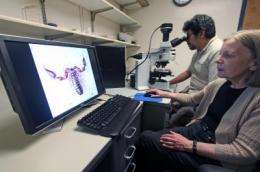
Jeanne Zeh, lead author of a paper published in Nature’s open access journal Scientific Reports today, examines a pseudoscorpion using a microscope operated by graduate student, and one of the co-authors, Melvin Bonilla. Zeh is an assistant professor in the Department of Biology in the University of Nevada, Reno’s College of Science. The paper is the first to report the transgenerational effects of tetracycline. Credit: Photo by Mike Wolterbeek, University of Nevada, Reno.
In a paper published today in Nature's open access journal Scientific Reports, researchers at the University of Nevada, Reno report that male pseudoscorpions treated with the antibiotic tetracycline suffer significantly reduced sperm viability and pass this toxic effect on to their untreated sons. They suggest that a similar effect could occur in humans and other species.
"This is the first research to show a transgenerational effect of antibiotics," David Zeh, chair of the Department of Biology in the College of Science, said. "Tetracycline has a significant detrimental effect on male reproductive function and sperm viability of pseudoscorpions reducing viability by up to 25 percent and now we know that effect is passed on to the next generation. We didn't see the effect in subsequent generations."
The research involved a three-generation study of the pseudoscorpion, Cordylochernes scorpioides, a small scorpion-like arachnid. To control for genetic influences, in the first generation, brothers and sisters from each of 21 broods were either treated with weekly doses of tetracycline from birth to adulthood or were reared as untreated controls. Subsequent generations were not treated with tetracycline. The antibiotic had no effect on male or female body size, sperm number or female reproduction, they found.
In the article, lead author and assistant biology professor Jeanne Zeh surmises that tetracycline may induce epigenetic changes in male reproductive tissues that may be passed to sons changes that do not alter the sequence of DNA but rather alter the way genes are expressed.
The broad-spectrum antibiotic tetracycline is commonly used in animal production, antimicrobial therapy, and for curing arthropods infected with bacterial endosymbionts such as Wolbachia. Despite more than six decades of therapeutic and agricultural use that has resulted in the evolution of widespread bacterial resistance, tetracycline is still commonly used as an additive in animal feed and as an accessible antimicrobial therapy in developing countries.
Provided by
University of Nevada, Reno
-
Long-term use of antibiotic to treat acne not associated with increased bacterial resistance
Apr 11, 2011 |
not rated yet |
0
-
Team tracks antibiotic resistance from swine farms to groundwater
Aug 21, 2007 |
not rated yet |
0
-
Grass Shows Promise for Removing Antibiotics from Water
Apr 14, 2010 |
not rated yet |
0
-
Putting bacterial antibiotic resistance into reverse
Apr 25, 2010 |
not rated yet |
0
-
Triple threat: One bacterium, three plasmids
Nov 14, 2011 |
not rated yet |
0
-
Motion perception revisited: High Phi effect challenges established motion perception assumptions
Apr 23, 2013 |
3 / 5 (2) |
2
-
Anything you can do I can do better: Neuromolecular foundations of the superiority illusion (Update)
Apr 02, 2013 |
4.5 / 5 (11) |
5
-
The visual system as economist: Neural resource allocation in visual adaptation
Mar 30, 2013 |
5 / 5 (2) |
9
-
Separate lives: Neuronal and organismal lifespans decoupled
Mar 27, 2013 |
4.9 / 5 (8) |
0
-
Sizing things up: The evolutionary neurobiology of scale invariance
Feb 28, 2013 |
4.8 / 5 (10) |
14
-
How can there be villous adenoma in colon, if there are no villi there
5 hours ago
-
How can there be a term called "intestinal metaplasia" of stomach
May 21, 2013
-
Pressure-volume curve: Elastic Recoil Pressure don't make sense
May 18, 2013
-
If you became brain-dead, would you want them to pull the plug?
May 17, 2013
-
MRI bill question
May 15, 2013
-
Ratio of Hydrogen of Oxygen in Dessicated Animal Protein
May 13, 2013
- More from Physics Forums - Medical Sciences
More news stories
How healthy are you for your age?
On May 22, JoVE will publish details of a technique to measure the health of human genetic material in relation to a patient's age. The method is demonstrated by the laboratory of Dr. Gil Atzmon at New York's Albert Einste ...
Medical research
2 hours ago |
not rated yet |
0
A molecular explanation for age-related fertility decline in women
(Medical Xpress)—Scientists supported by the National Institutes of Health have a new theory as to why a woman's fertility declines after her mid-30s. They also suggest an approach that might help slow ...
Medical research
4 hours ago |
not rated yet |
0
|
Medical researchers discover new ways to target, develop and design drugs to prevent and treat viral infection
Researchers at the University of Alberta have discovered a new drug target, developed a new drug and identified a new way to design drugs—all of which could be a winning combination in the battle against viruses.
Medical research
4 hours ago |
4 / 5 (1) |
0
|
Targeting the X-factor to tackle cardiovascular disease
New research at The University of Nottingham aimed at preventing harmful blood clots associated with heart disease and stroke has recently received a major funding boost from the British Heart Foundation.
Medical research
5 hours ago |
not rated yet |
0
Italy approves law on controversial stem cell therapy
Italian lawmakers on Wednesday gave their final approval to a law that allows limited use of a controversial type of stem cell therapy which has been condemned by many scientists but has given hope to families of terminally-ill ...
Medical research
5 hours ago |
5 / 5 (1) |
1
Scientists uncover molecular roots of cocaine addiction in the brain
Researchers at Johns Hopkins have unraveled the molecular foundations of cocaine's effects on the brain, and identified a compound that blocks cravings for the drug in cocaine-addicted mice. The compound, already proven safe ...
Taming suspect gene reverses schizophrenia-like abnormalities in mice
Scientists have reversed behavioral and brain abnormalities in adult mice that resemble some features of schizophrenia by restoring normal expression to a suspect gene that is over-expressed in humans with ...
Costs to treat stroke in America may double by 2030
Costs to treat stroke are projected to more than double and the number of people having strokes may increase 20 percent by 2030, according to the American Heart Association/American Stroke Association.
Acne treatment: Natural substance-based formula is more effective than artificial compounds
University of Granada scientists have patented a new treatment for acne that is based on completely natural substances and is much more effective than artificial formulas because it does not create resistance ...
Study finds new pneumococcal vaccine appears to be as safe as previously used vaccine
The new 13-valent pneumococcal conjugate vaccine (PCV13) appears to be as safe as the previous version used prior to 2010, the 7-valent pneumococcal conjugate vaccine (PCV7), according to a Kaiser Permanente study published ...
Addiction to unhealthy foods could help explain the global obesity epidemic
Research presented today shows that high-fructose corn syrup can cause behavioural reactions in rats similar to those produced by drugs of abuse such as cocaine. These results, presented by addiction expert Francesco Leri, ...