Can new diagnostic approaches help assess brain function in unconscious, brain-injured patients?
May 9, 2012 in Neuroscience

Can new diagnostic approaches help assess brain function in unconscious, brain-injured patients?

Enlarge

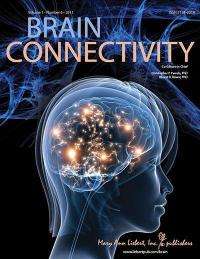
Brain Connectivity is the journal of record for researchers and clinicians interested in all aspects of brain connectivity. Credit: ©2012 Mary Ann Liebert, Inc., publishers

Disorders of consciousness such as coma or a vegetative state caused by severe brain injury are poorly understood and their diagnosis has relied mainly on patient responses and measures of brain activity. However, new functional and imaging-based diagnostic tests that measure communication and signaling between different brain regions may provide valuable information about the potential for consciousness in patients unable to communicate. These innovative approaches are described and compared in a Review article in the groundbreaking neuroscience journal Brain Connectivity.

Mélanie Boly and coauthors from University of Liège (Belgium), University of Milan (Italy), and University College London (UK) compare the benefits and limitations of three methods for studying the dynamics of brain communication and connectivity in response to internal and external stimulation: functional magnetic resonance imaging f(MRI); transcranial magnetic stimulation (TMS) combined with electroencephalograpy (EEG); and response to neuronal perturbation, measuring, for example, sensory evoked potentials (ERP). They report their findings and propose future research directions in the article "Brain Connectivity in Disorders of Consciousness."

"In recent years, there has been a tremendous interest in gaining a better understanding of the various disorders of consciousness. A variety of methods including fMRI and PET have been used to study these disorders," says Bharat Biswal, PhD, Co-Editor-in-Chief of Brain Connectivity and Associate Professor, University of Medicine and Dentistry of New Jersey. "This article provides a comprehensive analysis using three new and innovative methods to study disorders of consciousness."

More information: The article is available free on the Brain Connectivity website at http://www.liebertpub.com/brain.

Provided by Mary Ann Liebert, Inc.

not rated yet  

Rank not rated yet
Relevant PhysicsForums posts

More news stories

Addiction as a disorder of decision-making

New research shows that craving drugs such as nicotine can be visualized in specific regions of the brain that are implicated in determining the value of actions, in planning actions and in motivation. Dr. Alain Dagher, from ...

Neuroscience created 1 hour ago | popularity not rated yet | comments 0

Reducing caloric intake delays nerve cell loss

Activating an enzyme known to play a role in the anti-aging benefits of calorie restriction delays the loss of brain cells and preserves cognitive function in mice, according to a study published in the May ...

Neuroscience created 18 hours ago | popularity 5 / 5 (6) | comments 0 | with audio podcast

B vitamins could delay dementia

(Medical Xpress)—Despite spending billions of dollars on research and development, drug companies have been unable to come up with effective treatments for dementia and Alzheimer's Disease (AD). Now, A. ...

Neuroscience created 21 hours ago | popularity 4.9 / 5 (15) | comments 0 | with audio podcast report

Waiting for a sign? Researchers find potential brain 'switch' for new behavior

You're standing near an airport luggage carousel and your bag emerges on the conveyor belt, prompting you to spring into action. How does your brain make the shift from passively waiting to taking action when ...

Neuroscience created 22 hours ago | popularity 5 / 5 (1) | comments 0 | with audio podcast

If you can remember it, you can remember it wrong

(Medical Xpress)—Native peoples in regions where cameras are uncommon sometimes react with caution when their picture is taken. The fear that something must have been stolen from them to create the photo ...

Neuroscience created May 21, 2013 | popularity 4.3 / 5 (6) | comments 0 | with audio podcast report


Study finds new pneumococcal vaccine appears to be as safe as previously used vaccine

The new 13-valent pneumococcal conjugate vaccine (PCV13) appears to be as safe as the previous version used prior to 2010, the 7-valent pneumococcal conjugate vaccine (PCV7), according to a Kaiser Permanente study published ...

Addiction to unhealthy foods could help explain the global obesity epidemic

Research presented today shows that high-fructose corn syrup can cause behavioural reactions in rats similar to those produced by drugs of abuse such as cocaine. These results, presented by addiction expert Francesco Leri, ...

Study says empathy plays a key role in moral judgments

Is it permissible to harm one to save many? Those who tend to say "yes" when faced with this classic dilemma are likely to be deficient in a specific kind of empathy, according to a report published in the scientific journal ...

A molecular explanation for age-related fertility decline in women

(Medical Xpress)—Scientists supported by the National Institutes of Health have a new theory as to why a woman's fertility declines after her mid-30s. They also suggest an approach that might help slow ...

Phthalates: Study links chemicals widely found in plastics, processed food to elevated blood pressure in children, teens

Plastic additives known as phthalates (pronounced THAL-ates) are odorless, colorless and just about everywhere: They turn up in flooring, plastic cups, beach balls, plastic wrap, intravenous tubing and—according to the ...

Medical researchers discover new ways to target, develop and design drugs to prevent and treat viral infection

Researchers at the University of Alberta have discovered a new drug target, developed a new drug and identified a new way to design drugs—all of which could be a winning combination in the battle against viruses.