Drug could reverse scourge of cerebral malaria for survivors
May 1, 2012 in Diseases, Conditions, Syndromes
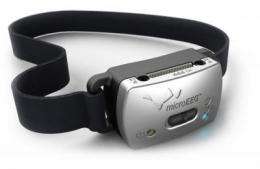
MSU is teaming up on a clinical trial in Africa with Bio-Signal Group, which has created a portable, wireless EEG monitoring device, called microEEG. Credit: Courtesy photo
Michigan State University researchers, with the help of a groundbreaking medical device, are starting a clinical trial in Africa they hope will provide relief for the hundreds of thousands of children who survive cerebral malaria but are left stricken with epilepsy or other neurologic disorders.
The impact of those disorders via loss of human potential and lack of societal contribution is immeasurable, said Gretchen Birbeck, a professor of neurology and ophthalmology in the College of Osteopathic Medicine.
Birbeck is leading the trial in the central African nation of Malawi that will use levetiracetam, or LVT, an anti-seizure medication used in the United States and other developed nations. However, the drug has never been tested to target cerebral malaria seizures.
"Seizure management in malaria endemic regions such as sub-Sahara Africa is challenging because the available antiepileptic drugs can suppress respiration, and assisted ventilation is unavailable," Birbeck said. "LVT does not have that effect, and if we can optimize a seizure control treatment that is both affordable and accessible in resource-limited settings, we may be able to improve neurologic outcomes in cerebral malaria survivors."
The research, part of MSU's Blantyre Malaria Project at Queen Elizabeth Central Hospital, is being funded with a nearly $2 million grant from the National Institutes of Health's National Institute of Neurological Disorders and Stroke.
Cerebral malaria is a severe form of malaria affecting the brain, occurring predominantly in children, with a mortality rate of 15-25 percent. It affects about three million children every year, primarily in sub-Saharan Africa.
Almost a third of cerebral malaria survivors develop epilepsy or other neurologic disorders, according to research Birbeck also director of MSU's International Neurologic & Psychiatric Epidemiology Program published previously in The Lancet Neurology.
The new clinical trial will test the safety and feasibility of LVT to control seizures in children specifically with cerebral malaria. Instead of delivering the drug intravenously, which is too costly for most developing nations such as Malawi, it will be given via a tube in the nasal passage, an effective method in hospitals and clinics that lack resources.
About 40 children will be selected for the trial. If all safety standards are met, dosage will be increased until 75 percent of children are free of seizures for 24 hours (typically, only 20 percent of children admitted with cerebral malaria and seizures are seizure free in the first 24 hours).
To accurately test whether children are staying seizure free, MSU is collaborating with New York-based biotechnology firm Bio-Signal Group, which has created a portable, wireless EEG monitoring device, called microEEG that can accommodate up to 32 electrodes and connects via Bluetooth technology to a small monitoring machine.
"Unfortunately, many children who survive malaria continue to have seizures with no physical symptoms, but their brains still are being damaged," Birbeck said. "To evaluate the effectiveness of LVT, we need continuous EEG monitoring, which is very tough to do even in the best environment."
Bio-Signal's microEEG features a monitor the size of a deck of cards that can be worn on the arm, with a collection of wires going to the electrodes on the child's head. The monitor then transfers data in real-time to a computer, where it quickly can be analyzed and shared with colleagues.
"This state-of-the-art technology, which we believe can be used effectively in our resource-limited setting, allows us to conduct this trial," Birbeck said.
If the clinical trial shows LVT can be safe and potentially effective for seizure control in cerebral malaria, Birbeck and her team will proceed with a phase III randomized clinical trial.
"Since LVT is relatively affordable for short-term use and feasibly could be delivered in resource-limited settings, this therapy could potentially be scaled up for broad use throughout malaria endemic African countries," she said.
Provided by
Michigan State University
-
Researchers link cerebral malaria to epilepsy, behavior disorders
Nov 16, 2010 |
not rated yet |
0
-
Guidelines stress caution when combining anti-epileptic, HIV drugs
Jan 04, 2012 |
not rated yet |
0
-
Researchers find cerebral malaria may be a major cause of brain injury in African children
Jul 29, 2008 |
not rated yet |
0
-
'Window into the brain' reveals deadly secrets of malaria
Jan 15, 2009 |
not rated yet |
0
-
Newer antimalarials more effective than quinine against severe malaria
Mar 16, 2011 |
not rated yet |
0
-
Motion perception revisited: High Phi effect challenges established motion perception assumptions
Apr 23, 2013 |
3 / 5 (2) |
2
-
Anything you can do I can do better: Neuromolecular foundations of the superiority illusion (Update)
Apr 02, 2013 |
4.5 / 5 (11) |
5
-
The visual system as economist: Neural resource allocation in visual adaptation
Mar 30, 2013 |
5 / 5 (2) |
9
-
Separate lives: Neuronal and organismal lifespans decoupled
Mar 27, 2013 |
4.9 / 5 (8) |
0
-
Sizing things up: The evolutionary neurobiology of scale invariance
Feb 28, 2013 |
4.8 / 5 (10) |
14
-
Classical and Quantum Mechanics via Lie algebras
Apr 15, 2011
- More from Physics Forums - Independent Research
More news stories
Ginger compounds may be effective in treating asthma symptoms
Gourmands and foodies everywhere have long recognized ginger as a great way to add a little peppery zing to both sweet and savory dishes; now, a study from researchers at Columbia University shows purified components of the ...
Diseases, Conditions, Syndromes
12 hours ago |
5 / 5 (1) |
0
New research identifies practice changes to improve value and quality of GI procedures
There are significant cost and risk factors associated with two procedures commonly used to diagnose or treat gastrointestinal problems, according to research presented at Digestive Disease Week (DDW).
Diseases, Conditions, Syndromes
May 19, 2013 |
not rated yet |
0
Consuming coffee linked to lower risk of detrimental liver disease, study finds
Regular consumption of coffee is associated with a reduced risk of primary sclerosing cholangitis (PSC), an autoimmune liver disease, Mayo Clinic research shows. The findings were being presented at the Digestive Disease ...
Diseases, Conditions, Syndromes
May 19, 2013 |
not rated yet |
0
|
New case of SARS-like virus in Saudi: ministry
A new case of the deadly coronavirus has been detected in Saudi Arabia where 15 people have already died after contracting it, the health ministry announced on Saturday on its Internet website.
Diseases, Conditions, Syndromes
May 18, 2013 |
not rated yet |
0
Little evidence for prediction rules for low back pain
(HealthDay)—Few randomized clinical trials have been done to assess clinical prediction rules for patients with lower back pain, and the trials that have been done are of low quality and do not provide ...
Diseases, Conditions, Syndromes
May 17, 2013 |
not rated yet |
0
|
New theory on genesis of osteoarthritis comes with successful therapy in mice
Scientists at Johns Hopkins have turned their view of osteoarthritis (OA) inside out. Literally. Instead of seeing the painful degenerative disease as a problem primarily of the cartilage that cushions joints, ...
Computational tool translates complex data into simplified 2-dimensional images
In their quest to learn more about the variability of cells between and within tissues, biomedical scientists have devised tools capable of simultaneously measuring dozens of characteristics of individual ...
Researchers identify a potential new risk for sleep apnea: Asthma
Researchers at the University of Wisconsin have identified a potential new risk factor for obstructive sleep apnea: asthma. Using data from the National Institutes of Health (Heart, Lung, and Blood Institute)-funded Wisconsin ...
Study finds that sleep apnea and Alzheimer's are linked
A new study looking at sleep-disordered breathing (SDB) and markers for Alzheimer's disease (AD) risk in cerebrospinal fluid (CSF) and neuroimaging adds to the growing body of research linking the two.
'Gap' for HIV vaccine efforts after latest setback
The hunt for an HIV vaccine has gobbled up $8 billion in the past decade, and the failure of the most recent efficacy trial has delivered yet another setback to 26 years of efforts.
Alzheimer's leaves bilingual victims stranded in Canada
The devastating effect of Alzheimer's disease on bilingual people has been thrown into focus in Canada, where the sudden loss of a second language can leave sufferers feeling like strangers in their own country.