FDA review favors first drug for HIV prevention (Update)
May 8, 2012 By MATTHEW PERRONE , AP Health Writer in HIV & AIDS
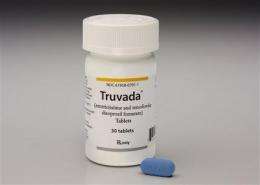
This photo provided by Gilead Sciences shows Truvada. Federal drug regulators on Tuesday affirmed landmark study results showing that a popular HIV-fighting pill can also help healthy people avoid contracting the virus that causes AIDS in the first place. While the pill appears safe and effective for prevention, scientists stressed that it only works when taken on a daily basis. The Food and Drug Administration will hold a meeting Thursday to discuss whether Truvada should be approved for people who are at risks of contracting HIV through sexual intercourse. The agency's positive review posted Tuesday suggests the daily pill will become the first drug approved to prevent HIV infection in high-risk patients. (AP Photo/Gilead Sciences)
(AP) -- A pill that has long been used to treat HIV has moved one step closer to becoming the first drug approved to prevent healthy people from becoming infected with the virus that causes AIDS.
The Food and Drug Administration said Tuesday that Gilead Sciences' Truvada appears to be safe and effective for HIV prevention. It concluded that taking the pill daily could spare patients "infection with a serious and life-threatening illness that requires lifelong treatment."
On Thursday a panel of FDA advisers will consider the review when it votes on whether Truvada should be approved as a preventative treatment for people who are at high risk of contracting HIV through sexual intercourse. The FDA is not required to follow the advice of its panels, but it usually does.
An estimated 1.2 million Americans have HIV, which attacks the immune system and, unless treated with antiviral drugs, develops into AIDS, a fatal condition in which the body cannot fight off infections. If Truvada is approved, it would be a major breakthrough in the 30-year campaign against the AIDS epidemic. There have been no other drugs proven to prevent HIV and a vaccine is believed to be decades away.
Gilead Sciences Inc., based in Foster City, Calif., has marketed Truvada since 2004 as a treatment for people who are infected with the virus. The medication is a combination of two older HIV drugs, Emtriva and Viread. Doctors usually prescribe the medications as part of a drug cocktail that makes it harder for the virus to reproduce. Patients with low viral levels have reduced symptoms and are far less likely to develop AIDS.
Researchers first reported that Truvada could prevent people from contracting HIV in 2010. A three-year study found that daily doses cut the risk of infection in healthy gay and bisexual men by 44 percent, when accompanied by condoms and counseling. Another study found that Truvada reduced infection by 75 percent in heterosexual couples in which one partner was infected with HIV and the other was not.
Because Truvada is already on the market to manage HIV, some doctors already prescribe it as a preventive measure. But FDA approval would allow the drugmaker Gilead Sciences to formally market its drug for that use.
FDA reviewers on Tuesday said that patients must be diligent about taking the pill every day if using it as a preventative measure. Adherence to the medication was less than perfect in clinical trials, and reviewers said that patients in the real world may forget to take their medication even more than those in clinical studies.
Some patient advocacy groups say the drug is an important new option to prevent HIV, alongside condoms, counseling and other measures. Last month, advocacy group AIDS United and more than a dozen other groups sent a letter to the FDA, urging approval of Truvada.
"If we're going to reduce the more than 50,000 new HIV infections in this country each year, we need to increase the available options for people," said Ronald Johnson, AIDS United's vice president.
But support for FDA approval is not unanimous.
Although the FDA is legally barred from considering cost when reviewing drugs, health care providers have raised concerns about Truvada's price tag: $900 a month, or just under $11,000 per year. Medicare and Medicaid, the nation's largest health insurance plans, generally cover drugs approved by the FDA, and analysts expect most large health insurers to follow suit.
Additionally, some researchers say the prevention pill is not the chemical equivalent of condoms, which they say remain the best weapon against AIDS. They also worry about Truvada's mixed success rate in preventing infection among women: Last year, a study in women was stopped early after researchers found that women taking the drug were more likely to become infected than those taking placebo.
Researchers speculated that women may require a higher dose of the drug to prevent infection. They also said the disappointing results may have resulted from women not taking the pills consistently.
"We know that if the person doesn't take the medication every day they will not be protected," said Dr. Rodney Wright, director of HIV programs at Montefiore Medical Center in New York and chairman of the AIDS Health Foundation. "So the concern is that there may not be adequate adherence to provide protection in the general population."
©2012 The Associated Press. All rights reserved. This material may not be published, broadcast, rewritten or redistributed.
-
AIDS prevention pill study halted; no benefit seen
Apr 18, 2011 |
not rated yet |
0
-
Pill to block HIV slated for testing
Apr 23, 2012 |
not rated yet |
0
-
Anti-AIDS groups hail drug but worry over cost
Nov 24, 2010 |
not rated yet |
0
-
Drug stops HIV among hetero couples, not just gays
Jul 13, 2011 |
not rated yet |
0
-
AIDS drug trials may be virus stopper
May 18, 2006 |
not rated yet |
0
-
Motion perception revisited: High Phi effect challenges established motion perception assumptions
Apr 23, 2013 |
3 / 5 (2) |
2
-
Anything you can do I can do better: Neuromolecular foundations of the superiority illusion (Update)
Apr 02, 2013 |
4.5 / 5 (11) |
5
-
The visual system as economist: Neural resource allocation in visual adaptation
Mar 30, 2013 |
5 / 5 (2) |
9
-
Separate lives: Neuronal and organismal lifespans decoupled
Mar 27, 2013 |
4.9 / 5 (8) |
0
-
Sizing things up: The evolutionary neurobiology of scale invariance
Feb 28, 2013 |
4.8 / 5 (10) |
14
-
Classical and Quantum Mechanics via Lie algebras
Apr 15, 2011
- More from Physics Forums - Independent Research
More news stories
Engineered cytomegalovirus protects monkeys from HIV equivalent
(Medical Xpress)—A new study by researchers in the US has shown that an ancient virus can be modified to help in the fight against the simian immunodeficiency virus SIV, which is the equivalent in monkeys ...
HIV & AIDS
May 24, 2013 |
5 / 5 (3) |
0
|
New microsphere-based methods for detecting HIV antibodies
Detection of HIV antibodies is used to diagnose HIV infection and monitor trials of experimental HIV/AIDS vaccines. New, more sensitive detection systems being developed use microspheres to capture HIV antibodies ...
HIV & AIDS
May 23, 2013 |
5 / 5 (1) |
0
Fecal microbiota tx feasible for recurrent C. difficile in HIV
(HealthDay)—For HIV-infected individuals with recurrent Clostridium difficile infection, fecal microbiota therapy is feasible, according to a letter published in the May 21 issue of the Annals of Intern ...
HIV & AIDS
May 22, 2013 |
not rated yet |
0
Canada lifts ban on gay men donating blood
Canadian health authorities lifted Wednesday what was effectively a ban on gay men giving blood, announcing new rules making men who have not had sex with men in the past five years eligible.
HIV & AIDS
May 22, 2013 |
not rated yet |
1
AIDS scientists optimistic of AIDS cure, for some
Top AIDS scientists were optimistic Wednesday of finding a cure for the disease that has claimed 30 million lives—but said it might not work for all people.
HIV & AIDS
May 22, 2013 |
not rated yet |
0
First drug to improve heart failure mortality in over a decade
Coenzyme Q10 decreases all cause mortality by half, according to the results of a multicentre randomised double blind trial presented today at Heart Failure 2013 congress. It is the first drug to improve heart failure mortality ...
Seniors more likely to crash when driving with pet, study finds
(HealthDay)—Animals make great companions for senior citizens, but elderly people who always drive with a pet in the car are far more likely to crash than those who never drive with a pet, researchers have ...
Heart failure accelerates male 'menopause'
Heart failure accelerates the aging process and brings on early andropausal syndrome (AS), according to research presented today at the Heart Failure Congress 2013. AS, also referred to as male 'menopause', was four times ...
New immune system discovered
(Medical Xpress)—A research team, led by Jeremy Barr, a biology post-doctoral fellow, unveils a new immune system that protects humans and animals from infection.
Death highest in heart failure patients admitted in January, on Friday, and overnight
Mortality and length of stay are highest in heart failure patients admitted in January, on Friday, and overnight, according to research presented today at the Heart Failure Congress 2013. The analysis of nearly 1 million ...
Feds fight morning-after pill age ruling in NY
(AP)—Department of Justice lawyers have again asked a federal appeals court in New York to delay lifting age restrictions and prescription requirements on an emergency contraceptive popularly known as the morning-after ...