Girl with deformed face learns to navigate world
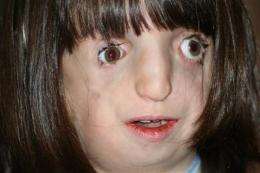
(AP) -- What if you knew, even before your child was born, that she wouldn't look like everyone else?
Clara Beatty's parents knew.
They were living in Belgium at the time, a decade ago. Prenatal screening was extensive, probably more than would have been done in the United States.
Those tests determined that baby Clara, their third child, was likely to be a perfectly normal kid inside. But even in the womb, doctors could see severe facial deformities - droopy eyes, under-developed cheekbones and a tiny jaw. It meant she'd need a tube in her neck to help her breathe after birth. The lack of an outer ear and restricted ear canals also would mean she'd have hearing aids by the time she was 6 months old.
In Belgium, it was unusual for babies to be born with Treacher Collins syndrome, caused by a genetic mutation. Parents almost always opted to abort, doctors said.
But the Beattys wouldn't hear of it. It wasn't any big moral statement, they say.
"There was just no question," Janet Beatty says. No wavering, despite the looks of disapproval from the medical staff before she was born and even after, in the intensive care unit.
"It was kind of strange sometimes . with the doctors, some of whom I think really, really questioned why we had this baby," says Eric Beatty, Clara's dad.
The next few years would be so challenging that the family moved back to the United States, both for family support and to seek medical care at Chicago's Children's Memorial Hospital and other institutions. There were breathing and feeding issues. The family had 24-hour nursing care for the first three years of Clara's life because she vomited so frequently.
They were lucky, they realized, to have that kind of help.
Still, it took a toll on Clara's parents, especially her mom. Janet Beatty just wanted her daughter to be OK physically, to not be constantly worried that she might stop breathing, or choke. She wanted her daughter to have the happy childhood that her other two children had had - free from the physical challenges and, yes, free from the constant stares of strangers when they were out in public.
"Make her normal," her mother, Janet Beatty, thought privately. "I want that normal kid. I didn't want people to stare, and I didn't want people running away from her."
Cosmetic surgery was an option. But on a child so young, it would have to be redone, over and over. It was better, doctors said, to wait until her teen years.
And as her parents discovered, Clara was quite able to cope, sometimes better than they. Even today, Janet Beatty is astounded at how well her youngest daughter navigates the world.
"Even when she was little, you could look at her and people would say there's an old soul in there," she says. "She just had these big eyes and you could see her taking everything in."
Certainly, there are times when Clara gets frustrated.
Now 9 years old and finishing the fourth grade, she looks forward to the day a few years from now when her skull will have grown enough for cosmetic surgery. It won't "fix" things, but likely will help her blend more - and possibly help her get rid of the breathing tube.
"I want to try to make myself as much like the other kids, so that I can stop having everyone asking me questions," Clara says, "because it gets so annoying."
She says it matter-of-factly - not like she's hurt or damaged by the questions and comments.
When people stare, she says, she just "smiles and says `hi,'" because that's what her parents have taught her to do.
It's easiest, of course, when she's in her "protective bubble," as her mom calls it - at home or school or church. There, people know her. To them, she is just Clara - the funny, kind girl who wants to be a doctor when she grows up, who's quick to help classmates with homework when she finishes her own.
She also volunteers as a mentor at the Special Gifts Theatre, an acting troupe for children with special needs. One cognitively impaired girl needed help with her lines.
"It's fun," Clara says, "to help someone and give them a better chance at life."
People often assume that Clara can't speak or understand them. Her classmates at school, however, are perplexed that a reporter would be doing a story about her.
"Why?" one asks.
"Because Clara is awesome!" another quickly replies.
The support is heartening, her parents say. This is what they hoped for their daughter, that she would be accepted, well-adjusted and confident - though they also know that she has many challenges.
When she goes to middle school next year, there will be new people to meet, new adjustments. Same with high school, college, dating.
Doctors have told her parents that Clara is more likely to worry about her appearance when she reaches adolescence. "Those are hard things to think about in a world where your physical presence, the way you look, is so much a part of society and how people react," says Eric Beatty, vice president of a manufacturing company.
"But as any parent will know, you just get on with life."
Clara - the girl with big, brown eyes and an easy smile - has helped them truly learn how to do that.
"We're all learning that we're just going to do what we're going to do, and we're not going to pay attention to what other people think," Janet Beatty says.
Still, the urge to protect will always be there.
"I just don't want her spirit to ever be crushed so much that she can't recover," she adds. "That's why it's good that she has the thick skin. I just want to keep it thick.
"She needs it."
©2012 The Associated Press. All rights reserved. This material may not be published, broadcast, rewritten or redistributed.


