Health experts narrow the hunt for Ebola
May 16, 2012 in Diseases, Conditions, Syndromes
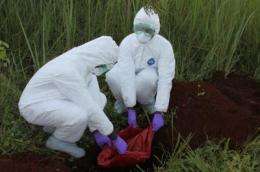
Health experts from the Wildlife Conservation Society and other members of the PREDICT consortium dispose of an animal carcass during a recent outbreak of Ebola in Africa in May 2011. In a new study, the team recommends focusing on animal carcasses rather than live animals when attempting to isolate the virus. Credit: Dr. Benard Ssebide
Response efforts to outbreaks of Ebola hemorrhagic fever in Africa can benefit from a standardized sampling strategy that focuses on the carcasses of gorillas, chimpanzees and other species known to succumb to the virus, according to a consortium of wildlife health experts.
In a recently published study of 14 previous human Ebola outbreaks and the responses of wildlife teams collecting animal samples, the authors of the new study conclude that most efforts to collect samples from live animals (i.e. rodents, bats, primates, birds) failed to isolate Ebola virus or antibodies. However, they found that collecting samples from animal carcasses during outbreaks was a more effective method for Ebola detection. The early detection of Ebola in animal populations near a human outbreak is crucial for learning more about this virus, which can strike human populations with a mortality rate of more than 80 percent.
"You can't test every single animal, so we used information from historical outbreaks to figure out how to help the field response team focus their effort," according to Wildlife Conservation Society (WCS) wildlife epidemiologist Sarah Olson, the lead author of the new report. "It turns out that carcass sampling yields a 50 percent chance of finding Ebola virus or antibodies compared to less than six percent when sampling free-ranging live animals."
The scientific consortium that participated in the study, published in an online issue of Emerging Health Threats, are key partners in PREDICT, part of USAID's Emerging Pandemic Threats Program that is improving global capacity to respond to emerging infectious diseases that originate in wildlife. PREDICT is led by the University of California at Davis, in partnership with Ecohealth Alliance, Global Viral Forecasting Initiative, the Smithsonian Institution, and the Wildlife Conservation Society.
"The Emerging Pandemic Threats program is a visionary investment by USAID to protect and improve global health because it has made it possible for us to, for the first time, pre-emptively, and on a global scale, identify novel pathogens in wildlife that could pose pandemic threats to humans," said Dr. Jonna Mazet, Director of PREDICT and Director of the One Health Institute at the University of California, Davis School of Veterinary medicine. "This study is a great example of how PREDICT is using science to improve our ability to detect lethal diseases, like Ebola."
The study was designed to develop a set of animal sampling recommendations to maximize the effectiveness of Ebola outbreak response efforts with limited resources. Specifically, the study was prompted by a 2011 outbreak near Kampala, Uganda, in which a 12-year-old girl died from Ebola hemorrhagic fever. PREDICT wildlife veterinarians were sent to the victim's village to screen wildlife as a potential source of the virus.
"This study digests over 30 years of accumulated knowledge so field teams can arrive informed and prepared," adds WCS epidemiologist and senior author, Damien Joly.
The authors also point to some scientific "loose ends" that can be incorporated into future animal sampling efforts during Ebola outbreak response. For instance, despite some evidence of Ebola in dogs and pigs, the number of samples acquired from these animals is limited to just two outbreaks; the authors recommend increasing the number of samples collected from these groups in the future to better determine their role in Ebola outbreaks. The study also confirms that while fruit bats should be a focus of investigation as a potential reservoir for Ebola, field teams need to be prepared to sample hundreds of bats because virus prevalence across all bats sampled to date is very low, estimated at 3 percent.
More information: "Dead or alive: animal sampling during Ebola hemorrhagic fever outbreaks in humans," Emerging Health Threats.
Provided by
Wildlife Conservation Society
-
Pattern of Human Ebola Outbreaks Linked to Wildlife and Climate
Nov 14, 2006 |
not rated yet |
0
-
Single vaccines to protect against both rabies and Ebola
Aug 25, 2011 |
not rated yet |
0
-
Ebola outbreaks killing thousands of gorillas and chimpanzees
Apr 16, 2007 |
not rated yet |
0
-
Researchers discover structure of key Ebola protein
Jan 12, 2009 |
not rated yet |
0
-
Vaccine for Ebola virus
Mar 31, 2008 |
not rated yet |
0
-
Motion perception revisited: High Phi effect challenges established motion perception assumptions
Apr 23, 2013 |
3 / 5 (2) |
2
-
Anything you can do I can do better: Neuromolecular foundations of the superiority illusion (Update)
Apr 02, 2013 |
4.5 / 5 (11) |
5
-
The visual system as economist: Neural resource allocation in visual adaptation
Mar 30, 2013 |
5 / 5 (2) |
9
-
Separate lives: Neuronal and organismal lifespans decoupled
Mar 27, 2013 |
4.9 / 5 (8) |
0
-
Sizing things up: The evolutionary neurobiology of scale invariance
Feb 28, 2013 |
4.8 / 5 (10) |
14
-
Classical and Quantum Mechanics via Lie algebras
Apr 15, 2011
- More from Physics Forums - Independent Research
More news stories
FDA warns of infections tied to Tennessee pharmacy
(AP)—Government health officials are investigating several health problems reported with potentially contaminated medications made by a Tennessee specialty pharmacy.
Diseases, Conditions, Syndromes
1 hour ago |
not rated yet |
0
Comorbidities common with alopecia areata
(HealthDay)—Comorbid conditions often accompany alopecia areata, according to a study published online May 22 in JAMA Dermatology.
Diseases, Conditions, Syndromes
2 hours ago |
not rated yet |
0
Top-ranked golfer beats scoliosis
(HealthDay)—As a world-class golfer, Stacy Lewis' accomplishments are remarkable. But it was a physical challenge in her childhood that defined her ascent to the top of her sport.
Diseases, Conditions, Syndromes
3 hours ago |
not rated yet |
0
Saudi to send animal samples to US in coronavirus probe (Update)
Saudi Arabia said Friday it would send samples taken from animals possibly infected with a deadly SARS-like virus to the United States for testing in a bid to find the source of disease.
Diseases, Conditions, Syndromes
6 hours ago |
not rated yet |
0
WHO voices deep concern over spread of SARS-like virus
The World Health Organization voiced deep concern Thursday over the SARS-like virus that has killed 22 people in less than a year, saying it might potentially spread more widely between humans.
Diseases, Conditions, Syndromes
9 hours ago |
5 / 5 (1) |
0
Researchers identify first drug targets in childhood genetic tumor disorder
Two mutations central to the development of infantile myofibromatosis (IM)—a disorder characterized by multiple tumors involving the skin, bone, and soft tissue—may provide new therapeutic targets, according to researchers ...
Driving and hands-free talking lead to spike in errors, study shows
Talking on a hands-free device while behind the wheel can lead to a sharp increase in errors that could imperil other drivers on the road, according to new research from the University of Alberta.
Engineered cytomegalovirus protects monkeys from HIV equivalent
(Medical Xpress)—A new study by researchers in the US has shown that an ancient virus can be modified to help in the fight against the simian immunodeficiency virus SIV, which is the equivalent in monkeys ...
Hormone levels may provide key to understanding psychological disorders in women
Women at a particular stage in their monthly menstrual cycle may be more vulnerable to some of the psychological side-effects associated with stressful experiences, according to a study from UCL.
Going live: Immune cell activation in multiple sclerosis
Biological processes are generally based on events at the molecular and cellular level. To understand what happens in the course of infections, diseases or normal bodily functions, scientists would need to ...
Controlling mood through the motions of mitochondria
(Medical Xpress)—Regulating the distribution of power in neurons is done by a system that makes the national electric grid look simple by comparison. Each neuron has several thousand mitochondria confined ...