In Spain, 70 percent of women use contraceptives during their first sexual encounter
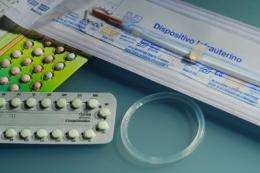
Contraceptive use in Spain during the first sexual encounter is similar to other European countries. However, there are some geographical differences between Spanish regions: women in Murcia use contraceptives less (55.8 percent) whereas women in the Basque Country use them more (76.7 percent). Credit: SINC
Contraceptive use in Spain during the first sexual encounter is similar to other European countries. However, there are some geographical differences between Spanish regions: women in Murcia use contraceptives less (55.8%) whereas women in the Basque Country use them more (76.7%).
Spanish researchers have analysed the prevalence of contraceptive use during the first sexual encounter over the last month in 5,141 sexually active women between the ages of 15 and 49 years through Spain's 17 autonomous communities.
"Bearing in mind the individual factors amongst women that determine contraceptive use, living in one autonomous community or another also has an influence," as explained to SINC by Dolores Ruiz Muñoz, researcher at the Public Health Agency of Barcelona and lead author of the study.
Published in the Health & Place journal, the results reveal that the prevalence of contraceptive use during the first sexual encounter is 70.4%. It varies in the different regions from 55.8% in Murcia to 76.7% in the Basque Country.
In this case, contraceptive use shows positive correlation in women with a university education and negative correlation amongst women from poor backgrounds.
This video is not supported by your browser at this time.
Contraceptive use in Spain during the first sexual encounter is similar to other European countries. However, there are some geographical differences between Spanish regions: women in Murcia use contraceptives less (55.8 percent) whereas women in the Basque Country use them more (76.7 percent). Credit: SINC
Ruiz Muñoz points out that "contraceptive use during the first sexual encounter was more common amongst non-religious women in developed countries who had high educational attainment and their first sexual experience was between the ages of 18 and 19 years."Furthermore, the prevalence of contraceptive use during the four weeks prior to the interview stood at 77.2%. Percentages varied from 70.9% in Navarra to 86.7% in Asturias, which suggested less difference between the different regions that in the case of the first sexual encounter.
The use of contraceptives during sexual relations in the month before the study was more common amongst younger women, those who live alone, those with higher educational attainment, those with children and those that had used contraceptives during their first sexual encounter.
"There are many factors that influence the correlation between the region and women at an intermediate level" continues the researcher. "These factors which influence the context must be taken into account to ensure all women throughout Spain have equal access to contraceptives regardless of their socio-economic level or the area where they live."
There are still inequalities
According to experts, contraceptives are the most effective way of preventing unplanned pregnancy and their use is widespread in Spain. Nonetheless, there are still some inequalities in their use.
In conclusion, this study highlights the importance of considering the social, economic and political characteristics of regions when designing administrative measures and promotion methods for contraceptive use.
"This is important in light of the new 2010 law in Spain on Sexual and Reproductive Health, which aims to ensure equal access to contraceptive methods for all women", concludes Ruiz Muñoz.
More information: Dolores Ruiz-Muñoz, Gloria Pérez, Mercè Gotsens, Maica Rodríguez-Sanz. "Regional inequalities in the use of contraception in Spain: A multilevel approach". Health & Place 18 (2012) 408.
Provided by
Spanish Foundation for Science and Technology (FECYT)
-
Contraceptive methods shape women's sexual pleasure and satisfaction
Dec 08, 2008 |
not rated yet |
0
-
The IUD is the most popular long-acting contraceptive amongst Europeans
Oct 28, 2009 |
not rated yet |
0
-
Emergency contraception: Advance provision does not reduce pregnancy rates
Mar 16, 2010 |
not rated yet |
0
-
Over the counter contraceptive pill will not reduce unplanned pregnancies, says expert
Dec 24, 2008 |
not rated yet |
0
-
Contraception: It's better to be doubly safe than sorry
Feb 12, 2008 |
not rated yet |
0
-
Motion perception revisited: High Phi effect challenges established motion perception assumptions
Apr 23, 2013 |
3 / 5 (2) |
2
-
Anything you can do I can do better: Neuromolecular foundations of the superiority illusion (Update)
Apr 02, 2013 |
4.5 / 5 (11) |
5
-
The visual system as economist: Neural resource allocation in visual adaptation
Mar 30, 2013 |
5 / 5 (2) |
9
-
Separate lives: Neuronal and organismal lifespans decoupled
Mar 27, 2013 |
4.9 / 5 (8) |
0
-
Sizing things up: The evolutionary neurobiology of scale invariance
Feb 28, 2013 |
4.8 / 5 (10) |
14
-
Classical and Quantum Mechanics via Lie algebras
Apr 15, 2011
- More from Physics Forums - Independent Research
More news stories
Pre-proceedings process fails to reduce length of care proceedings, but can help divert cases from court
A major new report on a procedure that aims to reduce the duration of care proceedings for children has found it made no significant difference to what happened in court, and cases lasted just as long regardless of whether ...
Health
1 hour ago |
not rated yet |
0
Report reveals impact of public injecting
New research undertaken on the streets of Richmond and Abbotsford has revealed increasing health risks for people who inject drugs and significant community concern over the impact of injecting in public ...
Health
1 hour ago |
not rated yet |
0
Consumer group flags high SPF ratings on sunscreen
(AP)—Sunbathers this summer will find new sunscreen labels that are designed to make the products more effective and easier to use.
Health
4 hours ago |
not rated yet |
0
ER docs are key to reducing health care costs
Emergency physicians are key decisionmakers for nearly half of all hospital admissions, highlighting a critical role they can play in reducing health care costs, according to a new report from the RAND Corporation.
Health
5 hours ago |
not rated yet |
0
New research identifies risks, interventions for children's GI health
An increasing number of U.S. children are experiencing gastrointestinal issues that require interventions to resolve, according to research presented at Digestive Disease Week (DDW).
Health
May 18, 2013 |
not rated yet |
0
|
Team finds mechanism linking key inflammatory marker to cancer
In a new study described in the journal Oncogene, researchers reveal how a key player in cell growth, immunity and the inflammatory response can be transformed into a primary contributor to tumor growth.
New study identifies risk factors for depression among COPD patients
Patients suffering from chronic obstructive pulmonary disease (COPD) typically suffer from depression more frequently than those without COPD, resulting in higher levels of disability and illness and increasing the overall ...
Rise in type 2 diabetes amongst young
The number of young people diagnosed with type 2 diabetes has seen the sharpest rise over the last twenty years compared to a background of a general increase across the board, new University research has ...
Inflammatory bowel disease raises risk of melanoma
Patients with inflammatory bowel disease (IBD) are at higher risk of melanoma, a form of skin cancer, report researchers at Mayo Clinic. Researchers found that IBD is associated with a 37 percent greater risk for the disease. ...
Pharmaceutical advances offer new options for health outcomes
Research presented at Digestive Disease Week (DDW) explores pharmaceutical advances for treating irritable bowel syndrome with diarrhea (IBS-D) and hepatitis C.
Stress test may help predict increased mortality risk in sleep apnea patients
Many studies have shown that men and women who suffer from obstructive sleep apnea (OSA) - a disorder that causes breathing to halt intermittently during sleep – have a higher mortality rate than those who do not have the ...