Chipping away at cancer
June 25, 2012 in Medical research

Chipping away at cancer

Enlarge

(Medical Xpress) -- In the last two decades, the number of deaths from col­orectal cancer has steadily declined, according to the Amer­ican Cancer Society. While some of the decrease can be attrib­uted to better treat­ment prac­tices, early detec­tion is another pri­mary factor. Nonethe­less, col­orectal cancer is still the second leading cause of death among men and women in the U.S., and is expected to be respon­sible for more than 50,000 deaths in 2012.

“Each of us has wit­nessed cancer in our home,” said phar­ma­ceu­tical sci­ences grad­uate stu­dent Jaydev Upponi, who has helped design a new tech­nology to “give back, to con­tribute sci­ence that could help in the long run.”

Upponi and his class­mates, elec­trical and com­puter engi­neering grad­uate stu­dent Asan­terabi Malima and mechan­ical engi­neering grad­uate stu­dent Cihan Yilmaz, recently founded a com­pany to develop a screening chip that uses nanopar­ti­cles to detect col­orectal cancer ear­lier than cur­rently possible.

Cur­rent detec­tion and mon­i­toring strate­gies include expen­sive and often inac­cu­rate tests such as a colonoscopy, the suc­cess of which depends on the com­pe­tency of the exam­iner. An emerging screening assay, on the other hand, ana­lyzes blood sam­ples for a cancer-​​specific pro­tein called car­ci­noem­bry­onic antigen, or CEA. But cur­rent CEA screens have high thresh­olds and require large blood vol­umes and sig­nif­i­cant blood sample prepa­ra­tion, which make them expen­sive, time con­suming and less sensitive.

“We saw that we have a tech­nology that can address some of these con­cerns for diag­nosis and mon­i­toring,” said Malima, a member of Northeastern’s NSF-​​funded Center for High-​​rate Nanoman­u­fac­turing.

Using their exper­tise acquired in the labs of Ahmed Bus­naina, the William Lin­coln Smith Pro­fessor of Mechan­ical and Indus­trial Engi­neering, and Vladimir Torchilin, a Dis­tin­guished Pro­fessor of Phar­ma­ceu­tical Sci­ences, the student-​​researchers devel­oped a 0.25-millimeter chip that can detect very low con­cen­tra­tions of bio­markers in the blood such as CEA.

Called nuchip, the tech­nology could also be applied to a variety of other bio­markers, such as BNP, a pro­tein asso­ci­ated with con­ges­tive heart failure.

“First we coat nanopar­ti­cles with CEA-​​specific anti­bodies,” Yilmaz said of the design process. “Then we assemble the nanopar­ti­cles onto the chip.”

The anti­bodies bind to CEA, the amount of which will deter­mine whether blood con­cen­tra­tion levels are above normal.

The team will ini­tially use the device to mon­itor patients who are already being treated for col­orectal cancer. “Mon­i­toring is a way to see if their treat­ment is effec­tive or not. It can be extremely cru­cial espe­cially in rapidly growing col­orectal can­cers, to detect increases in the bio­marker,” Upponi said. “I think that’s one area where our device can be extremely beneficial.”

The data the researchers col­lect from these mon­i­toring studies will allow them to estab­lish guide­lines for using the chip to diag­nose cancer in the future. “Part of our work right now is answering ques­tions like ‘What should be our clin­ical sen­si­tivity and speci­ficity?’” Malima said.

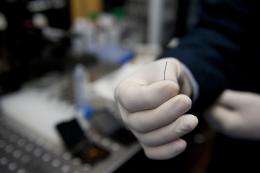
Because the chip can be engi­neered to detect a variety of bio­markers at once (by using a variety of anti­bodies to coat the nanopar­ti­cles), the tech­nology could also be very useful in the emerging field of per­son­al­ized med­i­cine, using nuchip devices designed for spe­cific pop­u­la­tions. Three North­eastern student-​​researchers have devel­oped a screening chip that uses nanopar­ti­cles to detect col­orectal ear­lier than ever before.

Provided by Northeastern University search and more info website

5 /5 (1 vote)  

Rank 5 /5 (1 vote)
Tags

Related Stories
Relevant PhysicsForums posts

More news stories

Study reveals new mechanism for estrogen suppression of liver lipid synthesis

By discovering the new mechanism by which estrogen suppresses lipid synthesis in the liver, UC Irvine endocrinologists have revealed a potential new approach toward treating certain liver diseases.

Medical research created May 23, 2013 | popularity 5 / 5 (1) | comments 0 | with audio podcast

MRI-based measurement helps predict vascular disease in the brain

Aortic arch pulse wave velocity, a measure of arterial stiffness, is a strong independent predictor of disease of the vessels that supply blood to the brain, according to a new study published in the June issue the journal ...

Medical research created May 23, 2013 | popularity not rated yet | comments 0

Antibiotics: A new understanding of sulfonamide nervous system side effects

Since the discovery of Prontosil in 1932, sulfonamide antibiotics have been used to combat a wide spectrum of bacterial infections, from acne to chlamydia and pneumonia. However, their side effects can include serious neurological ...

Medical research created May 23, 2013 | popularity 3 / 5 (1) | comments 0 | with audio podcast

Scientists discover molecule triggers sensation of itch

Scientists at the National Institutes of Health report they have discovered in mouse studies that a small molecule released in the spinal cord triggers a process that is later experienced in the brain as ...

Medical research created May 23, 2013 | popularity 5 / 5 (3) | comments 0 | with audio podcast

Discarded immune cells induce the relocation of stem cells

Spanish researchers have discovered that the daily clearance of neutrophils from the body stimulates the release of hematopoietic stem cells from the bone marrow into the bloodstream, according to a report published today ...

Medical research created May 23, 2013 | popularity 5 / 5 (2) | comments 0


Engineered cytomegalovirus protects monkeys from HIV equivalent

(Medical Xpress)—A new study by researchers in the US has shown that an ancient virus can be modified to help in the fight against the simian immunodeficiency virus SIV, which is the equivalent in monkeys ...

Researchers identify first drug targets in childhood genetic tumor disorder

Two mutations central to the development of infantile myofibromatosis (IM)—a disorder characterized by multiple tumors involving the skin, bone, and soft tissue—may provide new therapeutic targets, according to researchers ...

Hormone levels may provide key to understanding psychological disorders in women

Women at a particular stage in their monthly menstrual cycle may be more vulnerable to some of the psychological side-effects associated with stressful experiences, according to a study from UCL.

Are there atheists in foxholes? Study says they're the minority

Ernie Pyle – an iconic war correspondent in World War II – reportedly said "There are no atheists in foxholes." A new joint study between two brothers at Cornell and Virginia Wesleyan found that only ...

Going live: Immune cell activation in multiple sclerosis

Biological processes are generally based on events at the molecular and cellular level. To understand what happens in the course of infections, diseases or normal bodily functions, scientists would need to ...

Help at hand for people with schizophrenia

How can healthy people who hear voices help schizophrenics? Finding the answer for this is at the centre of research conducted at the University of Bergen.