Conscious perception is a matter of global neural networks
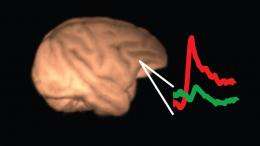
Neurons in the lateral prefrontal cortex represent the content of consciousness. The red trace depicts neural activity (neuronal discharges) in the lateral prefrontal cortex when a stimulus is consciously perceived for 1 second while the green trace depicts neural activity when the same stimulus is suppressed from awareness. Credit: MPI for Biological Cybernetics
(Medical Xpress) -- Consciousness is a selective process that allows only a part of the sensory input to reach awareness. But up to today it has yet to be clarified which areas of the brain are responsible for the content of conscious perception. Theofanis Panagiotaropoulos and his colleagues - researchers at the Max Planck Institute for Biological Cybernetics in Tübingen and University Pompeu Fabra in Barcelona - have now discovered that the content of consciousness is not localized in a unique cortical area, but is most likely an emergent property of global networks of neuronal populations.
The question which parts of the brain are responsible for the things that reach our awareness is one of the main puzzles in neurobiology today. Previous research on the brains of primates has shown that neurons in primary and secondary cortices provide poor representation of visual consciousness. In contrast, the neurons in the temporal lobe seem to reliably reflect the actual conscious perception of a visual stimulus. These findings indicated that not all parts of the brain are responsible for the content of conscious awareness. Nevertheless, the question whether only one of the brain's areas is responsible for the content of perception or whether more regions are involved in the process has so far remained unanswered.
The Max Planck scientists in Tübingen led by Nikos Logothetis have now addressed this issue using electrophysiological methods to monitor the neural activity in the lateral prefrontal cortex of macaque monkeys during ambiguous visual stimulation. The visual stimuli used allow for multiple perceptual interpretations, even though the actual input remained the same. In doing so, Panagiotaropoulos and his team were able to show that the electrical activity monitored in the lateral prefrontal cortex correlates with what the macaque monkeys actually perceive.
They thus concluded that visual awareness is not only reliably reflected in the temporal lobe, but also in the lateral prefrontal cortex of primates. The results depict that the neuronal correlates of consciousness are embedded in this area, which has a direct connection to premotor and motor areas of the brain, and is therefore able to directly affect motor output. These findings support the frontal lobe hypothesis of conscious visual perception established in 1995 by the researchers Crick (the co-discoverer of the structure of the DNA molecule) and Koch that awareness is related to neural activity with direct access to the planning stages of the brain.
The results support this theory in so far as they show that the lateral prefrontal cortex is involved in the process of visual awareness. However, the fact that neural activity in two different cortical areas reflects conscious perception shows that the decision which sensory input reaches our awareness is most likely not made in a unique cortical area but, rather, that a global network of neurons from different areas of the brain is responsible for it. Our results therefore broaden the hypothesis and create new questions regarding the cortical mechanisms of visual awareness, Panagiotaropoulos explains. In the near future the group is going to record the electrical activity in both regions simultaneously.
By this they will try to find out which of the two areas is activated first and draw conclusions on how the two areas interact with each other during conscious perception. This may lead to a better understanding of why only certain things reach our awareness and others remain suppressed.
More information: Theofanis I. Panagiotaropoulos, et al, Visual Consciousness in the Lateral Prefrontal Cortex, Neuron, Volume 74, Issue 5, 924-935, June 7th, 2012, 10.1016/j.neuron.2012.04.013
Journal reference:
Neuron
Provided by
Max Planck Society
-
Study suggest that conscious perception has little to do with the primary visual cortex
Mar 05, 2012 |
not rated yet |
0
-
Attention and awareness uncoupled in brain imaging experiments
Nov 10, 2011 |
not rated yet |
0
-
Deeper insight in the activity of cortical cells
Jul 12, 2011 |
not rated yet |
0
-
Can we 'learn to see?': Study shows perception of invisible stimuli improves with training
Oct 21, 2009 |
not rated yet |
0
-
Learning to see consciously
Mar 09, 2011 |
not rated yet |
0
-
Motion perception revisited: High Phi effect challenges established motion perception assumptions
Apr 23, 2013 |
3 / 5 (2) |
2
-
Anything you can do I can do better: Neuromolecular foundations of the superiority illusion (Update)
Apr 02, 2013 |
4.5 / 5 (11) |
5
-
The visual system as economist: Neural resource allocation in visual adaptation
Mar 30, 2013 |
5 / 5 (2) |
9
-
Separate lives: Neuronal and organismal lifespans decoupled
Mar 27, 2013 |
4.9 / 5 (8) |
0
-
Sizing things up: The evolutionary neurobiology of scale invariance
Feb 28, 2013 |
4.8 / 5 (10) |
14
-
How can there be villous adenoma in colon, if there are no villi there
11 hours ago
-
How can there be a term called "intestinal metaplasia" of stomach
May 21, 2013
-
Pressure-volume curve: Elastic Recoil Pressure don't make sense
May 18, 2013
-
If you became brain-dead, would you want them to pull the plug?
May 17, 2013
-
MRI bill question
May 15, 2013
-
Ratio of Hydrogen of Oxygen in Dessicated Animal Protein
May 13, 2013
- More from Physics Forums - Medical Sciences
More news stories
Having both migraines, depression may mean smaller brain
(HealthDay)—Migraines and depression can each cause a great deal of suffering, but new research indicates the combination of the two may be linked to something else entirely—a smaller brain.
Neuroscience
1 hour ago |
5 / 5 (1) |
0
|
Researchers analyse hunting behaviour of fish larvae in virtual reality
Moving objects attract greater attention – a fact exploited by video screens in public spaces and animated advertising banners on the Internet. For most animal species, moving objects also play a major ...
Neuroscience
4 hours ago |
not rated yet |
0
|
Signs of motor disorders can appear years before disease manifestation
It is known that signs of neurological disorders such as Alzheimer's and Huntington's disease can appear years before the disease becomes manifest; these signs take the form of subtle changes in the brain and behavior of ...
Neuroscience
4 hours ago |
not rated yet |
0
Taming suspect gene reverses schizophrenia-like abnormalities in mice
Scientists have reversed behavioral and brain abnormalities in adult mice that resemble some features of schizophrenia by restoring normal expression to a suspect gene that is over-expressed in humans with ...
Neuroscience
6 hours ago |
5 / 5 (1) |
0
|
Scientists uncover molecular roots of cocaine addiction in the brain
Researchers at Johns Hopkins have unraveled the molecular foundations of cocaine's effects on the brain, and identified a compound that blocks cravings for the drug in cocaine-addicted mice. The compound, already proven safe ...
Neuroscience
6 hours ago |
not rated yet |
0
|
Systematic screening of med adherence will ID barriers
(HealthDay)—Implementation of systematic monitoring for medication adherence will allow for identification of barriers to adherence and tailoring of interventions, according to a viewpoint piece published ...
FDA panel backs experimental Merck insomnia drug
(AP)—A federal panel of medical experts says that an experimental insomnia drug from Merck & Co Inc. appears safe and effective, despite evidence from company trials that the pill can cause daytime sleepiness and difficulty ...
American cancer society celebrates 100 years of progress
(HealthDay)—The American Cancer Society, which is celebrating on Wednesday a century of fighting a disease once viewed as a death sentence, is making a pledge to put itself out of business.
Brain can be trained in compassion, study shows
Until now, little was scientifically known about the human potential to cultivate compassion—the emotional state of caring for people who are suffering in a way that motivates altruistic behavior.
Swine flu pandemic of 2009 more deadly for younger adults, study finds
As the world prepares for what may be the next pandemic strain of influenza virus, in the H7N9 bird flu, a new UC Irvine study reveals that the 2009 H1N1 swine flu pandemic was deadliest for people under the age of 65, while ...
'Boys will be boys' in US, but not in Asia
A new study shows there is a gender gap when it comes to behavior and self-control in American young children – one that does not appear to exist in children in Asia.