Study offers hope for more effective treatment of nearsightedness
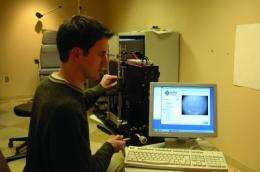
UH College of Optometry's David Berntsen's study compared the effects of wearing and then not wearing no-line bifocals in children with myopia. His results support the continued investigation of optical treatments that attempt to slow the progression of nearsightedness in children. Credit: Courtesy of The Ohio State University
Research by an optometrist at the University of Houston (UH) supports the continued investigation of optical treatments that attempt to slow the progression of nearsightedness in children.
Conducted by UH College of Optometry assistant professor David Berntsen and his colleagues from The Ohio State University, the study compared the effects of wearing and then not wearing progressive addition lenses, better known as no-line bifocals, in children who are nearsighted. With funding by a National Institutes of Health National Eye Institute training grant and support from Essilor of America Inc. and the American Optometric Foundation Ezell Fellowship program, the study examined 85 children from 6-11 years old over the course of two years. The results were published in Investigative Ophthalmology and Visual Science, one of the most widely read journals in the field.
Selected according to their eye alignment and accuracy of focusing on near objects, the myopic children were fitted with either normal single-vision lenses or no-line bifocals to correct their nearsightedness. In addition to observing and testing the children, the doctors obtained feedback from parents and guardians of both the children's outdoor activities and near-work tasks, such as reading and computer use.
Previous research suggested that nearsighted children who do not focus accurately when reading books or doing other near work may benefit more from wearing no-line bifocal glasses than nearsighted children who focus more accurately. Berntsen's study found a small, yet statistically significant, slowing of myopia progression in children wearing the bifocals compared to those who simply wore single-vision lenses. Berntsen asserts, however, that the results do not suggest that children be fitted with no-line bifocal lenses solely for the purpose of slowing the progression of myopia.
"While the small effect found in the group of children wearing bifocal spectacles does not warrant a change in clinical practice, we found the beneficial effect was still present for at least one year after children stopped wearing no-line bifocal lenses," Berntsen said. "This is promising if other optical lens designs can be developed that do an even better job of slowing how fast myopia increases in children."
By understanding why different types of lenses result in the slowing of myopia progression, Berntsen says researchers will be better able to design lenses that may be more effective in slowing the increase of nearsightedness in children.
"Single-vision lenses are normally prescribed when a child gets a pair of glasses, but glasses with progressive addition lenses were shown to slightly reduce myopic progression in our study," Berntsen said. "For any treatment that reduces myopia progression in children to be useful, the effect of the spectacles or contact lenses must persist after children stop wearing them. The fact that the small treatment effect from our study was still present one year after discontinuing the treatment is promising. The results suggest that if newer optical designs currently being investigated do a better job of slowing myopia progression, the effects may be expected to persist and decrease how nearsighted the child ultimately becomes."
An important goal of this study, in particular, was to help them improve their understanding of the mechanism behind myopia progression in children and why no-line bifocals cause this small reduction in its progression. Berntsen says the study results and evidence from other studies suggest that lenses specifically designed to change blur in the eye's peripheral vision may be able to slow the increase of nearsightedness.
"There is support for continuing to investigate new lenses specially designed to change the blur profile on the back of the eye in order to reduce the increase of myopia in children," Berntsen said. "There is still further research to be done, but our work is an important step in discovering the methods needed to slow the progression of nearsightedness."
More information: The study, titled "A randomized trial using progressive addition lenses to evaluate theories of myopia progression in children with a high lag of accommodation," is available at www.iovs.org/content/53/2/640
Provided by
University of Houston
-
Bifocals may slow progression of nearsightedness in children
Jan 11, 2010 |
not rated yet |
0
-
A life 'lens' ordinary
Apr 29, 2008 |
not rated yet |
0
-
Kids with contact lenses like their looks better than kids with glasses
Mar 02, 2009 |
not rated yet |
0
-
Medication slows progression of myopia in children
Aug 26, 2008 |
not rated yet |
0
-
Optometry experts prove the effectiveness of orthokeratology in myopic control
Jan 11, 2012 |
not rated yet |
0
-
Motion perception revisited: High Phi effect challenges established motion perception assumptions
Apr 23, 2013 |
3 / 5 (2) |
2
-
Anything you can do I can do better: Neuromolecular foundations of the superiority illusion (Update)
Apr 02, 2013 |
4.5 / 5 (11) |
5
-
The visual system as economist: Neural resource allocation in visual adaptation
Mar 30, 2013 |
5 / 5 (2) |
9
-
Separate lives: Neuronal and organismal lifespans decoupled
Mar 27, 2013 |
4.9 / 5 (8) |
0
-
Sizing things up: The evolutionary neurobiology of scale invariance
Feb 28, 2013 |
4.8 / 5 (10) |
14
-
Calculating on-axis elements of a solenoid
6 hours ago
-
latitude & longitude & air pressure
8 hours ago
-
Differences of Classical Mechanics when learned with Calc vs algebra?
11 hours ago
-
what is the distance traveled
15 hours ago
-
Image of a Convex Lens Cut in Half Horizontally
19 hours ago
-
Ray tracing through optical system of thick lenses
19 hours ago
- More from Physics Forums - Classical Physics
More news stories
Glaucoma drug can cause droopy eyelids
Prostaglandin analogues (PGAs), drugs which lower intraocular pressure, are often the first line of treatment for people with glaucoma, but their use is not without risks. PGAs have long been associated with blurred vision, ...
Ophthalmology
May 21, 2013 |
not rated yet |
0
Eyes on the sun: Child sunshine exposure and eye development
(Medical Xpress)—Exposure to sunshine as a small child is crucial to the development of a healthy eye according to results of long-term myopia study conducted by University of Sydney researchers.
Ophthalmology
May 21, 2013 |
5 / 5 (1) |
0
New study pinpoints biochemical mechanism underlying fibrosis following glaucoma surgery
The most common cause of failure after glaucoma surgery is scarring at the surgical site, so researchers are actively looking for ways to minimize or prevent scar formation. Previous work had suggested that vascular endothelial ...
Ophthalmology
May 17, 2013 |
not rated yet |
0
|
Early screenings key to diagnosing glaucoma
New research is emphasizing the importance of regular screenings for glaucoma, a disease that deteriorates the optic nerve over time and is a leading cause of irreversible blindness worldwide. The onset of glaucoma is associated ...
Ophthalmology
May 17, 2013 |
not rated yet |
0
|
University partners with Sony to find cure for 'lazy eye'
The University of Nottingham and Nottingham University Hospitals NHS Trust, have been working with Sony Computer Entertainment Europe (SCEE) to develop special 3-D glasses and games to help treat children ...
Ophthalmology
May 08, 2013 |
not rated yet |
0
Slowing the aging process—only with antibiotics
Swiss scientists reveal the mechanism responsible for aging hidden deep within mitochondria—and dramatically slow it down in worms by administering antibiotics to the young.
Rate of bicycle-related fatalities significantly lower in states with helmet laws
Existing research shows that bicyclists who wear helmets have an 88 percent lower risk of brain injury, but researchers at Boston Children's Hospital found that simply having bicycle helmet laws in place showed a 20 percent ...
Researchers complete largest genetic sequencing study of human disease
Researchers from Queen Mary, University of London have led the largest sequencing study of human disease to date, investigating the genetic basis of six autoimmune diseases.
Brain can be trained in compassion, study shows
Until now, little was scientifically known about the human potential to cultivate compassion—the emotional state of caring for people who are suffering in a way that motivates altruistic behavior.
Having both migraines, depression may mean smaller brain
(HealthDay)—Migraines and depression can each cause a great deal of suffering, but new research indicates the combination of the two may be linked to something else entirely—a smaller brain.
Novel approach for influenza vaccination shows promise in early animal testing
A new approach for immunizing against influenza elicited a more potent immune response and broader protection than the currently licensed seasonal influenza vaccines when tested in mice and ferrets. The vaccine ...