US high court upholds heart of Obama health law
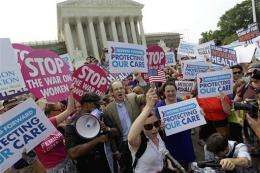
(AP) — The U.S. Supreme Court on Thursday upheld the heart of President Barack Obama's health care overhaul, handing him a huge election-year political victory and keeping in force the legislative centerpiece of his term, a law aimed at covering more than 30 million uninsured Americans.
The decision means the historic overhaul — opposed by virtually all Republicans including Mitt Romney, Obama's challenger — will continue to go into effect over the next several years, affecting the way that countless Americans receive and pay for their medical care.
The decision, written by conservative Chief Justice John Roberts, sided with Obama on the centerpiece of the law, which requires all Americans to have health insurance or face a federal fine.
"Whatever the politics, today's decision was a victory for people all over this country," Obama said, speaking on national television from the White House.
"It should be pretty clear by now that I didn't do this because it was good politics," he said. "I did it because it was good for the country."
By letting the law stand, the decision keeps the United States on a course toward joining all other major developed countries in guaranteeing health care for all its citizens.
Republicans, with an eye on the upcoming presidential election, were quick to respond. Romney said his mission now was to see the overhaul repealed, calling the changes in the system "bad law."
Republican Party Chairman Reince Priebus added in a statement: "Today's Supreme Court decision sets the stakes for the November election. Now, the only way to save the country from ObamaCare's budget-busting government takeover of health care is to elect a new president."
Republican House Speaker John Boehner said the health care law makes it harder for small businesses to hire workers. "Today's ruling underscores the urgency of repealing this harmful law in its entirety," he said.
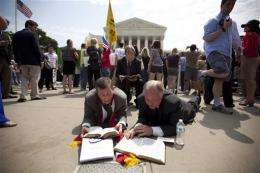
Stocks of hospital companies rose after the decision was announced, while shares of insurers fell sharply. Shares of drugmakers and device makers fell slightly.
The case was the most closely watched one before the court since a 2000 ruling resulted in George W. Bush being declared the winner of the presidential election.
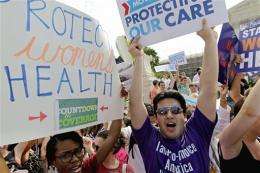
Bush nominated the youthful Roberts to head the nation's highest court in 2005, hoping to influence U.S. policy for decades by trying to build a conservative majority on the Supreme Court.
Then a junior senator from Illinois, Obama voted against John Roberts' nomination to the Supreme Court, fearing he would favor the powerful over the weak. But now it is Roberts who saved the signature achievement of Obama's presidency.
Roberts "saved the day — and perhaps the court" in the health care ruling, said Harvard law professor Laurence Tribe, a constitutional scholar who once hired Obama as a research assistant and also had the chief justice as a student.
Polls show a majority of Americans do not support the health care overhaul, which, ironically, was based on a plan put in place in Massachusetts when Romney was governor there. The Massachusetts law has been widely supported by residents since it took effect in 2006.
While Romney defends the Massachusetts plan, he has said such changes should be left to the individual states and not be imposed by the federal government. He has promised to revoke the health care overhaul if he wins the White House in November.
After the ruling, Republican campaign strategists said Romney will use it to continue campaigning against "Obamacare" and attacking it as a tax increase. His campaign said it raised more than $1 million in the hours after the court announced the ruling.
"Obama might have his law, but the GOP (Republican party) has a cause," said veteran campaign adviser Terry Holt. "This promises to galvanize Republican support around a repeal of what could well be called the largest tax increase in American history."
The requirement that all Americans have health insurance takes effect in 2014, at the same time that the law would prohibit insurance companies from denying coverage to people with existing health problems. Most experts had said the coverage guarantee would balloon costs unless virtually all people joined the insurance pool.
Most Americans already are insured. The law provides subsidies to help uninsured middle-class households pay premiums and expands federal health care for poor people.
An estimated 26 million people will remain without health coverage once the law is fully implemented, including illegal immigrants, people who don't sign up and elect to face the fine instead, and those who can't afford it even with the subsidies.
Republicans had claimed that Congress exceeded its constitutional authority by requiring Americans to buy insurance. The Obama administration argued that the mandate falls under Congress' power to regulate interstate commerce. Roberts rejected that argument but said the requirement could be considered a tax.
The court did find problems with the law's expansion of Medicaid — federal-state health coverage for the poor — but even there, it said the expansion could proceed as long as the federal government does not threaten to withhold states' entire Medicaid allotment if they don't take part in the law's extension.
The court's four liberal justices, Stephen Breyer, Ruth Bader Ginsburg, Elena Kagan and Sonia Sotomayor, joined Roberts in the decision. Justices Samuel Alito, Anthony Kennedy, Antonin Scalia and Clarence Thomas dissented.
Copyright 2012 The Associated Press. All rights reserved. This material may not be published, broadcast, rewritten or redistributed.


