Open-fire cooking may affect child cognitive development
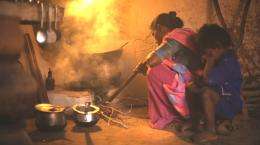
(Medical Xpress) -- Children exposed to open-fire cooking in developing countries experience difficulty with memory, problem-solving and social skills, according to researchers at the University of California, Riverside and Pitzer College in Claremont, Calif.
Research in the past decade has identified numerous health risks to children who are exposed regularly to smoke from open fires used in cooking. But until now, no one has associated smoke from cooking fires with deficits in cognitive development, said Mary Gauvain, professor of psychology at UC Riverside. She and Robert L. Munroe from Pitzer College co-authored “Exposure to open-fire cooking and cognitive performance in children,” which appears in the International Journal of Environmental Health Research.
Their research comes as international public and private agencies advocate, through the Global Alliance for Clean Cookstoves, the use of clean and efficient cooking stoves in the developing world. U.S. Secretary of State Hillary Clinton is among the alliance’s supporters because of the impacts of open-fire cooking on child health and global warming.
Gauvain said she and Munroe wondered about the effects of open-fire cooking on child cognitive development after reading a December 2009 article in The New Yorker about efforts to invent stoves that are inexpensive and could replace cooking methods that use wood, dung or straw.
Previous studies have shown that children’s exposure to carbon monoxide and toxins in smoke from open-fire cooking poses risks to immune systems and susceptibility to respiratory ailments, including pneumonia — the leading cause of death among young children worldwide — and changes to the lungs and other organs, including the brain, to children ages 3 and younger.
“We wondered if open-fire cooking could have anything to do with some of the differences in cognitive development we had seen in an earlier study,” she recalled. “We decided to look at our cognitive data in relation to cooking methods.”
Using previously collected data from the late 1970s, Gauvain and Munroe studied approximately 200 children ages 3 to 9 living in traditional communities in Belize, Kenya, Nepal and American Samoa. Two of the communities — Logoli in Kenya and Newars in Nepal — consistently used open-fire cooking with wood, dung or straw indoors. In American Samoa, cooking was done on kerosene stoves. Garifuna families in Belize, were split almost evenly among those who cooked only with wood on open fires, those who used both open-fire and kerosene-stove cooking, and those who cooked nearly exclusively with kerosene stoves.
The California researchers examined the results of cognitive assessments that tested the children’s block-building, memory and pattern-recognition skills, and observed structured play. The latter is play that involves a sequence of purposeful actions, such as making a toy or playing a game with rules. Such play is a way of engaging with peers that is beneficial for cognitive development, Gauvain said.
She and Munroe found that exposure to open-fire cooking, as opposed to cooking on kerosene stoves, was associated with both lower cognitive performance and less frequent structured play, regardless of culture, child age and educational level, and socioeconomic status.
Because their study was not experimental they cannot determine that smoke from open-fire cooking causes lower cognitive performance, the researchers said. However, the researchers point out that their results echo the findings of a 2008 study that found direct connections among toxins in the air, brain development and cognitive impairment. That study compared MRI scans of 9- and 10-year-old middle-class children living in Mexico City, where there are high levels of air pollution, and Polotitlán, a city in Mexico with low air-pollution levels.
Gauvain and Munroe said the fact that the negative effects of open-fire cooking were strongest for the youngest children, who spent more time in the home where the cooking took place, “suggests that these deleterious effects may subside as the brain matures or as children spend less time in the presence of open-fire cooking.”
The question, Gauvain said, is if there is a cognitive deficit and all children suffer some exposure, “What are the long-range implications for the community? … If there is damage, can switching to non-wood-burning stoves be beneficial? Developing safe cooking methods is important. Exposure to wood-burning stoves may be more damaging than people realize. It could have cognitive and behavioral effects. We’re trying to draw attention to the fact that the problem may be much broader in scope.”


