Researchers demonstrate technique to give us better understanding of human tissues
June 7, 2012 By Matt Shipman in Medical research
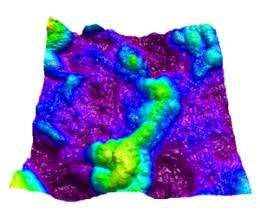
High resolution atomic force microscopy image of inner limiting membrane extracted from a human eye.
(Medical Xpress) -- Research from North Carolina State University demonstrates that a relatively new microscopy technique can be used to improve our understanding of human tissues and other biomedical materials. The study focused specifically on eye tissues, which are damaged by scarring in diabetic patients.
Our findings are a proof of concept, showing that this technique is extremely effective at giving us the data we need on these tissues, says Dr. Albena Ivanisevic, co-author of a paper describing the research. Specifically, it gives a great deal of information on the composition of these tissues, as well as the tissues topography, or surface characteristics. Ivanisevic is an associate professor of materials science and engineering at NC State and associate professor of the joint biomedical engineering program at NC State and the University of North Carolina at Chapel Hill.
The study is one of the first to explore how this technology, called bimodal dual AC mode microscopy, can improve our understanding of human tissues and biomaterials.
The research team, which included researchers from Purdue University and the University of Louisville School of Medicine, examined two types of eye tissue from diabetic patients. Specifically, they looked at the inner limiting membrane (ILM), which is the surface layer of the retina, and so-called epiretinal membranes. Epiretinal membranes are scar tissues that form on the ILM in diabetics. Scar tissue can cause significant damage to the retina and, if untreated, may lead to blindness.
There are multiple treatments for this scarring. In the United States, a common technique is for a surgeon to peel off the ILM, removing the scar tissue with it. In many other parts of the world, surgeons inject dye into the eye to better distinguish the parts of the eye they will operate on. This process is not currently allowed in the United States, due to concerns about the dyes toxicity.
The researchers launched this project, in part, to determine if bimodal dual AC mode microscopy could be used to provide a better understanding of the topographical properties of the ILM. Further, the researchers wanted to use the technology to see if it offered insight into how or whether various dyes affect the topographical characteristics of the ILM. All of this information could be used to improve surgical outcomes and to foster research into additional treatments for the condition, Ivanisevic says.
The researchers found that bimodal dual AC mode microscopy, an atomic force imaging technique, captured the properties of the tissue in exceptional detail. Atomic force imaging effectively runs a probe over the surface of a material to collect data on its topography, similar to the way in which a record players needle runs over the surface of an album.
The next step would be to use this technology to assess the utility and potential risk of various dyes, Ivanisevic says. If we can find a dye that is extremely effective and poses little risk, it may be approved for use in future surgeries.
The paper, Deposition of Triamcinolone Acetonide and Its Effect on Soft Tissue Topography, was published online June 5 in Advanced Healthcare Materials. Lead author of the paper is Celimar Valentin-Rodriguez, a Ph.D. student at Purdue. Co-authors are Ivanisevic and Dr. Tongalp Tezel, of Louisville. The research was supported by a George Washington Carver Fellowship and Research To Prevent Blindness Inc.
More information: The paper, Deposition of Triamcinolone Acetonide and Its Effect on Soft Tissue Topography, was published online June 5 in Advanced Healthcare Materials. Lead author of the paper is Celimar Valentin-Rodriguez, et al, of Louisville. The research was supported by a George Washington Carver Fellowship and Research To Prevent Blindness Inc.
Abstract
Bimodal imaging is utilized to characterize the topography of human tissue samples. The deposition of Triamcinolone Acetonide (TA) on various surfaces including surgical human inner limiting membrane (ILM) samples and collagen fibrillar sheets- was studied. Changes in composition were well defined with bimodal imaging when TA deposition was examined on mica. TA sedimentation resulted in observable changes in ILM topography when compared to collagen fibrillar sheets. The heterogeneous chemical and topographical features of the ILM tissues promoted the TA crystallization compared to the flatter and homogeneous collagen surfaces. Higher spatial resolution was achieved by imaging ILM samples in the new bimodal imaging mode. The most apparent difference was observed in the imaging of ILM samples which had been exposed to the steroid TA. The study demonstrated the usefulness of bimodal imaging to evaluate tissue samples.
Provided by
North Carolina State University
-
Research finds gallium nitride is non-toxic, biocompatible - holds promise for implants
Oct 24, 2011 |
not rated yet |
0
-
The use of a different resonance in atomic force microscopy enhances resolution
Apr 14, 2011 |
not rated yet |
0
-
Making lifesaving devices less life-threatening
Feb 16, 2011 |
not rated yet |
0
-
Bits of life, drop by drop
Jan 16, 2012 |
not rated yet |
0
-
Shellfish and inkjet printers may hold key to faster healing from surgeries
Mar 18, 2009 |
not rated yet |
0
-
Motion perception revisited: High Phi effect challenges established motion perception assumptions
Apr 23, 2013 |
3 / 5 (2) |
2
-
Anything you can do I can do better: Neuromolecular foundations of the superiority illusion (Update)
Apr 02, 2013 |
4.5 / 5 (11) |
5
-
The visual system as economist: Neural resource allocation in visual adaptation
Mar 30, 2013 |
5 / 5 (2) |
9
-
Separate lives: Neuronal and organismal lifespans decoupled
Mar 27, 2013 |
4.9 / 5 (8) |
0
-
Sizing things up: The evolutionary neurobiology of scale invariance
Feb 28, 2013 |
4.8 / 5 (10) |
14
-
How can there be a term called "intestinal metaplasia" of stomach
6 hours ago
-
Pressure-volume curve: Elastic Recoil Pressure don't make sense
May 18, 2013
-
If you became brain-dead, would you want them to pull the plug?
May 17, 2013
-
MRI bill question
May 15, 2013
-
Ratio of Hydrogen of Oxygen in Dessicated Animal Protein
May 13, 2013
-
Alcohol and acetaminophen
May 13, 2013
- More from Physics Forums - Medical Sciences
More news stories
Common food supplement fights degenerative brain disorders
Widely available in pharmacies and health stores, phosphatidylserine is a natural food supplement produced from beef, oysters, and soy. Proven to improve cognition and slow memory loss, it's a popular treatment for older ...
Medical research
35 minutes ago |
not rated yet |
0
|
Finding a family for a pair of orphan receptors in the brain
Researchers at Emory University have identified a protein that stimulates a pair of "orphan receptors" found in the brain, solving a long-standing biological puzzle and possibly leading to future treatments for neurological ...
Medical research
1 hour ago |
not rated yet |
0
|
Insight into the dazzling impact of insulin in cells
Australian scientists have charted the path of insulin action in cells in precise detail like never before. This provides a comprehensive blueprint for understanding what goes wrong in diabetes.
Medical research
1 hour ago |
4.5 / 5 (2) |
0
|
Do men's and women's hearts burn fuel differently?
Researchers at the University of Illinois at Chicago College of Medicine will study gender differences in how the heart uses and stores fat—its main energy source—and how changes in fat metabolism play ...
Medical research
4 hours ago |
not rated yet |
0
Study suggests new source of kidneys for transplant
Nearly 20 percent of kidneys that are recovered from deceased donors in the U.S. are refused for transplant due to factors ranging from scarring in small blood vessels of the kidney's filtering units to the organ going too ...
Medical research
20 hours ago |
5 / 5 (2) |
0
|
Estimates reveal low population immunity to new bird flu virus H7N9 in humans
The level of immunity to the recently circulating H7N9 influenza virus in an urban and rural population in Vietnam is very low, according to the first population level study to examine human immunity to the virus, which was ...
Waiting for a sign? Researchers find potential brain 'switch' for new behavior
You're standing near an airport luggage carousel and your bag emerges on the conveyor belt, prompting you to spring into action. How does your brain make the shift from passively waiting to taking action when ...
Glaucoma drug can cause droopy eyelids
Prostaglandin analogues (PGAs), drugs which lower intraocular pressure, are often the first line of treatment for people with glaucoma, but their use is not without risks. PGAs have long been associated with blurred vision, ...
Teens exposed to schoolmate's death by suicide much more likely to consider or attempt suicide
Youth who had a schoolmate die by suicide are significantly more likely to consider or attempt suicide, according to a study in published in CMAJ (Canadian Medical Association Journal). This effect can last 2 years or mo ...
Most elite athletes believe doping substances are effective in improving performance
Most elite athletes consider doping substances "are effective" in improving performance, while recognising that they constitute cheating, can endanger health and entail the obvious risk of sanction. At the same time, the ...
People on higher incomes are happier with new knees
Knee replacement surgery is a very common procedure. However, it does not always resolve function or pain in all the recipients of new knees. A study by Robert Barrack, MD and his colleagues from the Washington University ...