Novel nanotherapeutic delivers clot-busting drugs directly to obstructed blood vessels (w/ Video)
July 5, 2012 in Medical research
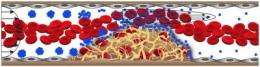
The shear-activated nanotherapeutic breaks apart and releases its drug when it encounters regions of vascular narrowing. Credit: Wyss Institute
(Medical Xpress) -- Researchers at the Wyss Institute for Biologically Inspired Engineering at Harvard University have developed a novel biomimetic strategy that delivers life-saving nanotherapeutics directly to obstructed blood vessels, dissolving blood clots before they cause serious damage or even death. This new approach enables thrombus dissolution while using only a fraction of the drug dose normally required, thereby minimizing bleeding side effects that currently limit widespread use of clot-busting drugs.
The research findings, which were published online today in the journal Science, have significant implications for treating major causes of death, such as heart attack, stroke, and pulmonary embolism, that are caused by acute vascular blockage by blood thrombi.
The inspiration for the targeted vascular nanotherapeutic approach came from the way in which normal blood platelets rapidly adhere to the lining of narrowed vessels, contributing to the development of atherosclerotic plaques. When vessels narrow, high shear stresses provide a physical cue for circulating platelets to stick to the vessel wall selectively in these regions. The vascular nanotherapeutic is similarly about the size of a platelet, but it is an aggregate of biodegradable nanoparticles that have been coated with the clot-busting drug, tissue plasminogen activator (tPA). Much like when a wet ball of sand breaks up into individual grains when it is sheared between two hands, the aggregates selectively dissociate and release tPA-coated nanoparticles that bind to clots and degrade them when they sense high shear stress in regions of vascular narrowing, such as caused by blood clot formation.
This video is not supported by your browser at this time.
A blood clot within a mouse artery disappears following the injection of a clot-busting, shear-activated nanotherapeutic. The bright areas are fluorescent-labeled platelets. Credit: Wyss Institute
Disruption of normal blood flow to the heart, lung, and brain due to thrombosis is one of the leading causes of death and long-term adult disability in the developing world. Today, patients with pulmonary embolism, strokes, heart attacks, and other types of acute thrombosis leading to near-complete vascular occlusion, are most frequently treated in an acute care hospital setting using systemic dosages of powerful clot-dissolving drugs. Because these drugs can cause severe and often fatal bleeding as they circulate freely throughout the body, the size of the dosage given to any patient is limited because efficacy must be balanced against risk.
The new shear-activated nanotherapeutic has the potential to overcome these efficacy limitations. By targeting and concentrating drug at the precise site of the blood vessel obstruction, the Wyss team has been able to achieve improved survival in mice with occluded lung vessels with less than 1/50th of the normal therapeutic dose, which should translate into fewer side effects and greater safety. This raises the possibility that, in the future, an emergency technician might be able immediately administer this nanotherapeutic to anyone suspected of having a life-threatening blood clot in a vital organ before the patient even reached the hospital.
The inter-disciplinary and inter-institutional collaborative research team, which was led by Wyss Founding Director Donald Ingber M.D., Ph.D., and Wyss Technology Development Fellow Netanel Korin, Ph.D., also included Wyss postdoctoral Fellow Mathumai Kanapathipillai, Ph.D., as well as Benjamin D. Matthews, Marilena Crescente, Alexander Brill, Tadanori Mammoto, Kaustabh Ghosh, Samuel Jurek, Sidi A. Bencherif, Deen Bhatta, Ahmet U. Coskun, Charles L. Feldman, and Denisa D. Wagner from Brigham and Women's Hospital, Children's Hospital Boston, Harvard Medical School, the Harvard School of Engineering and Applied Sciences, and Northeastern University. Ingber is also the Judah Folkman Professor of Vascular Biology at Harvard Medical School and Children's Hospital Boston, and Professor of Bioengineering at Harvard's School of Engineering and Applied Sciences.
Commenting on the work, Ingber noted that "the vascular nanotherapeutic we developed that selectively becomes activated in regions of high shear stress, much like living platelets do, is a wonderful example of how we at the Wyss Institute take inspiration from biology, and how biomimetic strategies can lead to new and unexpected solutions to age-old problems that existing technologies can't address."
More information: "Shear-Activated Nanotherapeutics for Drug Targeting to Obstructed Blood Vessels," by N. Korin et al., Science, 2012.
Journal reference:
Science
Provided by
Harvard University
-
New 'smart' nanotherapeutics can deliver drugs directly to the pancreas
Jan 12, 2012 |
not rated yet |
0
-
New microdevice enables culture of circulating tumor cells for cancer diagnosis, treatment
Apr 24, 2012 |
not rated yet |
0
-
Researchers create living human gut-on-a-chip
Mar 27, 2012 |
not rated yet |
0
-
Capillary formation’s mechanical determinants: One growth factor can have many effects
Mar 09, 2009 |
not rated yet |
0
-
Gelatin-based nanoparticle treatment may be a more effective clot buster
Nov 14, 2011 |
not rated yet |
0
-
Motion perception revisited: High Phi effect challenges established motion perception assumptions
Apr 23, 2013 |
3 / 5 (2) |
2
-
Anything you can do I can do better: Neuromolecular foundations of the superiority illusion (Update)
Apr 02, 2013 |
4.5 / 5 (11) |
5
-
The visual system as economist: Neural resource allocation in visual adaptation
Mar 30, 2013 |
5 / 5 (2) |
9
-
Separate lives: Neuronal and organismal lifespans decoupled
Mar 27, 2013 |
4.9 / 5 (8) |
0
-
Sizing things up: The evolutionary neurobiology of scale invariance
Feb 28, 2013 |
4.8 / 5 (10) |
14
-
Why is zone 1 in liver more prone to ischemic injury?
11 hours ago
-
How can there be villous adenoma in colon, if there are no villi there
May 22, 2013
-
How can there be a term called "intestinal metaplasia" of stomach
May 21, 2013
-
Pressure-volume curve: Elastic Recoil Pressure don't make sense
May 18, 2013
-
If you became brain-dead, would you want them to pull the plug?
May 17, 2013
-
MRI bill question
May 15, 2013
- More from Physics Forums - Medical Sciences
More news stories
Antibiotics: A new understanding of sulfonamide nervous system side effects
Since the discovery of Prontosil in 1932, sulfonamide antibiotics have been used to combat a wide spectrum of bacterial infections, from acne to chlamydia and pneumonia. However, their side effects can include serious neurological ...
Medical research
58 minutes ago |
not rated yet |
0
|
Scientists discover molecule triggers sensation of itch
Scientists at the National Institutes of Health report they have discovered in mouse studies that a small molecule released in the spinal cord triggers a process that is later experienced in the brain as the sensation of ...
Medical research
58 minutes ago |
5 / 5 (1) |
0
|
Discarded immune cells induce the relocation of stem cells
Spanish researchers have discovered that the daily clearance of neutrophils from the body stimulates the release of hematopoietic stem cells from the bone marrow into the bloodstream, according to a report published today ...
Medical research
2 hours ago |
not rated yet |
0
Hormone signal drives motor neuron growth, fish study shows
A discovery made in fish could aid research into motor neuron disease.
Medical research
2 hours ago |
not rated yet |
0
First successful treatment of pediatric cerebral palsy with autologous cord blood
Bochum's medics have succeeded in treating cerebral palsy with autologous cord blood. Following a cardiac arrest with severe brain damage, a 2.5 year old boy had been in a persistent vegetative state – with minimal chances ...
Medical research
3 hours ago |
not rated yet |
0
Multiple research teams unable to confirm high-profile Alzheimer's study
Teams of highly respected Alzheimer's researchers failed to replicate what appeared to be breakthrough results for the treatment of this brain disease when they were published last year in the journal Science.
Drug reverses Alzheimer's disease deficits in mice, research confirms
An anti-cancer drug reverses memory deficits in an Alzheimer's disease mouse model, University of Pittsburgh Graduate School of Public Health researchers confirm in the journal Science.
Economic incentives increase blood donation without negative consequences
Can economic incentives such as gift cards, T-shirts, and time off from work motivate members of the public to increase their donations of blood?
Researchers find common childhood asthma unconnected to allergens or inflammation
Little is known about why asthma develops, how it constricts the airway or why response to treatments varies between patients. Now, a team of researchers at Weill Cornell Medical College, Columbia University Medical Center ...
Motion quotient: IQ predicted by ability to filter motion (w/ video)
A brief visual task can predict IQ, according to a new study. This surprisingly simple exercise measures the brain's unconscious ability to filter out visual movement. The study shows that individuals whose ...
Brain uses internal 'average voice' prototype to identify who is talking
(Medical Xpress)—The human brain is able to identify individuals' voices by comparing them against an internal 'average voice' prototype, according to neuroscientists.