Budget office: Obama's health law reduces deficit

July 25, 2012 by ANDREW TAYLOR in Health
In this Jan. 27, 2010 file photo, Congressional Budget Office (CBO) Director Douglas Elmendorf testifies on Capitol Hill in Washington. Will President Barack Obama’s health care law increase the government’s huge deficit or reduce it? How many people will it really cover? How much will it cost taxpapers? Congress’ nonpartisan budget scorekeepers release their findings, the first in-depth look at the law since the Supreme Court ruled it constitutional. (AP Photo/Manuel Balce Ceneta, File)
(AP) President Barack Obama's health care overhaul will shrink rather than increase America's huge federal deficits over the next decade, Congress' nonpartisan budget scorekeepers said Tuesday, supporting Obama's contention in a major election-year dispute with Republicans.
About 3 million fewer uninsured people will gain health coverage because of last month's Supreme Court ruling granting states more leeway to opt out, and that will cut the federal costs by $84 billion, the Congressional Budget Office said in the biggest changes from earlier estimates.
Republicans have insisted that "Obamacare" will actually raise deficits by "trillions," according to presidential candidate Mitt Romney. But that's not so, the budget office said.
The office gave no updated estimate for total deficit reductions from the law, approved by Congress and signed by Obama in 2010. But it did estimate that Republican legislation to repeal the overhaul passed recently by the House would itself boost the deficit by $109 billion from 2013 to 2022.
"Repealing the (health care law) will lead to an increase in budget deficits over the coming decade, though a smaller one than previously reported," budget office director Douglas Elmendorf said in a letter to Republican House Speaker John Boehner.
The law's mix of spending cuts and tax increases would more than offset new spending to cover uninsured people, Elmendorf explained.
Tuesday's budget projections were the first since the Supreme Court upheld most of the law last month but gave states the option of rejecting a planned expansion of federal Medicaid coverage for their low-income residents. As a consequence, the budget office said the law will cover fewer uninsured people.

President Barack Obama waves upon his arrival, Tuesday, July 24, 2012, at the 142nd Fighter Wing Oregon Air National Guard Base, in Portland, Ore. President Barack Obama has arrived in Oregon to raise money for his re-election campaign. (AP Photo/Rick Bowmer)
Thirty million uninsured people will be covered by 2022, or about 3 million fewer than projected this spring before the court ruling, the report said.As a result, taxpayers will save about $84 billion from 2012 to 2022. That brings the total cost of expanding coverage down to $1.2 trillion, from about $1.3 trillion in the previous estimate.
The Congressional Budget Office has consistently projected that Obama's overhaul will reduce the deficit.
When the health care law is fully in effect, 92 percent of U.S. citizens and legal residents are estimated to have coverage, as compared to 81 percent now.
Democrats hailed Tuesday's estimates as vindication for the president. "This confirms what we've been saying all along: the Affordable Care Act saves lots of money," said Senate Majority Leader Harry Reid.
Republicans said they remain unswervingly committed to repealing what they dismiss as "Obamacare." Romney says if elected he will begin to dismantle the law his first day in office.
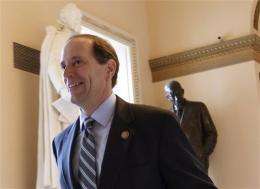
In this Feb. 17, 2012 file photo, House Ways and Means Committee Chairman Rep. David Camp, R-Mich. walks to his office on Capitol Hill in Washington. Will President Barack Obama’s health care law increase the government’s huge deficit or reduce it? How many people will it really cover? How much will it cost taxpapers? Congress’ nonpartisan budget scorekeepers release their findings, the first in-depth look at the law since the Supreme Court ruled it constitutional. (AP Photo/J. Scott Applewhite, File)
Medicaid has been one big question hanging over the future of Obama's law since the Supreme Court ruled.Some Repubican-led states, such as Texas and Florida, say they will not go forward with the expansion. Others are uncommitted, awaiting the voters' verdict on Obama in November.
Although the federal government would bear all of the initial cost of that expansion, many states would have to open their Medicaid programs to low-income childless adults for the first time.
CBO analysts did not try to predict which specific states would jump in and which would turn down the Medicaid expansion. Instead, they assumed that many states would eventually cut deals with the federal government to expand their programs to some degree.
The big coverage expansion under the law doesn't start until 2014, with middle-class uninsured people signing up for subsidized private plans and more low-income people picked up through Medicaid.
Copyright 2012 The Associated Press. All rights reserved. This material may not be published, broadcast, rewritten or redistributed.
-
US high court upholds heart of Obama health law
Jun 27, 2012 |
not rated yet |
0
-
Gov. Perry says Texas won't expand Medicaid
Jul 10, 2012 |
not rated yet |
0
-
Top US court to announce fate of Obama health plan
Jun 28, 2012 |
not rated yet |
0
-
US appeals court upholds Obama's health care law
Jun 29, 2011 |
not rated yet |
0
-
US High court upholds key part of Obama health law
Jun 28, 2012 |
not rated yet |
0
-
Motion perception revisited: High Phi effect challenges established motion perception assumptions
Apr 23, 2013 |
3 / 5 (2) |
2
-
Anything you can do I can do better: Neuromolecular foundations of the superiority illusion (Update)
Apr 02, 2013 |
4.5 / 5 (11) |
5
-
The visual system as economist: Neural resource allocation in visual adaptation
Mar 30, 2013 |
5 / 5 (2) |
9
-
Separate lives: Neuronal and organismal lifespans decoupled
Mar 27, 2013 |
4.9 / 5 (8) |
0
-
Sizing things up: The evolutionary neurobiology of scale invariance
Feb 28, 2013 |
4.8 / 5 (10) |
14
-
Classical and Quantum Mechanics via Lie algebras
Apr 15, 2011
- More from Physics Forums - Independent Research
More news stories
New research identifies risks, interventions for children's GI health
An increasing number of U.S. children are experiencing gastrointestinal issues that require interventions to resolve, according to research presented at Digestive Disease Week (DDW).
Health
15 hours ago |
not rated yet |
0
|
Youth who have their first drink during puberty have higher levels of later drinking
Research shows that the earlier the age at which youth take their first alcoholic drink, the greater the risk of developing alcohol problems. Thus, age at first drink (AFD) is generally considered a powerful predictor of ...
Health
May 17, 2013 |
not rated yet |
0
British MPs concerned about parliamentary boozing
One quarter of British lawmakers believe there is an "unhealthy" drinking culture in the Houses of Parliament, according to a survey published on Friday.
Health
May 17, 2013 |
not rated yet |
0
Patient openness to research can depend on race and sex of study personnel
Researchers at the University of Cincinnati (UC) have found that the race and sex of study personnel can influence a patient's decision on whether or not to participate in clinical research.
Health
May 17, 2013 |
not rated yet |
0
Clinical support for patient self-management is rhetoric rather than reality
The processes to allow people to self-manage their own illness are not being used appropriately by health professionals to the benefit of their patients, new research suggests.
Health
May 17, 2013 |
not rated yet |
0
Consuming coffee linked to lower risk of detrimental liver disease, study finds
Regular consumption of coffee is associated with a reduced risk of primary sclerosing cholangitis (PSC), an autoimmune liver disease, Mayo Clinic research shows. The findings were being presented at the Digestive Disease ...
Ketamine shows significant therapeutic benefit in people with treatment-resistant depression
Patients with treatment-resistant major depression saw dramatic improvement in their illness after treatment with ketamine, an anesthetic, according to the largest ketamine clinical trial to-date led by researchers from the ...
Research examines new methods for managing digestive health
Research presented at Digestive Disease Week (DDW) explores new methods for managing digestive health through diet and lifestyle.
New research identifies practice changes to improve value and quality of GI procedures
There are significant cost and risk factors associated with two procedures commonly used to diagnose or treat gastrointestinal problems, according to research presented at Digestive Disease Week (DDW).
New smartphone application improves colonoscopy preparation
The use of a smartphone application significantly improves patients' preparation for a colonoscopy, according to new research presented today at Digestive Disease Week (DDW). The preparation process, which begins days in ...
US psychiatry gets makeover in new manual
The latest makeover to a massive psychiatric tome honored by some, reviled by others and even called the "Bible" of mental disorders is being released Saturday with a host of new changes.


Jul 25, 2012
Rank: 5 / 5 (1)
"Nothing the Kenyan Impersonator does can be good, so this estimate must be part of the Big Conspiracy!"
"Congress nonpartisan budget scorekeepers" No, they must be taken over by Alien mind parasites! No non-partisan people could ever disagree with my world-view (sarcasm).