The Olympics and bare feet: What have we learned?
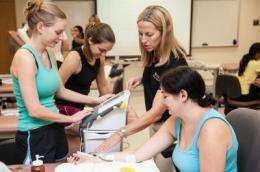
Physical therapy instructor Carey Rothschild works with students at the University of Central Florida in Orlando. Credit: UCF/Abi Bell
Ethiopian runner Abebe Bikila made history when he earned a gold medal at the 1960 Summer Olympics in Rome. His speed and agility won him the gold, but it was barefoot running that made him a legend.
When the shoes Bikila was given for the race didn't fit comfortably, he ditched them for his bare feet. After all, that's the way he had trained for the Olympics in his homeland.
Racing shoeless led to success for Bikila, and now, more than 50 years later, runners are continuing to take barefoot strides. Several Olympic runners have followed Bikila and nationally the trend has exploded over the past decade. There's even a national association dedicated to barefoot running. However, scientists are stuck on whether it either prevents or increases injuries.
"Bikila may have been on to something," said Carey Rothschild, an instructor of physical therapy at the University of Central Florida in Orlando who specializes in orthopedic sports injuries. "The research is really not conclusive on whether one approach is better than the other. But what is clear is that it's really a matter of developing a good running form and sticking to it, not suddenly changing it."
Rothschild, a 12-year runner who has completed the Boston Marathon three times, reviewed research and found injuries happened with or without shoes. So she conducted a survey with the help of the Track Shack in Orlando to get to the bottom of the controversy.
What she found was striking.
Most people said they turned to barefoot running in the hopes of improving performance and reducing injuries. Ironically, those who said they never tried it avoided it for fear it would cause injuries and slow their times.
However, research shows that there are risks to running no matter what someone puts on his or her feet.
Barefoot runners tend to land on their mid or forefoot as opposed to the heel, which good athletic shoes try to cushion.
Some studies suggest that barefoot running causes a higher level of stress fractures on the front part of the foot and increased soreness in the calves. But runners who wear athletic shoes can also suffer everything from knee injuries to hip problems, related to repeated stress from impact forces at the heel.
"There is no perfect recipe," said Rothschild, a resident of Winter Park.
In a paper publishing in the August edition of the Journal of Strength And Conditioning, Rothschild reviews the research and provides a guide for those who want to explore barefoot running as a way to train for marathons. It's a 10-12 week program that slowly eases people who run in shoes onto their bare feet.
She suggests getting a thorough physical examination and biomechanical assessment from a physical therapist or other trained professional so that strength and flexibility deficits can be identified and addressed first. That should be done before gradually transitioning to bare feet.
"The bottom line is that when a runner goes from shoes to no shoes, their body may not automatically change its gait," Rothschild said. "But there are ways to help make that transition smoother and lower the risk of injuries."
The researcher concludes that barefoot running in and of itself is neither good nor bad. As with running in shoes, proper training and conditioning are essential.
However, Rothschild does offer a warning.
Anyone with lower extremity or deformity or with a disease that creates a lack of sensation on the feet should probably avoid barefoot running because they can't necessarily feel injuries resulting from running on hard surfaces.
Provided by
University of Central Florida
-
Probing Question: Is it better to run barefoot?
Dec 07, 2006 |
not rated yet |
0
-
Study finds barefoot runners have less foot stress than shod ones (w/ Video)
Jan 27, 2010 |
not rated yet |
0
-
Born to run barefoot? Some end up getting injured
May 22, 2012 |
not rated yet |
0
-
Running shoes may cause damage to knees, hips and ankles
Jan 04, 2010 |
not rated yet |
0
-
Shoes: A treatment for osteoarthritis in the knees?
Mar 24, 2010 |
not rated yet |
0
-
Motion perception revisited: High Phi effect challenges established motion perception assumptions
Apr 23, 2013 |
3 / 5 (2) |
2
-
Anything you can do I can do better: Neuromolecular foundations of the superiority illusion (Update)
Apr 02, 2013 |
4.5 / 5 (11) |
5
-
The visual system as economist: Neural resource allocation in visual adaptation
Mar 30, 2013 |
5 / 5 (2) |
9
-
Separate lives: Neuronal and organismal lifespans decoupled
Mar 27, 2013 |
4.9 / 5 (8) |
0
-
Sizing things up: The evolutionary neurobiology of scale invariance
Feb 28, 2013 |
4.8 / 5 (10) |
14
-
Classical and Quantum Mechanics via Lie algebras
Apr 15, 2011
- More from Physics Forums - Independent Research
More news stories
Wireless ultrasound transducers help physicians
Siemens has presented the world's first ultrasound system with wireless transducers. The system's transducers, which can be easily operated with one hand, transmit ultrasound images via radio waves to the ...
Other
30 minutes ago |
not rated yet |
0
Flesh-eating disease victim gets prosthetic hands
(AP)—A woman who lost both hands, her left leg and right foot after contracting a flesh-eating disease has been fitted with prosthetic hands.
Other
May 18, 2013 |
not rated yet |
0
Illinois Senate approves medical marijuana bill
(AP)—Medical marijuana use in Illinois is now in Gov. Pat Quinn's hands after the state Senate approved legislation.
Other
May 17, 2013 |
5 / 5 (1) |
0
Nigerian court jails two over killer teething drug
A Nigerian court on Friday sentenced two officials from a pharmaceutical company to seven years in prison over the sale of an adulterated teething drug which killed 84 babies in 2008.
Other
May 17, 2013 |
not rated yet |
0
Many patients would switch doc to cut health care costs
(HealthDay)—Many Americans feel that keeping out-of-pocket health care costs is more important than staying with the same primary care physician.
Other
May 17, 2013 |
not rated yet |
0
Lymphatic fluid takes detour
When tumours metastasise, they can block lymphatic vessels, as researchers from ETH Zurich have discovered using a new method. The lymphatic fluid subsequently has to find a new path through the tissue. Such ...
Research uncovers a potential role of two proteins in diabetes
(Medical Xpress)—Flinders University researchers are breaking new ground in a decade-long journey to pinpoint the function of two closely related proteins.
Vitamin D could provide new and effective treatments for asthma
(Medical Xpress)—Scientists at King's College London have discovered that Vitamin D has the potential to significantly reduce the symptoms of asthma. The study, led by Professor Catherine Hawrylowicz from ...
Rethinking treatment goals improves results for 'untreatable' anorexics
(Medical Xpress)—Patients with the most severe and dangerous form of chronic anorexia are more likely to make a significant improvement towards recovery and stay in therapy if traditional psychological treatments are re-focused ...
Discovery of novel medicine for treatment of chronic wounds
Every 20 seconds, a limb is lost as a consequence of diabetic foot ulcer that does not heal. To date, medical solutions that can change this situation are very limited. In his doctoral thesis Yue Shen from the Industrial ...
Rise in type 2 diabetes amongst young
The number of young people diagnosed with type 2 diabetes has seen the sharpest rise over the last twenty years compared to a background of a general increase across the board, new University research has ...