Classifying disabilities tricky at Paralympics
August 26, 2012 by MARIA CHENG in Other
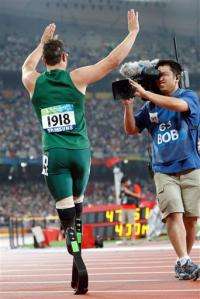
This is a Tuesday Sept. 16, 2008 file photo of Oscar Pistorius of South Africa, left, as he waves in front of a cameraman after he won the gold medal in the Men's 400m T44 final at the Beijing 2008 Paralympic Games in Beijing, China. With more global broadcast coverage than ever before, the London 2012 Paralympic Games in London will win its largest ever live television audience, except in the United States, where no events will be screened live by a traditional broadcaster, prompting complaints from some equality campaigners.(AP Photo/Andy Wong, File)
(AP)—Double-amputee runner Oscar Pistorius, probably the biggest star of the upcoming Paralympics, hasn't been able to skip one of the games' biggest bureaucratic hurdles: the disability classification system.
It exists to make the competition as fair as possible, but with so many disabilities and degrees of severity, classifying Paralympic athletes can often seem like a sport in itself. According to that system, Pistorius is classed as a double amputee below the knee and eligible only to compete against other Paralympic athletes with a similar impairment. Yet the South African recently made history as the first disabled athlete ever to compete on the track at the Olympics, running in the 400 meters on carbon-fiber blades.
"We assume that Oscar is worse off than someone who has only lost one limb, but in fact he is a very balanced runner," said David Howe, a disability sport expert at Britain's Loughborough University and former Paralympic runner. "Someone who is running with one human leg and one prosthetic will be more unbalanced."
The classification, while "reasonably good," is still partly subjective and influenced by traditional assumptions, Howe said.
Paralympic athletes are divided into four main groups: amputees, the blind, those with cerebral palsy and those with spinal injuries or other physical disabilities. Depending on the sport, Paralympians either compete against others with the same disability, or across categories based on an evaluation of their ability to perform their chosen sport. Their classification is determined by a panel that includes experts in medicine and the sport's biomechanics.
"The goal is to make sure athletes in the same class have the same chance at a gold medal," said Peter Van de Vliet, science and medical director at the International Paralympic Committee.
He said they previously assessed athletes based on their disabilities but they now focus on their sporting potential, meaning athletes with different impairments can compete directly against each other.
"If you put a double leg amputee into a racing wheelchair and do the same for a paraplegic (who has non-functioning legs), they both are in the same position of needing to use their arms to propel the wheelchair," he said. "In that sense, classification is no different than age or weight categories."
The London Paralympics will also once again include intellectually disabled athletes. Those events were suspended in the last two games after a scandal in which the winning basketball team from Spain was comprised mostly of players without any such disability. Van de Vliet said the classification for intellectually disabled competitors has been completely revamped since then and now includes stricter criteria, like a psychological evaluation.
Experts said the system is constantly evolving as officials get more experience with Paralympic sports.
Even the athletes admit the classification system isn't always straightforward.
British wheelchair sprinter Hannah Cockcroft, who is classified as having cerebral palsy and brain damage, has said skeptics sometimes wonder whether that's the right classification because she is so chatty. But she said it fits since two parts of her brain are damaged and she has trouble doing simple things like tying her shoes. Cockcroft said she occasionally wonders about the categories of other Paralympic athletes but without knowing their full story, it is impossible to judge.
Each of the 20 Paralympic sports has its own rules. For example, track and field divides athletes into categories based on their disability and its severity. Others, like judo and five-a-side football, are only open to blind athletes.
Swimming is one of a handful of sports that throws all of the athletes together, allowing amputees, those with cerebral palsy, spinal cord injuries and other disabilities to directly compete against each other.
That can make for a very diverse line-up of athletes on the starting blocks, including swimmers with dwarfism, those missing a limb and others with cerebral palsy, who might look able-bodied but have coordination and movement problems. While the athletes with cerebral palsy have to work harder to coordinate their muscles to swim, those with dwarfism have a high level of drag in the water but may have better balance. In theory, the classification system is meant to even out those differences, Van de Vliet said.
"Classification is unique to Paralympic sport but it is crucial that the competition is fair and correct," Van de Vliet said. "For us, making sure athletes are in the correct class is as important as doping."
Copyright 2012 The Associated Press. All rights reserved. This material may not be published, broadcast, rewritten or redistributed.
-
New research re-introduces athletes with learning difficulties into the Paralympic Games
Aug 22, 2012 |
not rated yet |
0
-
The challenges and rewards of Paralympic medicine
Jul 05, 2012 |
not rated yet |
0
-
Canadian researcher works to make paralympic games safer
Aug 23, 2012 |
not rated yet |
0
-
Reverse inclusion and the question of disability
Jan 17, 2012 |
not rated yet |
0
-
Study finds head impacts in contact sports may reduce learning in college athletes
May 16, 2012 |
not rated yet |
0
-
Motion perception revisited: High Phi effect challenges established motion perception assumptions
Apr 23, 2013 |
3 / 5 (2) |
2
-
Anything you can do I can do better: Neuromolecular foundations of the superiority illusion (Update)
Apr 02, 2013 |
4.5 / 5 (11) |
5
-
The visual system as economist: Neural resource allocation in visual adaptation
Mar 30, 2013 |
5 / 5 (2) |
9
-
Separate lives: Neuronal and organismal lifespans decoupled
Mar 27, 2013 |
4.9 / 5 (8) |
0
-
Sizing things up: The evolutionary neurobiology of scale invariance
Feb 28, 2013 |
4.8 / 5 (10) |
14
-
Classical and Quantum Mechanics via Lie algebras
Apr 15, 2011
- More from Physics Forums - Independent Research
More news stories
ACP issues recommendations for management of high blood glucose in hospitalized patients
High blood glucose is associated with poor outcomes in hospitalized patients, and use of intensive insulin therapy (IIT) to control hyperglycemia is a common practice in hospitals. But the recent evidence does not show a ...
Other
May 24, 2013 |
4 / 5 (1) |
0
Future doctors unaware of their obesity bias
Two out of five medical students have an unconscious bias against obese people, according to a new study by researchers at Wake Forest Baptist Medical Center. The study is published online ahead of print in the Journal of ...
Other
May 23, 2013 |
not rated yet |
0
Plastic realistic: Medical students to use plastinated human bodies for anatomy learning
Nanyang Technological University's (NTU) new medical school will be pioneering the use of plastinated bodies for medical education in Singapore.
Other
May 23, 2013 |
not rated yet |
0
Survey points out deficiencies in addictions training for medical residents
A 2012 survey of internal medicine residents at Massachusetts General Hospital (MGH) – one of the nation's leading teaching hospitals – found that more than half rated the training they had received in addiction and other ...
Other
May 22, 2013 |
5 / 5 (1) |
0
Early use of tracheostomy for mechanically ventilated patients not associated with improved survival
For critically ill patients receiving mechanical ventilation, early tracheostomy (within the first 4 days after admission) was not associated with an improvement in the risk of death within 30 days compared to patients who ...
Other
May 21, 2013 |
not rated yet |
0
First drug to improve heart failure mortality in over a decade
Coenzyme Q10 decreases all cause mortality by half, according to the results of a multicentre randomised double blind trial presented today at Heart Failure 2013 congress. It is the first drug to improve heart failure mortality ...
Heart failure accelerates male 'menopause'
Heart failure accelerates the aging process and brings on early andropausal syndrome (AS), according to research presented today at the Heart Failure Congress 2013. AS, also referred to as male 'menopause', was four times ...
Seniors more likely to crash when driving with pet, study finds
(HealthDay)—Animals make great companions for senior citizens, but elderly people who always drive with a pet in the car are far more likely to crash than those who never drive with a pet, researchers have ...
New immune system discovered
(Medical Xpress)—A research team, led by Jeremy Barr, a biology post-doctoral fellow, unveils a new immune system that protects humans and animals from infection.
Brain can be trained in compassion, study shows
Until now, little was scientifically known about the human potential to cultivate compassion—the emotional state of caring for people who are suffering in a way that motivates altruistic behavior.
Do salamanders hold the solution to regeneration?
Salamanders' immune systems are key to their remarkable ability to regrow limbs, and could also underpin their ability to regenerate spinal cords, brain tissue and even parts of their hearts, scientists have ...