Field guide to the Epstein-Barr virus charts viral paths toward cancer
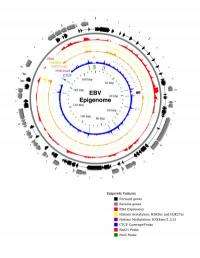
Researchers from The Wistar Institute and Memorial Sloan-Kettering Cancer Center (MSKCC) have teamed to publish the first annotated atlas of the Epstein-Barr virus genome, creating the most comprehensive study of how the viral genome interacts with its human host during a latent infection. Epstein-Barr virus (EBV), which is thought to be responsible for one percent of all human cancers, establishes a latent infection in nearly 100 percent of infected adult humans.
The atlas is designed to guide researchers toward new means of creating therapies against EBV-latent infection and the cancers associated with latent EBV infection, such as B cell lymphomas, gastric carcinomas, and nasopharyngeal carcinomas. The project provides the best look yet at how EBV interacts with the genes and proteins of its host cells.A representation of the annotated EBV "epigenome," listing the protein and chemical decorations added to the EBV DNA that get passed along to new copies of the EBV virus.
As a supplement to the EBV genome—the characterization of the virus's genes—the atlas describes the epigenome—all the protein and chemical decorations added to the EBV DNA that get passed along to new copies of the EBV virus–and the transcriptome—the catalog of all the RNA transcripts created from EBV DNA, which are either coded into protein or serve to regulate DNA directly. The researchers discovered numerous new points of interaction between viral DNA and its host, highlighting the extensive coevolution of the virus and pointing toward possible targets for future cancer and anti-viral drugs.
"Epstein-Barr is a human tumor virus associated with many carcinomas and lymphomas and how it is regulated is something we need to understand in detail," said Paul Lieberman, Ph.D., the McNeil Professor of Molecular Medicine and Translational Research and director of Wistar's Center for Chemical Biology and Translational Medicine. "The EBV atlas is an instructive guide for how to analyze an entire, intact genome."
The published report is available online now through the journal Cell Host & Microbe, and all of the raw and processed data that went into creating the atlas are freely available online through the Lieberman laboratory.
"EBV is parasitic organism, but it is a self-contained organism that needs to obey the general rules of regulation and dynamics if it is going to reproduce and survive," Lieberman said. "Everything is integrated in this one small genome, containing just 90 or so genes, but the elements that govern its survival apply to our genomes and those of many other organisms."
EBV infection occurs within epithelial cells of the throat, sinuses, and gut, but long-term residence occurs within long-lived memory B cells, the white blood cells of the immune system that remember pathogens and produce antibodies. Once inside cells, the viral DNA becomes, in effect, a minichromosome, thriving alongside human chromosomes and relying on the same gene reading and regulating mechanisms that human chromosomes use. As the virus sets up shop in the host cell, it can—if other conditions in the cell are permissive—cause the cell to become cancerous. Indeed, the atlas project confirms that the most "active" EBV genomes are often found in the most cancerous cell lines.
The EBV atlas describes over 60 human transcription factors—human proteins that bind to the EBV genome and control how viral genes are regulated—many of which were previously unknown to interact with EBV. One newly-identified factor, Pax5, is especially interesting, according to Lieberman, because it is a gene that's largely responsible for how B cells rearrange its chromosomes to develop new, unique antibodies.
The EBV atlas project was instigated by MSKCC's Aaron Arvey, Ph.D., while he was a doctoral student in the laboratory of study co-author Christina Leslie, Ph.D., a member of the Sloan-Kettering Institute's Computational Biology Program. While analyzing data for the Encyclopedia of DNA Elements (ENCODE) Consortium, a multi-institutional project of the National Human Genome Research Institute to build a comprehensive list of all the ways human cells interact with and regulate their genes, Arvey also collected data related to EBV, which maintains a stable infection in the cells he had studied..
At his urging, the Leslie lab began a collaboration with the Lieberman lab at Wistar, which has studied the virus and its relationship to cancer for over two decades. The project involved studying 700 sets of genetic data from over 50 separate lines of B cells infected with EBV. The Leslie lab took on the work of developing collecting the data, while the Lieberman lab conducted the experimental validation to back up their findings.
"The vast majority of data analyzed in the paper comes from large-scale next-generation sequencing experiments carried out by projects such as ENCODE and HapMap," said Leslie. "Our study depends critically on the unbiased nature of sequencing data—since we could detect transcription factor binding sites and histone modifications along the EBV genome as well as transcripts of viral origin from sequencing experiments in human cells—as well as the availability of large public data sets."
While not affiliated with ENCODE directly, the EBV atlas project benefited greatly from the data generated through the project. According to Leslie, the fact that they could derive such a detailed characterization of the EBV epigenome and transcriptome largely from public data underscores the value of these big data resources.
More information: Cell Host & Microbe, Volume 12, Issue 2, 233-245, 16 August 2012 doi: 10.1016/j.chom.2012.06.008


