Revealing the importance of culture in Latino dental health
August 9, 2012 By Kate Rauch in Dentistry
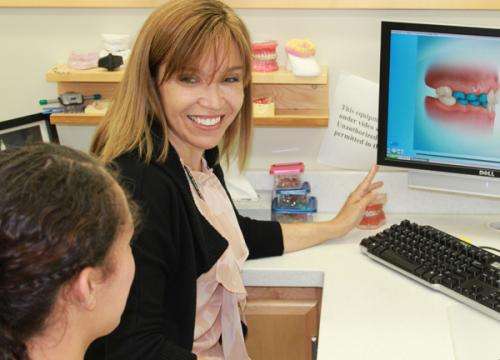
Maria Orellana, DDS, PhD, assistant professor in the UCSF School of Dentistry, is trying to understand what is preventing Latinos from getting the dental and orthodontic care other people are getting.
Maria Orellana, DDS, PhD, assistant professor in the UCSF School of Dentistry, has long observed that Latino parents are often more resistant to having their children get braces or retainers to straighten teeth than parents of other ethnicities. But beyond simply recognizing this trend, Orellana wants to know why.
Im trying to understand what is preventing Latinos from getting the dental and orthodontic care other people are getting. Is it mainly economical or something else? she says.
In a recent preliminary study, Orellana confirmed what she already suspected the importance of acculturation, or the process of becoming Americanized, on dental care.
A survey of 63 young Latinos between the ages of 8 and 17, and their parents, revealed that the more acculturated children and adults are, the greater importance they put on dental and orthodontic care.
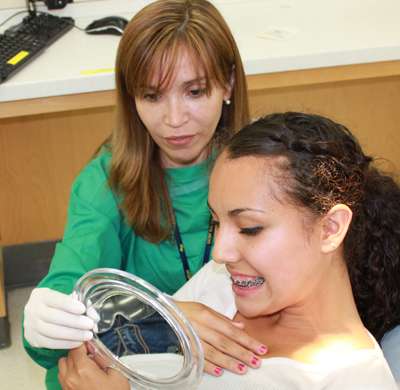
Here are kids that come into the clinic and they dont want to smile, she says. It affects their self-confidence. And perhaps not surprisingly, the more acculturated children were often at odds with their less acculturated parents, Orellana notes.
The survey, conducted at the UCSF clinic, asked about dental and orthodontic experiences and views, income, and the use of English, as a barometer of acculturation. Orellana compared responses between parents and their children, and compared levels of acculturation with dental experiences and attitudes. In seeking treatment, socioeconomic status played a role but acculturation also played a role, she says.
For help with the studys statistical analysis, Orellana turned to the Consultation Services program managed by UCSFs Clinical and Translational Science Institute (CTSI). Adept at conceptualizing research based on need and on running projects, Orellana says she needed assistance with the mathematical nitty-gritty of data analysis. Its great help to vet ideas with UCSF colleagues who are experienced in a field that Im not an expert in. Its a unique way of collaborating for practical results.
In fact, Orellana uses CTSIs Consultation Services to support much of her research, including work with statistics and study design, or simply to brainstorm. It helps me expedite studies so I can complete them and get them published, she says. Its helping a great deal in the work Im doing with Latino populations.
Her study highlights the need for cultural sensitivity in efforts to improve dental care among Latinos, says Orellana, who plans to expand the research. Its very important to relate not only to the teenagers, but also to the parents.
The parents, or caregivers, are part of the solution, because they are the decision-makers, Orellana adds. And for new-comers or the less acculturated, having Spanish-speaking providers who can educate immigrants about the importance of oral health is key.
More information: Recent preliminary study: iadr.confex.com/ia… r133708.html
Provided by
University of California, San Francisco
-
Helping kids describe cancer symptoms through cartoons and digital technology
Aug 09, 2012 |
not rated yet |
0
-
The kids are alright
May 26, 2011 |
not rated yet |
0
-
Unmet dental needs in Los Angeles children shown in study
May 09, 2011 |
not rated yet |
0
-
Eyes are windows to more than a child's soul
Sep 01, 2011 |
not rated yet |
0
-
Preschoolers tend to have negative perceptions of overweight children: Canadian study
Apr 02, 2012 |
not rated yet |
0
-
Motion perception revisited: High Phi effect challenges established motion perception assumptions
Apr 23, 2013 |
3 / 5 (2) |
2
-
Anything you can do I can do better: Neuromolecular foundations of the superiority illusion (Update)
Apr 02, 2013 |
4.5 / 5 (11) |
5
-
The visual system as economist: Neural resource allocation in visual adaptation
Mar 30, 2013 |
5 / 5 (2) |
9
-
Separate lives: Neuronal and organismal lifespans decoupled
Mar 27, 2013 |
4.9 / 5 (8) |
0
-
Sizing things up: The evolutionary neurobiology of scale invariance
Feb 28, 2013 |
4.8 / 5 (10) |
14
-
The idea behind a reverse shock
4 hours ago
-
Guass's Law for a charge distribution
4 hours ago
-
Noise dependence
4 hours ago
-
siphon and bernouli theorum
6 hours ago
-
Hot gas expansion rate into outer space
6 hours ago
-
Magnetic field lines through copper
11 hours ago
- More from Physics Forums - Classical Physics
More news stories
Primary care docs should play role in kids' dental health, experts say
(HealthDay)—When it comes to the care of your children's teeth, dentists aren't the only experts who can help.
Dentistry
May 21, 2013 |
not rated yet |
0
Guidelines issued to prevent infection with dental work
(HealthDay)—Practitioners might consider discontinuing prophylactic antibiotics for patients with prosthetic implants undergoing dental procedures, and these patients should be encouraged to maintain appropriate ...
Dentistry
May 14, 2013 |
not rated yet |
0
First analysis of dental therapists finds increase in access for children, low-income adults
A new report assessing the economic viability of services provided by practicing midlevel dental providers in the U.S. shows that they are expanding preventive dental care to people who need it most: children and those who ...
Dentistry
May 14, 2013 |
not rated yet |
0
Excessive soda can mimic illicit drug use effects on teeth
(HealthDay)—Manifestation of dental erosion caused by illicit drug use or excessive soda consumption needs to be distinguished from dental caries, according to case studies published in the March/April ...
Dentistry
May 13, 2013 |
5 / 5 (1) |
0
Common habits that harm your teeth
Are you wrecking your teeth without even knowing it? For instance, chewing on ice or opening stuff with your teeth may be convenient but using your teeth as tools can cause them to crack or chip.
Dentistry
May 03, 2013 |
3 / 5 (1) |
1
Seniors more likely to crash when driving with pet, study finds
(HealthDay)—Animals make great companions for senior citizens, but elderly people who always drive with a pet in the car are far more likely to crash than those who never drive with a pet, researchers have ...
First drug to improve heart failure mortality in over a decade
Coenzyme Q10 decreases all cause mortality by half, according to the results of a multicentre randomised double blind trial presented today at Heart Failure 2013 congress. It is the first drug to improve heart failure mortality ...
Heart failure accelerates male 'menopause'
Heart failure accelerates the aging process and brings on early andropausal syndrome (AS), according to research presented today at the Heart Failure Congress 2013. AS, also referred to as male 'menopause', was four times ...
Death highest in heart failure patients admitted in January, on Friday, and overnight
Mortality and length of stay are highest in heart failure patients admitted in January, on Friday, and overnight, according to research presented today at the Heart Failure Congress 2013. The analysis of nearly 1 million ...
Feds fight morning-after pill age ruling in NY
(AP)—Department of Justice lawyers have again asked a federal appeals court in New York to delay lifting age restrictions and prescription requirements on an emergency contraceptive popularly known as the morning-after ...
New immune system discovered
(Medical Xpress)—A research team, led by Jeremy Barr, a biology post-doctoral fellow, unveils a new immune system that protects humans and animals from infection.