A new starring role for astrocytes
August 10, 2012 in Medical research

A new starring role for astrocytes

Enlarge

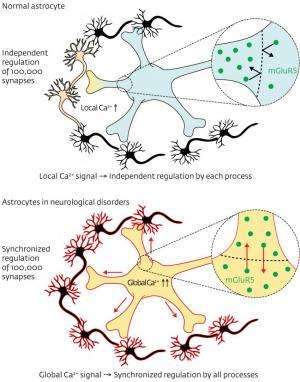
Figure 1: Healthy astrocytes send separate signals through each process, while astrocytes in neurological disorders send synchronous signals to their entire network. © 2012 Katsuhiko Mikoshiba, Misa Arizono and Hiroko Bannai, RIKEN Brain Science Institute

Astrocytes, previously thought of as helper cells for neurons, have recently been shown to send signals themselves. The signals are chemical not electrical and astrocytes send them to neurons, vascular cells and other astrocytes to improve the efficiency of synaptic signaling. A team led by Katsuhiko Mikoshiba and Hiroko Bannai at the RIKEN Brain Science Institute, Wako, have described the mechanism that allows astrocytes to signal each cell in their network individually.

Named for their star-like shape, have a central ‘soma’ and many ray-like arms connecting to the cells they regulate. Healthy astrocytes send separate Ca2+ signals through each ray, called a ‘process’. Signaling was known to be regulated by a receptor in the cellular membrane called the metabotropic glutamate receptor (mGluR5), but it was unclear how the signals were confined to individual processes. Understanding this specificity may be therapeutically important because in brains affected with Alzheimer’s disease or epilepsy astrocytes send global signals, more like a megaphone broadcast than the telephone calls made by healthy astrocytes (Fig. 1).

To understand how astrocyte signaling is regulated, the researchers tagged individual mGluR5 receptors with quantum dots—semiconductor nano-crystals that emit light when excited—then observed how the receptors migrated through the fluid membrane. Video footage revealed that receptors did not pass from the process to the soma. In normal astrocytes, the mGluR5-selective diffusion barrier could, by compartmentalization of Ca2+ signaling, allow each process to regulate its contacting partners independently.

To investigate the character of the barrier, Mikoshiba’s team attempted to undermine it. Over-expression of mGluR5 overwhelmed the barrier, which they infer is made of proteins that interact with the cytosolic portion of mGluR5. Each barrier protein pairs with a single mGluR5 molecule and prevents it from crossing to the soma. However, the number of barrier proteins is finite and an overabundance of mGluR5 leaves some receptors free to cross into the soma, thus enabling propagation of global signals through every process in the astrocyte.

Experimental models of Alzheimer’s disease and epilepsy have shown increased concentrations of mGlu5 in astrocytes. The researchers believe that understanding the molecular nature of the diffusion barrier will provide new targets for the treatment of these conditions. Once they reveal the molecular nature of the barrier, the team hopes to produce a transgenic mouse lacking the astrocytic barrier protein. “We are very curious to know the effect of global astrocytic Ca2+ signaling on the neuronal network and neuro-vascular coupling,” says Mikoshiba.

More information: Arizono, M., Bannai, H., Nakamura, K., Niwa, F., Enomoto, M., Matsu-ura, T., Miyamoto, A., Sherwood, M.W., Nakamura, T. & Mikoshiba, K. Receptor-selective diffusion barrier enhances sensitivity of astrocytic processes to metabotropic glutamate receptor stimulation. Science Signaling 5, ra27 (2012). stke.sciencemag.or… s;5/218/ra27

Journal reference: Science Signaling search and more info website

Provided by RIKEN search and more info website

not rated yet  

Rank not rated yet
Relevant PhysicsForums posts

More news stories

Computational tool translates complex data into simplified 2-dimensional images

In their quest to learn more about the variability of cells between and within tissues, biomedical scientists have devised tools capable of simultaneously measuring dozens of characteristics of individual ...

Medical research created 4 hours ago | popularity 5 / 5 (1) | comments 0 | with audio podcast

Now we know why old scizophrenia medicine works on antibiotics-resistant bacteria

In 2008 researchers from the University of Southern Denmark showed that the drug thioridazine, which has previously been used to treat schizophrenia, is also a powerful weapon against antibiotic-resistant bacteria such as ...

Medical research created May 17, 2013 | popularity 3.7 / 5 (3) | comments 0 | with audio podcast

SUMO wrestling cells reveal new protective mechanism target for stroke

Scientists investigating the interaction of a group of proteins in the brain responsible for protecting nerve cells from damage have identified a new target that could increase cell survival.

Medical research created May 17, 2013 | popularity 5 / 5 (1) | comments 0

How serotonin receptors can shape drug effects, from LSD to migraine medication

New findings by researchers carrying out experiments at the U.S. Department of Energy Office of Science's Advanced Photon Source (APS) help explain why some drugs that interact with two kinds of human serotonin ...

Medical research created May 17, 2013 | popularity 4 / 5 (1) | comments 0 | with audio podcast

Preventing blood poisoning

Peptide molecules derived from the body's natural immune system can help boost the body's defence against life-threatening blood poisoning, joint University research has uncovered.

Medical research created May 17, 2013 | popularity 4 / 5 (1) | comments 0 | with audio podcast


Researchers identify a potential new risk for sleep apnea: Asthma

Researchers at the University of Wisconsin have identified a potential new risk factor for obstructive sleep apnea: asthma. Using data from the National Institutes of Health (Heart, Lung, and Blood Institute)-funded Wisconsin ...

Study finds that sleep apnea and Alzheimer's are linked

A new study looking at sleep-disordered breathing (SDB) and markers for Alzheimer's disease (AD) risk in cerebrospinal fluid (CSF) and neuroimaging adds to the growing body of research linking the two.

'Gap' for HIV vaccine efforts after latest setback

The hunt for an HIV vaccine has gobbled up $8 billion in the past decade, and the failure of the most recent efficacy trial has delivered yet another setback to 26 years of efforts.

New theory on genesis of osteoarthritis comes with successful therapy in mice

Scientists at Johns Hopkins have turned their view of osteoarthritis (OA) inside out. Literally. Instead of seeing the painful degenerative disease as a problem primarily of the cartilage that cushions joints, ...

Alzheimer's leaves bilingual victims stranded in Canada

The devastating effect of Alzheimer's disease on bilingual people has been thrown into focus in Canada, where the sudden loss of a second language can leave sufferers feeling like strangers in their own country.

Ginger compounds may be effective in treating asthma symptoms

Gourmands and foodies everywhere have long recognized ginger as a great way to add a little peppery zing to both sweet and savory dishes; now, a study from researchers at Columbia University shows purified components of the ...