Study finds how stress, depression can shrink the brain
August 12, 2012 in Psychology & Psychiatry

Yale team discovers how stress and depression can shrink the brain

Enlarge

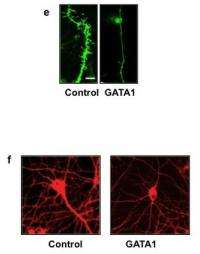
Expression of a single gene dramatically decreases synaptic connections between brain cells. Yale scientists believe this may explain why people suffering from chronic stress and depression suffer loss of brain volume. Courtesy Yale University

Major depression or chronic stress can cause the loss of brain volume, a condition that contributes to both emotional and cognitive impairment. Now a team of researchers led by Yale scientists has discovered one reason why this occurs — a single genetic switch that triggers loss of brain connections in humans and depression in animal models.

The findings, reported in the Aug. 12 issue of the journal Nature Medicine, show that the genetic switch known as a transcription factor represses the expression of several genes that are necessary for the formation of synaptic connections between brain cells, which in turn could contribute to loss of brain mass in the prefrontal cortex.

"We wanted to test the idea that stress causes a loss of brain synapses in humans," said senior author Ronald Duman, the Elizabeth Mears and House Jameson Professor of Psychiatry and professor of neurobiology and of pharmacology. "We show that circuits normally involved in emotion, as well as cognition, are disrupted when this single transcription factor is activated."

The research team analyzed tissue of depressed and non-depressed patients donated from a brain bank and looked for different patterns of gene activation. The brains of patients who had been depressed exhibited lower levels of expression in genes that are required for the function and structure of brain synapses. Lead author and postdoctoral researcher H.J. Kang discovered that at least five of these genes could be regulated by a single transcription factor called GATA1. When the transcription factor was activated, rodents exhibited depressive-like symptoms, suggesting GATA1 plays a role not only in the loss of connections between neurons but also in symptoms of depression.

Duman theorizes that genetic variations in GATA1 may one day help identify people at high risk for or sensitivity to stress.

"We hope that by enhancing synaptic connections, either with novel medications or behavioral therapy, we can develop more effective antidepressant therapies," Duman said.

Journal reference: Nature Medicine search and more info website

Provided by Yale University search and more info website

4.8 /5 (6 votes)  

Filter


Move the slider to adjust rank threshold, so that you can hide some of the comments.


Display comments: newest first

Sinister1811
Aug 13, 2012

Rank: 5 / 5 (1)
I've been suffering with depression for a while. And I've also had various types of cognitive issues lately, which is causing difficulty with simple daily tasks. Go figure.
Sinister1811
Aug 13, 2012

Rank: 5 / 5 (1)
Besides, this should be considered "old news". If there's anything I've learned from personal experience with depression, it's that it causes issues with concentration, thought and memory... Whichever way, I believe, there is a clear link between depression and cognitive processes.
DarkHorse66
Aug 13, 2012

Rank: 5 / 5 (1)
I think that the real question is now; WHY does the down regulation occur, with stress or depression? Is this a so-called survival/self-preservation mechanism? Or is it 'just' because of the neurotransmitter disregulation that occurs when depressed/stressed etc? I can empathise, I know how you feel. As for the 'issues' that you mention, I'm still dealing with a pretty severe version myself. My particular form of ADHD already gave me some problems in all of those domains. CFS made them MUCH worse. I'm still in a slow, unpredictable and protracted recovery phase, so every day can get 'interesting'. I never know when I've done something and not realised that I've done, or forgotten something as if it had never happened and I am talking about things that I did 2mins ago and was trying to keep track of. Yes even that can happen.
Best regards DH66 :)
Rank 4.8 /5 (6 votes)
Related Stories
Relevant PhysicsForums posts

More news stories

US psychiatry gets makeover in new manual

The latest makeover to a massive psychiatric tome honored by some, reviled by others and even called the "Bible" of mental disorders is being released Saturday with a host of new changes.

Psychology & Psychiatry created 3 hours ago | popularity not rated yet | comments 0

Study reviews readmissions in inpatient psychiatric facilities

(HealthDay)—Most Medicare beneficiaries treated in inpatient psychiatric facilities (IPFs) exhibit characteristics associated with hospital readmission, according to a report prepared for the National Association ...

Psychology & Psychiatry created May 17, 2013 | popularity not rated yet | comments 0

Skydiving is never plane sailing

Skydivers show the same level of physical stress before every jump whether a first-timer or experienced jumper, say Northumbria researchers.

Psychology & Psychiatry created May 17, 2013 | popularity not rated yet | comments 0 | with audio podcast

Kids, especially boys, perceive sadness of depressed parents

Children of depressed parents pick up on their parents' sadness—whether mom or dad realizes their mood or not.

Psychology & Psychiatry created May 17, 2013 | popularity 4.5 / 5 (2) | comments 1 | with audio podcast

One in five U.S. kids has a mental health disorder, CDC reports

(HealthDay)—As many as one in five American children under the age of 17 has a diagnosable mental disorder in a given year, according to a new federal report.

Psychology & Psychiatry created May 16, 2013 | popularity 2.2 / 5 (5) | comments 1 | with audio podcast


New research identifies risks, interventions for children's GI health

An increasing number of U.S. children are experiencing gastrointestinal issues that require interventions to resolve, according to research presented at Digestive Disease Week (DDW).

New case of SARS-like virus in Saudi: ministry

A new case of the deadly coronavirus has been detected in Saudi Arabia where 15 people have already died after contracting it, the health ministry announced on Saturday on its Internet website.

AIDS science at 30: 'Cure' now part of lexicon

Big names in medicine are set to give an upbeat assessment of the war on AIDS on Tuesday, 30 years after French researchers identified the virus that causes the disease.

For combat veterans suffering from post-traumatic stress disorder, 'fear circuitry' in the brain never rests

Chronic trauma can inflict lasting damage to brain regions associated with fear and anxiety. Previous imaging studies of people with post-traumatic stress disorder, or PTSD, have shown that these brain regions can over-or ...

New colonoscope provides ground-breaking view of colon

A ground-breaking advance in colonoscopy technology signals the future of colorectal care, according to research presented today at Digestive Disease Week(DDW). Additional research focuses on optimizing the minimal withdrawal ...

Now we know why old scizophrenia medicine works on antibiotics-resistant bacteria

In 2008 researchers from the University of Southern Denmark showed that the drug thioridazine, which has previously been used to treat schizophrenia, is also a powerful weapon against antibiotic-resistant bacteria such as ...