Teens who smoke and drink may be more likely to abuse prescription opioids later
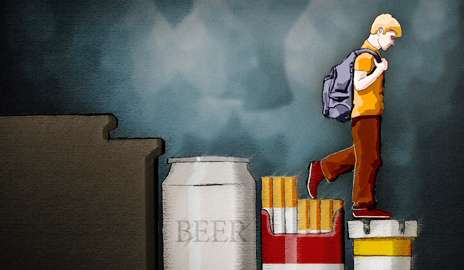
Illustration by Michael Helfenbein
(Medical Xpress) -- Adolescents who smoke cigarettes or use alcohol or marijuana may be at greater risk for subsequent abuse of prescription opioids as young adults, according to a new study by Yale School of Medicine.
The researchers believe their findings are the first to demonstrate that early alcohol, cigarette, and marijuana use are all associated, to varying degrees, with a two- to-three times greater likelihood of subsequent abuse of prescription opioids. The study appears online in the Journal of Adolescent Health.
The researchers set out to determine whether certain tenets of the so-called gateway hypothesis applied to subsequent abuse of prescription opioids specifically, whether substance use in the adolescent years was associated with later abuse of harder drugs. They studied demographic and clinic data collected from 18- to 25-year-olds from the 2006-2008 National Survey on Drug Use and Health to determine the likelihood, based on their prior usage.
Their findings included:
- 12% of the survey population of 18- to 25-year-olds reported current abuse of prescription opioids.
- For this population, prevalence of previous substance use was 57% for alcohol, 56% for cigarettes, and 34% for marijuana.
- In young men, previous abuse of all three substances was associated with an increased likelihood of subsequent opioid abuse during young adulthood, but only previous marijuana use carried this association among young women.
Journal reference:
Journal of Adolescent Health
Provided by
Yale University
-
Opioid abuse linked to mood and anxiety disorders
Dec 13, 2011 |
not rated yet |
0
-
White and Hispanic teens more likely to abuse drugs than African-Americans
Nov 07, 2011 |
not rated yet |
0
-
Illicit Canadian opioid use exceeds heroin
Nov 21, 2006 |
not rated yet |
0
-
Adolescents and young adults with mental health disorders at risk of long-term opioid use
Jun 06, 2012 |
not rated yet |
0
-
Friends and family enable most opioid abusers
Jun 15, 2011 |
not rated yet |
0
-
Motion perception revisited: High Phi effect challenges established motion perception assumptions
Apr 23, 2013 |
3 / 5 (2) |
2
-
Anything you can do I can do better: Neuromolecular foundations of the superiority illusion (Update)
Apr 02, 2013 |
4.5 / 5 (11) |
5
-
The visual system as economist: Neural resource allocation in visual adaptation
Mar 30, 2013 |
5 / 5 (2) |
9
-
Separate lives: Neuronal and organismal lifespans decoupled
Mar 27, 2013 |
4.9 / 5 (8) |
0
-
Sizing things up: The evolutionary neurobiology of scale invariance
Feb 28, 2013 |
4.8 / 5 (10) |
14
-
Relating physics forces and entropy
5 hours ago
-
Force Between Two Concentric Solenoids
9 hours ago
-
Synchrotron, question about insertion devices and electron velocity
9 hours ago
-
Equating differentials => equating coefficients
10 hours ago
-
The idea behind a reverse shock
16 hours ago
-
Guass's Law for a charge distribution
16 hours ago
- More from Physics Forums - Classical Physics
More news stories
Beer-industry advertising guidelines: Rating panels may help industry assess itself
In order to avoid exposing vulnerable groups such as children and young adults to alcohol advertising, industry groups have developed their own self-regulation guidelines. However, these guidelines have been criticized for ...
Addiction
May 17, 2013 |
not rated yet |
0
College women exceed NIAAA drinking guidelines more frequently than college men
In order to avoid harms associated with alcohol consumption, in 2009 the National Institute on Alcohol Abuse and Alcoholism issued guidelines that define low-risk drinking. These guidelines differ for men and women: no more ...
Addiction
May 17, 2013 |
not rated yet |
0
|
Individuals who drink heavily and smoke may show 'early aging' of the brain
Treatment for alcohol use disorders works best if the patient actively understands and incorporates the interventions provided in the clinic. Multiple factors can influence both the type and degree of neurocognitive abnormalities ...
Addiction
May 17, 2013 |
not rated yet |
0
|
Researchers analyze how Spanish smoking relapse booklets are distributed
Researchers from Moffitt Cancer Center and the University of South Florida have evaluated how Florida health care and social service agencies distribute "Libres para Siempre", a Spanish smoking relapse prevention booklet ...
Addiction
May 17, 2013 |
not rated yet |
0
No significant change seen in overall smokeless tobacco use among US youths
Tobacco use remains the leading preventable cause of death and disease in the United States. Declines in smoking among youths were observed from the late 1990s. "However, limited information exists on trends in smokeless ...
Addiction
May 14, 2013 |
not rated yet |
0
First drug to improve heart failure mortality in over a decade
Coenzyme Q10 decreases all cause mortality by half, according to the results of a multicentre randomised double blind trial presented today at Heart Failure 2013 congress. It is the first drug to improve heart failure mortality ...
Heart failure accelerates male 'menopause'
Heart failure accelerates the aging process and brings on early andropausal syndrome (AS), according to research presented today at the Heart Failure Congress 2013. AS, also referred to as male 'menopause', was four times ...
Seniors more likely to crash when driving with pet, study finds
(HealthDay)—Animals make great companions for senior citizens, but elderly people who always drive with a pet in the car are far more likely to crash than those who never drive with a pet, researchers have ...
New immune system discovered
(Medical Xpress)—A research team, led by Jeremy Barr, a biology post-doctoral fellow, unveils a new immune system that protects humans and animals from infection.
Brain can be trained in compassion, study shows
Until now, little was scientifically known about the human potential to cultivate compassion—the emotional state of caring for people who are suffering in a way that motivates altruistic behavior.
Do salamanders hold the solution to regeneration?
Salamanders' immune systems are key to their remarkable ability to regrow limbs, and could also underpin their ability to regenerate spinal cords, brain tissue and even parts of their hearts, scientists have ...