UK man who failed to overturn euthanasia law dies
August 22, 2012 by MARIA CHENG in Other

UK man who failed to overturn euthanasia law dies

Enlarge

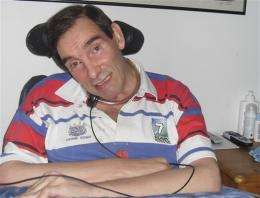
In this family photo released in Jan. 2012 by Tony and Jane Nicklinson, former corporate manager, rugby player, skydiving sports enthusiast Tony Nicklinson sits at his home in Wiltshire, England, where following a stroke he suffers from locked-in syndrome. The High Court in London has rejected an attempt by Tony Nicklinson suffering from locked-in syndrome to overturn Britain’s euthanasia law by refusing to legally allow doctors to end his life. (AP Photo/Tony and Jane Nicklinson)

(AP) — Tony Nicklinson, paralyzed and unable to speak, found life so unbearable he wanted to die. On Wednesday, the 58-year-old Briton got his wish.

His family said he died of pneumonia at home.

In January, Nicklinson asked the High Court to declare that any doctor who killed him with his consent would not be charged with murder. Last week, the court rejected his request, a decision that Nicklinson said had left him "devastated and heartbroken."

Nicklinson was a former corporate manager and rugby player who suffered a stroke in 2005 that left him with locked-in syndrome. He was unable to speak or move below his neck and required constant care. Nicklinson communicated mostly by blinking, although his mind had remained unaffected and his condition was not terminal.

Nicklinson had argued that British law violated his right to "private and family life" as guaranteed by the European Convention on Human Rights, on the ground that being able to choose how to die is a matter of personal autonomy. He had previously described his life as "a living nightmare."

One of his daughters said on Twitter that before he died, Nicklinson had asked them to tweet "Goodbye world the time has come, I had some fun."

Police said they would not be investigating Nicklinson's death. "We can confirm he passed away," a police spokesman said on customary condition of anonymity. "His death certificate has been signed by a doctor, so it is not a matter for Wiltshire Police or the coroner."

Saimo Chahal, Nicklinson's lawyer, said his health had deteriorated over the week-end after he caught pneumonia. Nicklinson had legal documents drawn up in 2004 to refuse any life-saving treatment. He had also been refusing food since last week.

Nicklinson had said that even if he were granted the right to die, he would not want to be killed immediately, but just wanted to know that the option existed.

Experts weren't sure what impact, if any, his death might have on the ongoing euthanasia debate in Britain.

Penney Lewis, a law professor at King's College London, said previous deaths of euthanasia advocates didn't have any effect on changing laws to allow the practice.

"The evidence seems to be that parliaments are not galvanized into action by the deaths of those who have been fighting for (euthanasia) legalization," she said in an email. Nicklinson "was so distressed by the High Court decision, it is sad to think he died while still absorbing that."

In Europe, only Belgium, Luxembourg and the Netherlands allow . Switzerland allows assisted suicide and is the only country that helps foreigners die at a clinic near Zurich.

Copyright 2012 The Associated Press. All rights reserved. This material may not be published, broadcast, rewritten or redistributed.

not rated yet  

Rank not rated yet
Tags

Related Stories
Relevant PhysicsForums posts

More news stories

Survey points out deficiencies in addictions training for medical residents

A 2012 survey of internal medicine residents at Massachusetts General Hospital (MGH) – one of the nation's leading teaching hospitals – found that more than half rated the training they had received in addiction and other ...

Other created 14 hours ago | popularity not rated yet | comments 0

Early use of tracheostomy for mechanically ventilated patients not associated with improved survival

For critically ill patients receiving mechanical ventilation, early tracheostomy (within the first 4 days after admission) was not associated with an improvement in the risk of death within 30 days compared to patients who ...

Other created May 21, 2013 | popularity not rated yet | comments 0

Decisions to forgo life support may depend heavily on the ICU where patients are treated

The decision to limit life support in patients in the intensive care unit (ICU) appears to be significantly influenced by physician practices and/or the culture of the hospital, suggests new findings from researchers at the ...

Other created May 21, 2013 | popularity not rated yet | comments 0

People on higher incomes are happier with new knees

Knee replacement surgery is a very common procedure. However, it does not always resolve function or pain in all the recipients of new knees. A study by Robert Barrack, MD and his colleagues from the Washington University ...

Other created May 21, 2013 | popularity not rated yet | comments 0

New search engine finds rare diagnoses

Doctors are trained to think "common disease" when they meet patients in their practices, and as they rarely or never meet a rare disease, it often takes many years to reach the right diagnosis. A new search tool called FindZebra ...

Other created May 21, 2013 | popularity not rated yet | comments 0


Slowing the aging process—only with antibiotics

Swiss scientists reveal the mechanism responsible for aging hidden deep within mitochondria—and dramatically slow it down in worms by administering antibiotics to the young.

Researchers complete largest genetic sequencing study of human disease

Researchers from Queen Mary, University of London have led the largest sequencing study of human disease to date, investigating the genetic basis of six autoimmune diseases.

Brain can be trained in compassion, study shows

Until now, little was scientifically known about the human potential to cultivate compassion—the emotional state of caring for people who are suffering in a way that motivates altruistic behavior.

Having both migraines, depression may mean smaller brain

(HealthDay)—Migraines and depression can each cause a great deal of suffering, but new research indicates the combination of the two may be linked to something else entirely—a smaller brain.

Rate of bicycle-related fatalities significantly lower in states with helmet laws

Existing research shows that bicyclists who wear helmets have an 88 percent lower risk of brain injury, but researchers at Boston Children's Hospital found that simply having bicycle helmet laws in place showed a 20 percent ...

Novel approach for influenza vaccination shows promise in early animal testing

A new approach for immunizing against influenza elicited a more potent immune response and broader protection than the currently licensed seasonal influenza vaccines when tested in mice and ferrets. The vaccine ...