Researchers help uncover how infants learn word meanings
August 1, 2012 in Psychology & Psychiatry
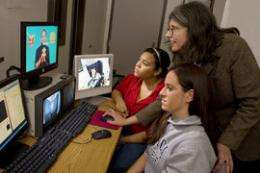
Nancy Rader and students
Research conducted in the Cognition Laboratory at Ithaca College is helping those who study child development gain a better understanding of how children learn the meanings of words. The researchers found that if a person holding an object while talking makes hand gestures that move the object in rhythm with speech, an infants attention will be drawn away from the speakers mouth and to the object.
The gestures help unstick the childs attention from the speakers mouth where the sound is coming from and direct it to the thing being held, said Nancy Rader, professor of psychology in the Ithaca College School of Humanities and Sciences.
Rader and her coauthor, Patricia Zukow-Goldring of UCLA, recently published their research in the journal Language Sciences. It was funded by a grant from the National Science Foundation and with support from Ithaca College. Rader and a team of undergraduate psychology students used eye-tracking cameras and software to follow an infants gaze as a speaker on videotape gestured and talked while holding a toy. Infants in the study were 9-14 months of age.
Previous research at the Ithaca College lab established that infants at this age will focus on the mouth of a speaker, an important aspect in learning the sounds of a language. What Rader and her colleagues have found in this new research is that the speakers gestures function to redirect the infants gaze from the mouth to the object as the word for the object is uttered. By bringing sight and sound together, this shift in attention helps infants associate a word-sound with an object, a basic challenge of early-language learning.
By understanding the early development pathways to language learning, we can also gain a better understanding of what goes wrong with some children, such as those with Autism Spectrum Disorders and other developmental disabilities involving early language problems.
The research results have also been published in the book Gesture and Multimodal Development.
Located within the Department of Psychology, the Cognition Laboratory is used for research that is designed to help us understand more about such topics as perception, language, problem solving and emotion. Under Raders supervision, undergraduate psychology majors gain valuable experience working with children and families as well as a greater appreciation and knowledge of the nature of research.
Provided by
Ithaca College
-
'Motherese' important for children's language development
May 06, 2011 |
not rated yet |
0
-
Babies raised in bilingual homes learn new words differently than infants learning one language
Sep 28, 2007 |
not rated yet |
0
-
Earlier autism diagnosis could mean earlier interventions
Oct 13, 2011 |
not rated yet |
0
-
It’s official: Learning languages makes you smarter
Oct 06, 2011 |
not rated yet |
0
-
Unconscious language learning
Nov 04, 2011 |
not rated yet |
0
-
Motion perception revisited: High Phi effect challenges established motion perception assumptions
Apr 23, 2013 |
3 / 5 (2) |
2
-
Anything you can do I can do better: Neuromolecular foundations of the superiority illusion (Update)
Apr 02, 2013 |
4.5 / 5 (11) |
5
-
The visual system as economist: Neural resource allocation in visual adaptation
Mar 30, 2013 |
5 / 5 (2) |
9
-
Separate lives: Neuronal and organismal lifespans decoupled
Mar 27, 2013 |
4.9 / 5 (8) |
0
-
Sizing things up: The evolutionary neurobiology of scale invariance
Feb 28, 2013 |
4.8 / 5 (10) |
14
-
Why is zone 1 in liver more prone to ischemic injury?
May 23, 2013
-
How can there be villous adenoma in colon, if there are no villi there
May 22, 2013
-
How can there be a term called "intestinal metaplasia" of stomach
May 21, 2013
-
Pressure-volume curve: Elastic Recoil Pressure don't make sense
May 18, 2013
-
If you became brain-dead, would you want them to pull the plug?
May 17, 2013
-
MRI bill question
May 15, 2013
- More from Physics Forums - Medical Sciences
More news stories
Are there atheists in foxholes? Study says they're the minority
Ernie Pyle – an iconic war correspondent in World War II – reportedly said "There are no atheists in foxholes." A new joint study between two brothers at Cornell and Virginia Wesleyan found that only ...
Psychology & Psychiatry
1 hour ago |
not rated yet |
0
Breathing exercises help veterans find peace after war, scholar says
(Medical Xpress)—Research by Stanford scholar Emma Seppala at the Center for Compassion and Altruism Research and Education found that post-traumatic stress disorder decreased in veterans who participated ...
Psychology & Psychiatry
1 hour ago |
not rated yet |
0
Depression raises diabetics' risk of severe low blood sugar episodes
(Medical Xpress)—Patients with diabetes who are depressed are much more likely to develop episodes of dangerously low blood sugars, or hypoglycemia, than are those who are not depressed, a new study has ...
Psychology & Psychiatry
2 hours ago |
not rated yet |
0
|
Motion quotient: IQ predicted by ability to filter motion (w/ video)
A brief visual task can predict IQ, according to a new study. This surprisingly simple exercise measures the brain's unconscious ability to filter out visual movement. The study shows that individuals whose ...
Psychology & Psychiatry
22 hours ago |
4.5 / 5 (10) |
1
|
Anxious men fare worse during job interviews, study finds
Nervous about that upcoming job interview? You might want to take steps to reduce your jitters, especially if you are a man.
Psychology & Psychiatry
23 hours ago |
5 / 5 (1) |
0
Saudi to send animal samples to US in coronavirus probe
Saudi Arabia said Friday it would send samples taken from animals possibly infected with a deadly SARS-like virus to the United States for testing in a bid to find the source of disease.
Engineered cytomegalovirus protects monkeys from HIV equivalent
(Medical Xpress)—A new study by researchers in the US has shown that an ancient virus can be modified to help in the fight against the simian immunodeficiency virus SIV, which is the equivalent in monkeys ...
New neuron formation could increase capacity for new learning, at the expense of old memories
New research presented today shows that formation of new neurons in the hippocampus - a brain region known for its importance in learning and remembering - could cause forgetting of old memories by causing a reorganization ...
Scientists put bowel cancer under the microscope
Researchers from London's Kingston University have begun a two-year study which could help prolong the lives of people with colorectal tumours.
Help at hand for people with schizophrenia
How can healthy people who hear voices help schizophrenics? Finding the answer for this is at the centre of research conducted at the University of Bergen.
Do doctors understand the individualisation of treatments?
The individualisation of drug treatments to support patients to self-manage their conditions is a concept that sits at the heart of policy, but a recent study in BMJ Open shows that there is no concrete defini ...