WMS issues important new practice guidelines for prevention and treatment of lightning injuries
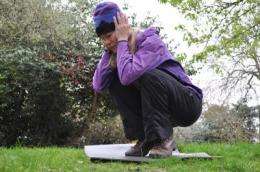
This is a strategy of last resort, as it is a difficult position to maintain for a long period of time. It should not be relied on as primary prevention but may reduce the risk of injury from an imminent lightning strike. Credit: Chris Davis, MD
About 24,000 people are killed by lightning every year, with about 10 times as many people injured. The Wilderness Medical Society has issued important new practice guidelines for precautions that can lower the likelihood of being killed or injured and recommendations for effective medical treatments post-strike. These guidelines appear in the September issue of Wilderness & Environmental Medicine.
Updating the 2006 guidelines, a panel of experts chosen for their clinical or research experience convened at the 2011 Annual Meeting of the Wilderness Medical Society in Snowmass, CO. Their task was to develop evidence-based practice guidelines for the prevention and treatment of lightning injuries to guide clinicians and disseminate knowledge about best practices.
"With some basic prevention strategies and common sense the vast majority of lightning injuries can be prevented," commented Chris Davis, MD, Wilderness Fellow and Clinical Instructor, University of Colorado Hospital, Department of Emergency Medicine, Aurora, CO.
Lightning-related deaths in the United States have declined consistently over the last 50 years to approximately 40 per year. More than 80% of victims are male and most deaths occur in individuals between 20 and 45 years of age. The prevention strategies outlined in these guidelines have the potential to reduce these fatalities and injuries further.
Using the American College of Chest Physicians classification scheme for the quality of evidence and recommendations, the panel identified 5 stronger and 2 weaker recommendations concerning prevention strategies. These include taking shelter when thunder is heard and avoiding bodies of water during lightning events.
The mechanism of sudden death from lightning strike is simultaneous cardiac and respiratory arrest. In many victims, despite return of spontaneous circulation (ROSC), a second cardiac arrest may occur if ventilation is not supported. This highlights the need for a "reverse triage" system for lightning strike victims where priority is initially given to those individuals without vital signs or spontaneous respirations. This and 17 other strategies for the treatment of injuries are included in the guidelines.
The panel concludes that "This article provides a summary of available evidence for the prevention and treatment of lightning injury. Most available data are based on small, retrospective case reports or series because the prospective study of lightning injuries is not logistically and ethically possible. Although the strength of the overall evidence is limited, the authors believe that many recommendations can be strongly supported as there is little risk of associated harm."
More information: "Wilderness Medical Society Practice Guidelines for the Prevention and Treatment of Lightning Injuries" by Chris Davis, MD; Anna Engeln, MD; Eric Johnson, MD; Scott E. McIntosh, MD, MPH; Ken Zafren, MD; Arthur A. Islas, MD, MPH; Christopher McStay, MD; William 'Will' R. Smith, MD; and Tracy Cushing, MD, MPH. It appears in Wilderness & Environmental Medicine, Volume 23, Issue 3 (September 2012) published by Elsevier. As a service to the medical community the article is freely available at www.wemjournal.org… 0-9/fulltext
Provided by
Elsevier
-
Where Lightning Strikes More Than Twice
Jun 21, 2010 |
not rated yet |
0
-
WMS issues important new practice guidelines for frostbite prevention and treatment
Jun 15, 2011 |
not rated yet |
0
-
New harmonized cardiovascular treatment guidelines make heart disease treatment easier
Sep 12, 2011 |
not rated yet |
0
-
Ball lightning may sometimes be explained as hallucinations
May 13, 2010 |
not rated yet |
0
-
Lightning strikes far more men than women, statistics show
Jun 30, 2011 |
not rated yet |
0
-
Motion perception revisited: High Phi effect challenges established motion perception assumptions
Apr 23, 2013 |
3 / 5 (2) |
2
-
Anything you can do I can do better: Neuromolecular foundations of the superiority illusion (Update)
Apr 02, 2013 |
4.5 / 5 (11) |
5
-
The visual system as economist: Neural resource allocation in visual adaptation
Mar 30, 2013 |
5 / 5 (2) |
9
-
Separate lives: Neuronal and organismal lifespans decoupled
Mar 27, 2013 |
4.9 / 5 (8) |
0
-
Sizing things up: The evolutionary neurobiology of scale invariance
Feb 28, 2013 |
4.8 / 5 (10) |
14
-
Classical and Quantum Mechanics via Lie algebras
Apr 15, 2011
- More from Physics Forums - Independent Research
More news stories
Free distribution of auditory orientation training system for the visually impaired
Researchers from the National Institute of Advanced Industrial Science and Technology (AIST), and the Research Institute of Electrical Communication (RIEC) of Tohoku University have jointly developed an auditory ...
Other
24 minutes ago |
not rated yet |
0
Vermont becomes third US state to legalize assisted suicide
Vermont became on Monday the third US state to legalize physician-assisted suicide.
Other
15 hours ago |
not rated yet |
0
Food laboratory accuracy remains a concern
Food microbiology laboratories continue to submit false negative results and false positive results on a routine basis. A retrospective study of nearly 40,000 proficiency test results over the past 14 years, presented today ...
Other
20 hours ago |
not rated yet |
0
Wireless ultrasound transducers help physicians
Siemens has presented the world's first ultrasound system with wireless transducers. The system's transducers, which can be easily operated with one hand, transmit ultrasound images via radio waves to the ...
Other
May 20, 2013 |
not rated yet |
0
Flesh-eating disease victim gets prosthetic hands
(AP)—A woman who lost both hands, her left leg and right foot after contracting a flesh-eating disease has been fitted with prosthetic hands.
Other
May 18, 2013 |
not rated yet |
0
Study shows where scene context happens in our brain
In a remote fishing community in Venezuela, a lone fisherman sits on a cliff overlooking the southern Caribbean Sea. This man –– the lookout –– is responsible for directing his comrades on the water, ...
Monoclonal antibody appears effective and safe in asthma Phase IIa trial
A novel approach to obstructing the runaway inflammatory response implicated in some types of asthma has shown promise in a Phase IIa clinical trial, according to U. S. researchers.
New rice contamination reported in China
Authorities are investigating rice mills in southern China following tests that found almost half of the staple grain in one of the country's largest cities was contaminated with a toxic metal.
New tumour-killer shows great promise in suppressing cancers
Scientists from Nanyang Technological University (NTU) and Lund University, Sweden, have bioengineered a novel molecule which has been proven to successfully kill tumour cells.
Analgesics prescribed more heavily to women than to men, study finds
Regardless of pain, social class or age, a woman is more likely to be prescribed pain-relieving drugs. A study published in Gaceta Sanitaria (Spanish health scientific journal) affirms that this phenomenon is inf ...
New factor to control oncogene-induced senescence
An article published on the journal Nature describes the major role that Pyruvate dehydrogenase (PDH) —an enzyme of cellular energy metabolism— plays in the regulation of the cellular senescence induce ...