First aid training for primary students has long-term benefits
September 5, 2012 in Other

First aid training for primary students has long-term benefits

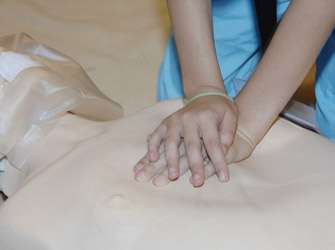
"When children are given professional first aid training at primary school, the benefits can be felt long term. That's why training in the early years is so incredibly important," says Fritz Sterz from the University Department of Emergency Medicine at the MedUni Vienna as pupils start school this week. The results of a recent study by Katrin Steiner from the MedUni Vienna, who is writing her thesis, also highlight this fact. The anaesthetist and emergency medicine physician has demonstrated that primary school children who are given first aid training in the first to fourth grades of school score highly when it comes to using a defibrillator or performing chest compressions.

The study centres around a class of 25 school from Vienna's 16th district. In , the children were given a professional first aid lesson as part of a project organised by Thomas Uray from the University Department of Emergency Medicine which involved practical exercises, video clips and . After it, 47.8 per cent of the children were able to execute an emergency call perfectly, 56.6 per cent were able to operate the correctly and 28.6 per cent were able to perform chest compressions appropriately.

The class has now undergone further training and testing in fourth grade by a team led by Katrin Steiner from the MedUni Vienna. "The children were able to remember the practical, hands-on actions very well and tackled the problems in a very motivated way without any inhibitions. Only the theory side of things had slipped a little in their memories," explains Steiner. Three years later, 100 per cent of the children were able to operate the defibrillator correctly after a refresher course, 95 per cent made the emergency call clearly and understandably, while 72.2 per cent were able to perform chest compressions correctly.

Parents learn from their children

"The results clearly speak in favour of first aid training at primary school," says Steiner. In Austria, this training is not currently on the curriculum - unlike countries such as Canada, the Czech Republic or Norway, for example. Just two to three hours of training per academic year are enough to perfectly prepare children for these types of emergency. The added bonus is that "parents learn from their children and benefit from their lower inhibitory threshold for providing first aid," says Steiner.

First aid courses for children are currently provided by the Austrian Red Cross Youth, the Samaritans and as part of the Children's University programme at the MedUni, which is held every year during the summer holidays.

One third can be saved

A recent study by the MedUni Vienna has shown that someone who is given cardiac massage by a first aider straight after a cardiac arrest has a 70% higher chance of survival. "Unfortunately, there is often no first aider on hand, or people are afraid of doing something wrong during resuscitation. never do any harm, unlike doing nothing," says Fritz Sterz from the University Department of at the MedUni Vienna. In Vienna alone, around 3,000 people die every year from cardiac arrest.

Provided by Medical University of Vienna search and more info website

4 /5 (1 vote)  

Rank 4 /5 (1 vote)
Relevant PhysicsForums posts

More news stories

Early use of tracheostomy for mechanically ventilated patients not associated with improved survival

For critically ill patients receiving mechanical ventilation, early tracheostomy (within the first 4 days after admission) was not associated with an improvement in the risk of death within 30 days compared to patients who ...

Other created 14 hours ago | popularity not rated yet | comments 0

Decisions to forgo life support may depend heavily on the ICU where patients are treated

The decision to limit life support in patients in the intensive care unit (ICU) appears to be significantly influenced by physician practices and/or the culture of the hospital, suggests new findings from researchers at the ...

Other created 16 hours ago | popularity not rated yet | comments 0

People on higher incomes are happier with new knees

Knee replacement surgery is a very common procedure. However, it does not always resolve function or pain in all the recipients of new knees. A study by Robert Barrack, MD and his colleagues from the Washington University ...

Other created 18 hours ago | popularity not rated yet | comments 0

New search engine finds rare diagnoses

Doctors are trained to think "common disease" when they meet patients in their practices, and as they rarely or never meet a rare disease, it often takes many years to reach the right diagnosis. A new search tool called FindZebra ...

Other created 19 hours ago | popularity not rated yet | comments 0

Delayed transfer to the ICU increases risk of death in hospital patients

Delayed transfer to the intensive care unit (ICU) in hospitalized patients significantly increases the risk of dying in the hospital, according to a new study from researchers in Chicago.

Other created 20 hours ago | popularity not rated yet | comments 0


Study says empathy plays a key role in moral judgments

Is it permissible to harm one to save many? Those who tend to say "yes" when faced with this classic dilemma are likely to be deficient in a specific kind of empathy, according to a report published in the scientific journal ...

Phthalates: Study links chemicals widely found in plastics, processed food to elevated blood pressure in children, teens

Plastic additives known as phthalates (pronounced THAL-ates) are odorless, colorless and just about everywhere: They turn up in flooring, plastic cups, beach balls, plastic wrap, intravenous tubing and—according to the ...

If you can remember it, you can remember it wrong

(Medical Xpress)—Native peoples in regions where cameras are uncommon sometimes react with caution when their picture is taken. The fear that something must have been stolen from them to create the photo ...

B vitamins could delay dementia

(Medical Xpress)—Despite spending billions of dollars on research and development, drug companies have been unable to come up with effective treatments for dementia and Alzheimer's Disease (AD). Now, A. ...

Insight into the dazzling impact of insulin in cells

Australian scientists have charted the path of insulin action in cells in precise detail like never before. This provides a comprehensive blueprint for understanding what goes wrong in diabetes.

Reducing caloric intake delays nerve cell loss

Activating an enzyme known to play a role in the anti-aging benefits of calorie restriction delays the loss of brain cells and preserves cognitive function in mice, according to a study published in the May ...