Bizarre tumor case may lead to custom cancer care
It's a medical nightmare: a 24-year-old man endures 350 surgeries since childhood to remove growths that keep coming back in his throat and have spread to his lungs, threatening his life. Now doctors have found a way to help him by way of a scientific coup that holds promise for millions of cancer patients.
The bizarre case is the first use in a patient of a new discovery: how to keep ordinary and cancerous cells alive indefinitely in the lab.
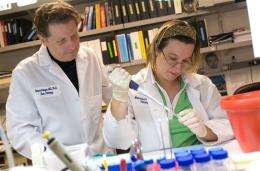
The discovery allows doctors to grow "mini tumors" from each patient's cancer in a lab dish, then test various drugs or combinations on them to see which works best. It takes only a few cells from a biopsy and less than two weeks to do, with materials and methods common in most hospitals.
Although the approach needs much more testing against many different types of cancer, researchers think it could offer a cheap, simple way to personalize treatment without having to analyze each patient's genes.
"We see a lot of potential for it," said one study leader, Dr. Richard Schlegel, pathology chief at Georgetown Lombardi Comprehensive Cancer Center in Washington. "Almost everyone could do it easily."
An independent expert agreed.
For infections, it's routine to grow bacteria from a patient in lab dishes to see which antibiotics work best, Dr. George Q. Daley of Children's Hospital Boston and the Harvard Stem Cell Institute said in an email. "But this has never been possible with cancer cells because they don't easily grow in culture," he said.
The new technique may reveal in advance whether a person would be helped by a specific chemotherapy, without risking side effects and lost time if the drug doesn't work. "Pretty nifty," Daley wrote.
In the case of the 24-year-old, described in Thursday's New England Journal of Medicine, lab-dish tests suggested that a drug used to treat a type of blood cancer and some other unrelated conditions might help.
It's not a drug that doctors would have thought to try, because the man technically does not have cancer. But his lung tumor shrank after a few months of treatment, and he has been stable for more than a year. He still has to have operations to remove throat growths that keep coming back, but only about once every five months.
The man, an information technology specialist in suburban Washington who asked to remain anonymous to protect his privacy, has recurrent respiratory papillomatosis, or RRP. It's usually due to infection at birth with certain types of a virus, HPV, that causes genital warts.
The condition causes wartlike growths in the throat, usually around the voice box. These growths usually are noncancerous but can turn malignant, and even benign ones can prove fatal if they spread to the lungs. The main treatment is surgery, usually with lasers to vaporize the growths and keep them from choking off the airway or making it tough to talk.
About 10,000 or more people in the U.S. have the disease, said Jennifer Woo, president of the RRP Foundation. Woo, 29, is a medical student at Georgetown and one of the researchers on the study. She also has the condition but said it is confined to her throat and has required only about 20 surgeries so far.
The man in the study has a much more serious case.
"I was diagnosed when I was 3 or 4. At first, I had to have surgery every 7 to 10 days," the man said in a phone interview. "I get short of breath and my voice will get more hoarse."
Two years ago, the growths to his lungs became extensive and life-threatening, and his physician, Dr. Scott Myers, described the condition at a meeting of Georgetown hospital specialists. "It's crushing the airway," Myers said.
Doctors suggested that the new lab method pioneered by Schlegel and others might help. It borrows an idea from stem cell researchers: adding mouse cells for nourishment, plus a chemical that prevents cell death to an ordinary lab culture medium. That enabled healthy and cancerous cells to keep growing indefinitely.
Researchers grew "mini tumors" from the man's lung mass and from healthy tissue and screened various drugs against them. One proved ineffective. Another worked against the tumor but at too high a dose to be safe. The third did the trick.
A similar approach could let doctors screen drugs for cancer patients.
"What could be more personalized than taking this person's cell, growing it in culture, finding a drug to treat them and then treat them?" said Doug Melton, co-director of the Harvard Stem Cell Institute. The Georgetown method gives an answer quickly enough that it could save lives, he said.
Tyler Jacks, a cancer researcher at the Massachusetts Institute of Technology and former president of the American Association for Cancer Research, said the next step is to show that this could work for many different cancers and that it leads to better outcomes in patients.
"It seems to have worked in this one instance, but other tumors might prove to be more challenging," he said.
The National Institutes of Health paid for much of this work and has already sent research teams to Georgetown to learn the method. About a dozen other universities have done the same, Schlegel said.
So far, his lab has grown prostate, breast, lung and colon cancer cells.
Georgetown University is seeking a patent on the method.
More information: Medical journal: www.nejm.org
Throat disease: www.nidcd.nih.gov/health/voice … pages/laryngeal.aspx
Copyright 2012 The Associated Press. All rights reserved. This material may not be published, broadcast, rewritten or redistributed.


