For a health reform model, try Brazil
September 24, 2012 by Alvin Powell in Health
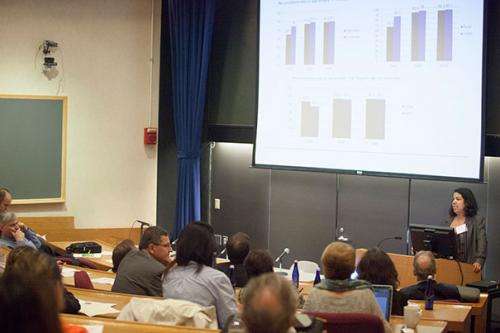
During the Harvard-Brazil Symposium, Luciana Mendes Santos Servo (pictured), health coordinator at the Institute for Applied Economic Research in Brazil, traced the changes in that country to Brazil’s 1988 constitution, which recognized health as a right for citizens and created a government obligation to improve it. Credit: Kris Snibbe/Harvard Staff Photographer
With the 2015 deadline to meet the United Nations' Millennium Development Goals (MDG) approaching, scholars and government officials gathered at the Harvard School of Public Health (HSPH) on Tuesday to search for lessons in the dramatic progress that Brazil has made in recent decades.
The eight Millennium Development Goals, adopted in 2000, set targets to attain international development objectives, including reducing extreme poverty and hunger; reducing child mortality; improving maternal health; achieving universal primary education; increasing equality for women; fighting AIDS, malaria, and other diseases; ensuring environmental sustainability; and fostering global partnerships for development.
The Harvard-Brazil Symposium, held in HSPH's Kresge Building, featured discussions of the health-related goals and of Brazil's progress in meeting them. It was sponsored by the Department of Global Health and Population, which is marking its 50th anniversary, as well as the Harvard Global Health Institute and Fundação Maria Cecilia Souto Vidigal.
Harvard School of Public Health Dean Julio Frenk, who sits on UN Secretary General Ban Ki-Moon's MDG Advocacy Group, introduced the event, saying that the goals' adoption marked the first time the world's nations agreed on common development objectives and on indicators to measure progress.
The result, he said, has been an unprecedented level of funding for the needs outlined, as well as progress that has been, in some cases, spectacular. Yet much remains to be done, making the search for examples that might be adapted to other situations an important strategy.
"The challenges that remain are enormous," Frenk said.
Luciana Mendes Santos Servo, health coordinator at the Institute for Applied Economic Research in Brazil, traced the changes in that country to Brazil's 1988 constitution, which recognized health as a right for citizens and created a government obligation to improve it.
That sparked the creation of several social welfare programs and reform of the health care system from one that was centered on hospitals and financed by private insurance, held mainly by those in the formal labor pool, to one that emphasized primary care and was open to all.
Brazil has already achieved the goals for reducing poverty and hunger and is on track to achieve the goals involving child mortality and universal education. Maternal health in the nation has improved, but the goal appears out of reach by 2015. Mendes credited three programs with the bulk of the change: a social security benefit for the elderly, a cash-transfer program for poor families, and a family health program that focuses on primary care.
The programs have provided additional benefits beyond health. The cash-transfer program for poor families, called Bolsa Familia, requires children to attend school, which has boosted school attendance, helping the nation to achieve universal primary school education.
While those programs appear to have been effective, some audience members questioned whether the cost burdens they put on government, particularly in an economic downturn, are sustainable. Mendes said that future financing will be a challenge, because she believes the government can't raise taxes further.
Eduardo Rios Neto, a professor at Brazil's Federal University of Minas Gerais, said the government programs were helped along by a period of economic growth and improvement of the labor market, and that, despite recent progress, social and income inequality in Brazil remain a major problem.
Brazil's progress doesn't mean its health challenges are over either, Mendes said. The rise of noncommunicable diseases, like heart disease, diabetes, and cancer, is a growing challenge.
"We have progressed, but we have some challenges," Mendes said.
Provided by
Harvard University
This story is published courtesy of the Harvard Gazette, Harvard University's official newspaper. For additional university news, visit Harvard.edu.
-
HIV and noncommunicable diseases hinder the progress of poor countries' Millennium Development Goals
Mar 02, 2010 |
not rated yet |
0
-
Researchers outline plan to end preventable child deaths in a generation
Jun 14, 2012 |
not rated yet |
0
-
High food prices derail Millennium goals: report
Apr 20, 2012 |
not rated yet |
0
-
Equitable approach the best way to rapidly increase overall maternal and child health coverage
Sep 19, 2012 |
not rated yet |
0
-
Mexico achieves universal health coverage in less than a decade
Aug 15, 2012 |
not rated yet |
0
-
Motion perception revisited: High Phi effect challenges established motion perception assumptions
Apr 23, 2013 |
3 / 5 (2) |
2
-
Anything you can do I can do better: Neuromolecular foundations of the superiority illusion (Update)
Apr 02, 2013 |
4.5 / 5 (11) |
5
-
The visual system as economist: Neural resource allocation in visual adaptation
Mar 30, 2013 |
5 / 5 (2) |
9
-
Separate lives: Neuronal and organismal lifespans decoupled
Mar 27, 2013 |
4.9 / 5 (8) |
0
-
Sizing things up: The evolutionary neurobiology of scale invariance
Feb 28, 2013 |
4.8 / 5 (10) |
14
-
Classical and Quantum Mechanics via Lie algebras
Apr 15, 2011
- More from Physics Forums - Independent Research
More news stories
New research identifies risks, interventions for children's GI health
An increasing number of U.S. children are experiencing gastrointestinal issues that require interventions to resolve, according to research presented at Digestive Disease Week (DDW).
Health
1 hour ago |
not rated yet |
0
|
Youth who have their first drink during puberty have higher levels of later drinking
Research shows that the earlier the age at which youth take their first alcoholic drink, the greater the risk of developing alcohol problems. Thus, age at first drink (AFD) is generally considered a powerful predictor of ...
Health
19 hours ago |
not rated yet |
0
British MPs concerned about parliamentary boozing
One quarter of British lawmakers believe there is an "unhealthy" drinking culture in the Houses of Parliament, according to a survey published on Friday.
Health
May 17, 2013 |
not rated yet |
0
Patient openness to research can depend on race and sex of study personnel
Researchers at the University of Cincinnati (UC) have found that the race and sex of study personnel can influence a patient's decision on whether or not to participate in clinical research.
Health
May 17, 2013 |
not rated yet |
0
Clinical support for patient self-management is rhetoric rather than reality
The processes to allow people to self-manage their own illness are not being used appropriately by health professionals to the benefit of their patients, new research suggests.
Health
May 17, 2013 |
not rated yet |
0
New colonoscope provides ground-breaking view of colon
A ground-breaking advance in colonoscopy technology signals the future of colorectal care, according to research presented today at Digestive Disease Week(DDW). Additional research focuses on optimizing the minimal withdrawal ...
AIDS science at 30: 'Cure' now part of lexicon
Big names in medicine are set to give an upbeat assessment of the war on AIDS on Tuesday, 30 years after French researchers identified the virus that causes the disease.
For combat veterans suffering from post-traumatic stress disorder, 'fear circuitry' in the brain never rests
Chronic trauma can inflict lasting damage to brain regions associated with fear and anxiety. Previous imaging studies of people with post-traumatic stress disorder, or PTSD, have shown that these brain regions can over-or ...
Melon focus headband turns to Kickstarter for rollout plans
(Medical Xpress)—What if the quality of your work depends more on your focus on the piano keys or canvas or laptop than your musical or painting or computing skills? If target users can be convinced, they ...
Temporal processing in the olfactory system
The neural machinery underlying our olfactory sense continues to be an enigma for neuroscience. A recent review in Neuron seeks to expand traditional ideas about how neurons in the olfactory bulb might encode information about ...
Now we know why old scizophrenia medicine works on antibiotics-resistant bacteria
In 2008 researchers from the University of Southern Denmark showed that the drug thioridazine, which has previously been used to treat schizophrenia, is also a powerful weapon against antibiotic-resistant bacteria such as ...