Japan tooth patch could be end of decay
September 16, 2012 in Dentistry

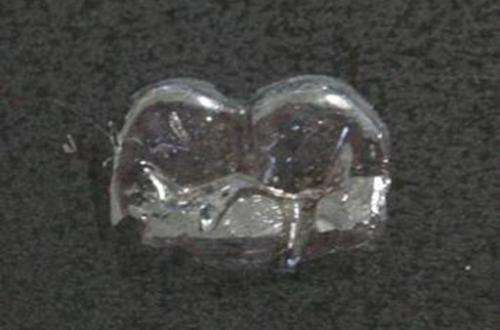
The tooth-patch, an ultra thin biocompatible film made from hydroxyapatitte

Enlarge

Handout picture released from Japan's Kinki University professor Shigeki Hontsu shows a tooth-patch, an ultra thin biocompatible film made from hydroxyapatitte. Scientists in Japan have created a microscopically thin film that can coat individual teeth to prevent decay or to make them appear whiter, the chief researcher said.

Scientists in Japan have created a microscopically thin film that can coat individual teeth to prevent decay or to make them appear whiter, the chief researcher said.

The "tooth patch" is a hard-wearing and ultra- made from hydroxyapatite, the main mineral in , that could also mean an end to sensitive teeth.

"This is the world's first flexible apatite sheet, which we hope to use to protect teeth or repair damaged enamel," said Shigeki Hontsu, professor at Kinki University's Faculty of Biology-Oriented Science and Technology in western Japan.

"Dentists used to think an all- sheet was just a dream, but we are aiming to create artificial enamel," the outermost layer of a tooth, he said earlier this month.

Researchers can create film just 0.004 millimetres (0.00016 inches) thick by firing lasers at compressed blocks of hydroxyapatite in a vacuum to make individual particles pop out.

These particles fall onto a block of salt which is heated to crystallise them, before the salt stand is dissolved in water.

The film is scooped up onto and dried, after which it is robust enough to be picked up by a pair of tweezers.

"The moment you put it on a , it becomes invisible. You can barely see it if you examine it under a light," Hontsu told AFP by telephone.

The sheet has a number of minute holes that allow liquid and air to escape from underneath to prevent their forming bubbles when it is applied onto a tooth.

One problem is that it takes almost one day for the film to adhere firmly to the tooth's surface, said Hontsu.

The film is currently transparent but it is possible to make it white for use in cosmetic dentistry.

Researchers are experimenting on disused at the moment but the team will soon move to tests with animals, Hontsu said, adding he was also trying it on his own teeth.

Five years or more would be needed before the film could be used in practical such as covering exposed dentin—the sensitive layer underneath enamel—but it could be used cosmetically within three years, Hontsu said.

The technology, which has been jointly developed with Kazushi Yoshikawa, associate professor at Osaka Dental University, is patented in Japan and South Korea and applications are under way in the United States, Europe and China.

(c) 2012 AFP

4.6 /5 (45 votes)  

Filter


Move the slider to adjust rank threshold, so that you can hide some of the comments.


Display comments: newest first

squirt16oz
Sep 16, 2012

Rank: 4.1 / 5 (7)
Ladies and gentlemen,
In my brief lifetime (pushing 70 years!) EVERY dental discovery and/or accessory has been claimed to be the end of dental caries (tooth decay!)! Flouride in the water was going to end the problem (it didn't!). Certain techniques (the use of polymer bonds and UV light for one!) was supposed to put an end to cavities, and didn't! The ONLY thing these developments have done for the patient is to raise the price of a filling, orthodontia, or whatever. We need to get back to the basics: brush you teeth with a soft brush twice a day; use floss daily; be aware of sugar and acids in our foods; stop worrying about the shape of our teeth; and, remember, real beauty is not in the smile...it is in the heart of the wearer!!
Skepticus
Sep 16, 2012

Rank: 1 / 5 (1)
Ladies and gentlemen...it is in the heart of the wearer!!

Totally agreed. I've been following the glacial progress of science trying to put dentists out of business for the last 25 years, and I've come to the conclusion that it will never happen in my lifetime (one can hope for our great-grand children!). Therefore,I nuke the scum entry point. Brush your teeth after meal, or eat carrots or celery to scour away the bits that stuck to my teeth. Brush my teeth with a mouthful of powder table salt, scouring away the plague and rejoicing in killing billions of the nasty buggers in your mouth that are doing harm to my precious enamel. My teeth is colored by tetracycline antibiotics when I was young, the parents nor the medicos then know anything about its side-effects; but pushing 47, I still have every tooth fully functional, never seen a dentist in my whole life, still nonchalantly crushing ice cubes for fun and joy to the dismay of my dentist-repaired teeth friends!
Deathclock
Sep 16, 2012

Rank: 5 / 5 (1)
Squirt, what you said about previous advances failing to end tooth decay does not apply here... this is artificial enamel... this is literally creating the exact same substance that already protects your teeth. With this we are not trying to use some new approach to the problem, we are trying to reproduce the one that already exists in nature.
Shootist
Sep 16, 2012

Rank: 3.7 / 5 (3)
Don't worry squirt, even if this works perfectly, it will never see the light of day in the USA. That ADA has too strong a lobby to ever allow it to be approved by the FDA.
GenesisNemesis
Sep 16, 2012

Rank: 5 / 5 (1)
Ladies and gentlemen,
In my brief lifetime (pushing 70 years!) EVERY dental discovery and/or accessory has been claimed to be the end of dental caries (tooth decay!)!


To be fair, they're saying it 'could' be the end of tooth decay, not that it is the end of tooth decay, and they're awaiting more experimental evidence that it is the case, not outright making any claims. I'm assuming that the material mentioned in the article has special properties which could aid against tooth decay, which hasn't been used before in this way the field, hence:

"Dentists used to think an all-apatite sheet was just a dream..."
mbruni
Sep 16, 2012

Rank: not rated yet
They cured Dental Carries when they invented the toothbrush and dental floss. The use of fluoride further made it increasingly difficult to develop carries. Every innovation and invention since has been developed to help those who are too lazy to brush and floss. People who don't care for their teeth then expect the dentist to fix it should pay through the ass.
cdt
Sep 16, 2012

Rank: 5 / 5 (1)
Granted that this won't be an end to dentistry (it will need to be applied by dentists, after all), it could help with reducing cavities by filling in and smoothing over nooks and crannies where bacteria tend to aggregate. You don't generally get cavities starting from a smooth tooth surface, after all.

And Skepticus, from what I've seen there seem to be two types of people when it comes to teeth -- those who get cavities and those who don't. The best explanation I've seen is that the pH level differs in the mouths of the two groups, with a higher pH being more beneficial. It doesn't seem to correlate with degree of brushing, flossing or other care.
ueli
Sep 16, 2012

Rank: not rated yet
Sounds great. Lets hope they can make it work.
There is however another way of achieving no caries on your teeth and that is using Xylitol in your diet instead of sugar. We have done it for years in our family and all our children have zero caries, no holes by just cleaning their teeth mostly once a day. Us adults managed to stop our filled teeth to get any worse and even the dentist had to admit that it works! The "toothpaste" we use is homemade with mostly xylitol and some glycerine with a drop of peppermint or eucalyptus oil and a small amount of salt. It is cheap and you can swallow it without any concerns which is particularily important for children.
irjsiq
Sep 16, 2012

Rank: 1 / 5 (1)
will never happen in my lifetime (one can hope for our great- children!)

Coupled/Crippled,by Our Ever-Expanding Debt;our Great-Grand-Children will be unable to pay for, or afford a Dental visit!

DNA will Ultimately prove/answer: Why some Octogenarians, with little
formal 'Dental Hygiene' during their lifetimes, 'Cross-Over' with, barring Accidents, their Natural Teeth!

Roy J Stewart,
Phoenix AZ

P.S. Pondering E=MC2. The most Distant light (recently posted as 47 Billion Light years) . . . Edge of Universe???
Presumably, that Light, also traveled Away/Opposite Direction for that same period of time . . . Is that forty-seven Billion Light Years an Elastic figure . . . for I 'estimates' I have read have placed as the 'edge of the Universe' from 15 Billion C/Years!
Also, as Galileo was scorned for 'daring' to say: "The Earth Revolves around the Sun, not The Sun, revolves 'round the Earth'!

ziphead
Sep 16, 2012

Rank: not rated yet
Novamin.
It is there on the market and comes pretty close to what it claims to do.
Skepticus
Sep 17, 2012

Rank: 5 / 5 (1)
@mbruni
People who don't care for their teeth then expect the dentist to fix it should pay through the ass.

Yeah, so why you are so pissed off that I never see a dentist in my 46 years by taking good care of my precious teeth myself, and rate my comment 1? Please explain, at least point out the which or why you disagree, as an intelligent, objective, logical, scientific-minded person, as most are on this science sounding board? Are you a dentist down on business, by any chance? I hope not.
Skepticus
Sep 17, 2012

Rank: not rated yet
...
And Skepticus, from what I've seen there seem to be two types of people when it comes to teeth -- those who get cavities and those who don't..

I beg to differ. Please quote peer-reviewed papers that say scientists can tell teeth from such and such populations from a double-blinded test. Imho, teeth are created equal-chemically and structurally-for everyone on this planet. Why so? In every population on this planet, there are persons who keep their teeth to old age, and those who don't. Taking the laxity of human behavior into account, that people eat for an hour or two or three, then rest for 8 hours or more for the plague, bacteria, acids to do the damage, how much time do they really spend on cleaning their grinders? And properly? who spend no more than 2-5 minutes a day? Who do look, check and do more? People have a regrettable tendency of ignoring low-maintenance systems until they go kaput-teeth, heart, liver, kidney, gut, you name it.
DarkHorse66
Sep 18, 2012

Rank: 5 / 5 (1)
@Skepticus; cdt does have a point, your likely level of caries/cavities does depend on the ph level of your saliva. There is a genetic basis as well, for variations in ph levels in individuals who might actually be doing the exact same things. Here are some articles. By the time that you have finished reading them, you should be quite an expert. The second one is my favourite; it is written for dental students and presents a comprehensive picture - but is easy to read:
http://en.wikiped...l_caries

A bit involved, but very informative:
http://www.cdha.o...ease.pdf

http://www.healin...-ph.html

This one as an example to simply to show that variations across different genomic subgroups do exist. I found a huge bundle of them.
http://www.ncbi.n.../7450777
Best Regards, DH66
NickFun
Sep 20, 2012

Rank: not rated yet
We have had numerous tooth decay remedies and cures since the 70s but why destroy a multi-billion business?
Vendicar Dickarian
Sep 22, 2012

Rank: 1 / 5 (1)
argghhhh....why does MedicalXpress.com make me sign in again after I've logged into Physorg? Surely this is an easy fix.

Anyway, @squirt16oz - you are absolutely correct. I'm in my mid-40s, and I've also seen countless "cures" for tooth decay. In fact, there was a lively debate on this very site last year about one such claim. Undoubtedly we will someday have a simple, cheap cure for tooth decay, but I'm not holding my breath.

Many of these new ideas are excellent as research tools, but fail in later stages as the engineers, designers, marketing and advertising folks get involved. What's that....you have yet to practice on a live human being? Oh, my....we'll talk to you again in about 15 years. I'm still waiting for "advances" I heard about in the 1980s and 1990s to come to fruition.
Rank 4.6 /5 (45 votes)
Relevant PhysicsForums posts

More news stories

Primary care docs should play role in kids' dental health, experts say

(HealthDay)—When it comes to the care of your children's teeth, dentists aren't the only experts who can help.

Dentistry created May 21, 2013 | popularity not rated yet | comments 0

Guidelines issued to prevent infection with dental work

(HealthDay)—Practitioners might consider discontinuing prophylactic antibiotics for patients with prosthetic implants undergoing dental procedures, and these patients should be encouraged to maintain appropriate ...

Dentistry created May 14, 2013 | popularity not rated yet | comments 0

First analysis of dental therapists finds increase in access for children, low-income adults

A new report assessing the economic viability of services provided by practicing midlevel dental providers in the U.S. shows that they are expanding preventive dental care to people who need it most: children and those who ...

Dentistry created May 14, 2013 | popularity not rated yet | comments 0

Excessive soda can mimic illicit drug use effects on teeth

(HealthDay)—Manifestation of dental erosion caused by illicit drug use or excessive soda consumption needs to be distinguished from dental caries, according to case studies published in the March/April ...

Dentistry created May 13, 2013 | popularity 5 / 5 (1) | comments 0

Common habits that harm your teeth

Are you wrecking your teeth without even knowing it? For instance, chewing on ice or opening stuff with your teeth may be convenient but using your teeth as tools can cause them to crack or chip.

Dentistry created May 03, 2013 | popularity 3 / 5 (1) | comments 1


Rate of bicycle-related fatalities significantly lower in states with helmet laws

Existing research shows that bicyclists who wear helmets have an 88 percent lower risk of brain injury, but researchers at Boston Children's Hospital found that simply having bicycle helmet laws in place showed a 20 percent ...

Slowing the aging process—only with antibiotics

Swiss scientists reveal the mechanism responsible for aging hidden deep within mitochondria—and dramatically slow it down in worms by administering antibiotics to the young.

Researchers complete largest genetic sequencing study of human disease

Researchers from Queen Mary, University of London have led the largest sequencing study of human disease to date, investigating the genetic basis of six autoimmune diseases.

Brain can be trained in compassion, study shows

Until now, little was scientifically known about the human potential to cultivate compassion—the emotional state of caring for people who are suffering in a way that motivates altruistic behavior.

Having both migraines, depression may mean smaller brain

(HealthDay)—Migraines and depression can each cause a great deal of suffering, but new research indicates the combination of the two may be linked to something else entirely—a smaller brain.

Novel approach for influenza vaccination shows promise in early animal testing

A new approach for immunizing against influenza elicited a more potent immune response and broader protection than the currently licensed seasonal influenza vaccines when tested in mice and ferrets. The vaccine ...