'Queer Bioethics': The birth of a new academic discipline
It's not every day that a new academic discipline is born. But that's exactly what happened in 2010, when the Project on Bioethics, Sexuality and Gender Identity — or "Queer Bioethics," for short—came to life at the University of Pennsylvania.
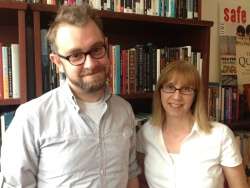
Supported by Penn's Department of Medical Ethics and Health Policy at the Perelman School of Medicine, this new initiative was founded and is co-directed by Lance Wahlert, the program director of the Master of Bioethics, and Autumn Fiester, the director of education in the Department of Medical Ethics and Health Policy.
And now, the nearly 2-year-old effort is seeing results. Earlier this month, the Journal of Bioethical Inquiry published a special issue, guest edited by Wahlert and Fiester, on the theme of "Bioethics, Sexuality and Gender Identity." Two other special issues of journals are already in the works: the Winter 2013 issue of the Journal of Medical Humanities will spotlight the theme of "Queer in the Clinic" and the Spring/Summer 2013 issue of the Journal of Homosexuality will more precisely focus on "Mapping Queer Bioethics: Space, Place and Locality."
In addition, the project has organized a day-long national conference to be held Friday, September 21, in Penn's Houston Hall. Prominent scholars —including several Penn faculty—from fields such as English, communications, sociology and the history of medicine will present on topics ranging from the ethics of HIV clinical trials to the history of sexuality and gender identity in Germany. The event is free to attend.
"The conference is an early culminating moment for this project," Fiester says.
Wahlert and Fiester launched the Queer Bioethics project after recognizing that queer-studies scholars, bioethicists and other academics were examining issues at the intersection of medicine and lesbian, gay, bisexual, transgender, queer and intersex, or LGBTQI, studies but lacked a common approach to probing the ethics surrounding the experience of LGBTQI individuals in health-care settings.
"LGBTQI persons are being forgotten in the bioethical discourse," Wahlert says. "Of course, we could make this same accusation of LGBTQI underrepresentation in any number of other academic fields. In the case of bioethics or clinical ethics or research ethics, though, the stakes are so high since the day-to-day health care needs of LGBTQI persons and their families are in the balance."
In the past, Wahlert says, select issues related to LGBTQI individuals had been the topic of ethical discussion, such as whether and how to treat intersex children, or how to care for patients with HIV/AIDS in the earliest years of the epidemic, when concepts of quarantine dominated the conversation and before combination drug therapies rendered the disease treatable. But he notes that these topics were largely studied not out of empathy for the queer community but out of medical, ethical and legal urgency.
With the field now formalized, Wahlert and Fiester see opportunities for scholars to turn their attention to areas of growing interest, including surrogate health-care decision-making rights for patients whose partners may not be legally recognized, care for transgender people and the Diagnostic and Statistical Manual of Mental Disorder's definitions of conditions related to LGBTQI persons, to name a few. Homosexuality, for example, wasn't removed from the DSM until 1973. And now, as the fifth edition of the DSM is being prepared, issues surrounding how to classify gender dysphoria and gender identity are under debate.
To grow the queer bioethics academic community needed to consider ethical issues such as these, Wahlert and Fiester have personally recruited an international consortium of more than 300 scholars whose diverse areas of expertise can inform the discipline.
"We now have this very large group of individuals who are in some way supporting the project or turning their scholarly eye to these issues," says Fiester.
Central to the endeavor is its interdisciplinary nature.
"The study of bioethics, medical ethics, is really the study of what's the right or the wrong thing to do in a medical environment, and the truth is, an M.D. or a J.D. or a Ph.D. in philosophy or theology, or a Ph.D. in nursing—none of those degrees makes one the absolute moral authority on the right or wrong thing to do in a bioethical moment," Wahlert says.
Only collectively, he says, with experts from different fields bringing their methodologies and strengths, can these discussions be broached to find the best solutions to ethical challenges.
Moving forward, Wahlert and Fiester want to further broaden the field, reaching out to more mainstream medical communities to increase awareness of the complexities of providing care to LGBTQI people. They plan to compile a clinical casebook that presents a variety of examples of ethical dilemmas related to providing health care for the queer community.
"We hope this will be used to teach the next generation—and current generation—of health-care providers how to navigate these ethical landmines," Fiester says.
Additional information about the Project on Bioethics, Sexuality and Gender Identity is available at www.queerbioethics.org.


