Cell death discovery suggests new ways to protect female fertility
September 22, 2012 in Medical research
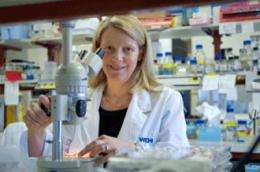
Associate Professor Clare Scott of the Walter and Eliza Hall Institute was one of the researchers leading a study that has suggested new ways to protect female fertility. Credit: Walter and Eliza Hall Institute, Australia
Melbourne researchers have identified a new way of protecting female fertility, offering hope to women whose fertility may be compromised by the side-effects of cancer therapy or by premature menopause.
The researchers, from the Walter and Eliza Hall Institute, Monash University and Prince Henry's Institute of Medical Research, made the discovery while investigating how egg cells die.
They found that two specific proteins, called PUMA and NOXA, cause the death of egg cells in the ovaries. The finding may lead to new strategies that protect women's fertility by blocking the activity of these two proteins.
This video is not supported by your browser at this time.
Researchers have identified a protein which is important for the death of egg cells in the ovaries. The finding could lead to new ways to prevent infertility in cancer patients and delay premature menopause. Associate Professor Clare Scott, Walter and Eliza Hall Institute, and Professor Martha Hickey, The Royal Women's Hospital and The University of Melbourne, discuss the significance of the finding, which was made by researchers at Walter and Eliza Hall Institute, Monash University and Prince Henry's Institute of Medical Research, Melbourne, Australia. Credit: The Walter and Eliza Hall Institute of Medical Research, Melbourne, Australia
Associate Professor Clare Scott from the Walter and Eliza Hall Institute said the research showed that when the DNA of egg cells is damaged following exposure to radiation or chemotherapy, such as that received during some cancer treatments, PUMA and NOXA trigger the death of the damaged eggs. This egg cell death causes many female cancer patients to become infertile."PUMA and NOXA can trigger cell death, and have been found to be necessary for the death of many different cell types in response to DNA damage," Associate Professor Scott, who is also an oncologist at The Royal Melbourne and Royal Women's Hospitals, said. "This removal of damaged cells is a natural process that is essential to maintaining health but, for women undergoing cancer treatment, can be devastating when it leads to infertility."
Associate Professor Scott, Dr Ewa Michalak and Professor Andreas Strasser from the Walter and Eliza Hall Institute, together with Associate Professor Jeffrey Kerr from Monash University, and Dr Karla Hutt and Professor Jock Findlay from Prince Henry's Institute of Medical Research, focused their studies on egg cells called primordial follicle oocytes, which provide each woman's lifetime supply of eggs. Low numbers of these egg cells can also be a cause of early menopause. Their findings are published online this week in the journal Molecular Cell.
Associate Professor Jeff Kerr said that when these egg-producing cells were missing the PUMA protein, they did not die after being exposed to radiation therapy. "This might ordinarily be cause for concern because you want damaged egg cells to die so as not to produce abnormal offspring," he said. "To our great surprise we found that not only did the cells survive being irradiated, they were able to repair the DNA damage they had sustained and could be ovulated and fertilized, producing healthy offspring. When the cells were also missing the NOXA protein, there was even better protection against radiation."
"We were very excited to see healthy offspring could be produced from these cells," Associate Professor Scott said. "It means that in the future, medications that block the function of PUMA could be used to stop the death of egg cells in patients undergoing chemotherapy or radiotherapy. Our results suggest that this could maintain the fertility of these patients."
A joint leader of the study, Professor Jock Findlay, head of the Female Reproductive Biology Group at Prince Henry's Institute, said the study could also have implications for delaying menopause. "We know that the timing of menopause is influenced by how many egg cells a female has," he said. "Interventions that slow the loss of egg cells from the ovaries could delay premature menopause. As well as prolonging female fertility, such a treatment could have the potential to reduce menopause-associated health conditions, such as osteoporosis and heart disease."
Journal reference:
Molecular Cell
Provided by
Walter and Eliza Hall Institute
-
Missing Puma reveals cancer conundrum
Aug 01, 2010 |
not rated yet |
0
-
No evidence older women generate new eggs
May 08, 2007 |
not rated yet |
0
-
Match your treatment to your cancer
Jun 30, 2011 |
not rated yet |
0
-
Biologists find way to reduce stem cell loss during cancer treatment
Sep 05, 2010 |
not rated yet |
0
-
Oocyte-specific gene mutations cause premature ovarian failure
May 22, 2008 |
not rated yet |
0
-
Motion perception revisited: High Phi effect challenges established motion perception assumptions
Apr 23, 2013 |
3 / 5 (2) |
2
-
Anything you can do I can do better: Neuromolecular foundations of the superiority illusion (Update)
Apr 02, 2013 |
4.5 / 5 (11) |
5
-
The visual system as economist: Neural resource allocation in visual adaptation
Mar 30, 2013 |
5 / 5 (2) |
9
-
Separate lives: Neuronal and organismal lifespans decoupled
Mar 27, 2013 |
4.9 / 5 (8) |
0
-
Sizing things up: The evolutionary neurobiology of scale invariance
Feb 28, 2013 |
4.8 / 5 (10) |
14
-
Why is zone 1 in liver more prone to ischemic injury?
May 23, 2013
-
How can there be villous adenoma in colon, if there are no villi there
May 22, 2013
-
How can there be a term called "intestinal metaplasia" of stomach
May 21, 2013
-
Pressure-volume curve: Elastic Recoil Pressure don't make sense
May 18, 2013
-
If you became brain-dead, would you want them to pull the plug?
May 17, 2013
-
MRI bill question
May 15, 2013
- More from Physics Forums - Medical Sciences
More news stories
Study reveals new mechanism for estrogen suppression of liver lipid synthesis
By discovering the new mechanism by which estrogen suppresses lipid synthesis in the liver, UC Irvine endocrinologists have revealed a potential new approach toward treating certain liver diseases.
Medical research
May 23, 2013 |
5 / 5 (1) |
0
|
MRI-based measurement helps predict vascular disease in the brain
Aortic arch pulse wave velocity, a measure of arterial stiffness, is a strong independent predictor of disease of the vessels that supply blood to the brain, according to a new study published in the June issue the journal ...
Medical research
May 23, 2013 |
not rated yet |
0
Antibiotics: A new understanding of sulfonamide nervous system side effects
Since the discovery of Prontosil in 1932, sulfonamide antibiotics have been used to combat a wide spectrum of bacterial infections, from acne to chlamydia and pneumonia. However, their side effects can include serious neurological ...
Medical research
May 23, 2013 |
3 / 5 (1) |
0
|
Scientists discover molecule triggers sensation of itch
Scientists at the National Institutes of Health report they have discovered in mouse studies that a small molecule released in the spinal cord triggers a process that is later experienced in the brain as ...
Medical research
May 23, 2013 |
5 / 5 (3) |
0
|
Discarded immune cells induce the relocation of stem cells
Spanish researchers have discovered that the daily clearance of neutrophils from the body stimulates the release of hematopoietic stem cells from the bone marrow into the bloodstream, according to a report published today ...
Medical research
May 23, 2013 |
5 / 5 (2) |
0
First drug to improve heart failure mortality in over a decade
Coenzyme Q10 decreases all cause mortality by half, according to the results of a multicentre randomised double blind trial presented today at Heart Failure 2013 congress. It is the first drug to improve heart failure mortality ...
Seniors more likely to crash when driving with pet, study finds
(HealthDay)—Animals make great companions for senior citizens, but elderly people who always drive with a pet in the car are far more likely to crash than those who never drive with a pet, researchers have ...
Heart failure accelerates male 'menopause'
Heart failure accelerates the aging process and brings on early andropausal syndrome (AS), according to research presented today at the Heart Failure Congress 2013. AS, also referred to as male 'menopause', was four times ...
Death highest in heart failure patients admitted in January, on Friday, and overnight
Mortality and length of stay are highest in heart failure patients admitted in January, on Friday, and overnight, according to research presented today at the Heart Failure Congress 2013. The analysis of nearly 1 million ...
Feds fight morning-after pill age ruling in NY
(AP)—Department of Justice lawyers have again asked a federal appeals court in New York to delay lifting age restrictions and prescription requirements on an emergency contraceptive popularly known as the morning-after ...
New immune system discovered
(Medical Xpress)—A research team, led by Jeremy Barr, a biology post-doctoral fellow, unveils a new immune system that protects humans and animals from infection.