'Big visions' for solving environmental health issues
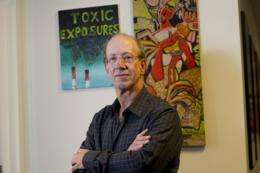
Many contaminants are easy for the public to spot, like emissions from the tailpipe of a car or the sludge from a massive oil spill washing up on the ocean's shores.
But Phil Brown, who joined Northeastern's faculty this fall, says many others are far less easy to identify—including those found in beauty products like deodorant and cologne or in flame retardants, which he has studied extensively.
"It's the things we don't think about being toxic that are in our everyday lives," said Brown, University Distinguished Professor of Sociology and Health Sciences with joint appointments in the College of Social Sciences and Humanities and the Bouvé College of Health Sciences.
For Brown, a renowned scholar whose interdisciplinary research combines social science and environmental health, issues like these are constantly in his crosshairs. Over the last 13 years at Brown University, he led a research group on environmental health science that was supported by a range of grants from several federal agencies, including the National Institutes of Health, the National Science Foundation and the Environmental Protection Agency.
His research included focusing on biomonitoring, which measures the level of contaminants in the human body, and on household exposure monitoring, which measures toxicants found in the air and dust inside our homes and the air in our driveways.
Now at Northeastern, Brown is the director of the new Social Science Environmental Health Research Institute. The institute's mission is to bring together an interdisciplinary team of researchers to conduct socialscience research, teaching, community engagement and policy work in the field.
Brown said environmental health researchers should be nimble and attuned to the world's emerging environmental health issues. Brown, for his part, navigated to the field of environmental health science in the 1980s while working in mental health policy. At the time, a colleague was serving as an expert witness in a high-profile groundwater-contamination case in Woburn, Mass., in which civil suits were brought against two companies following community concerns over rising levels of childhood leukemia and other illnesses.
The Woburn case captured Brown's attention immediately, compelling him to investigate.
"I spent a lot of time with the families who had been affected, whose children died or became sick, and that really changed my life," said Brown, who wrote a book on the topic called "No Safe Place: Toxic Waste, Leukemia, and Community Action."
Brown soon realized that many other communities grapple with similar environmental health issues, which led him to engage in the larger debate about environmental causes of illnesses. Over the years, he has also examined health-focused social movements in America dating back to the beginning of Medicare and Medicaid.
"You never know where the work will take you next," said Brown, who earned his Ph.D. in sociology from Brandeis University. "I'm always looking for interesting new things that are important, that concern people and that have an effect on many people's lives."
Many environmental health issues are local by nature, but Brown said they also serve as catalysts for worldwide environmental change. He praised innovators before him who paved the way for this type of thinking—including Barry Commoner, one of the founders of modern ecology, who passed away last week, and Rachel Carson, whose 1962 book "Silent Spring" exposed the dangers of the pesticide DDT. Both thought leaders, he said, brought environmental dangers to the public eye and helped spark the global environmental movement.
"We need to have those big visions and not be afraid to say, 'This is how the world can be better many years down the road,'" Brown said.


