Customized disc implant end plates up load distribution
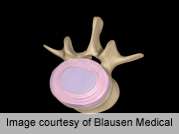
(HealthDay)—Customizing the end plate geometry of intervertebral disc implants correlates with improved load distribution and stiffness, according to a study published online Oct. 29 in The Spine Journal.
Neal de Beer, Ph.D.Eng., and Cornie Scheffer, Ph.D.Eng., from Stellenbosch University in South Africa, conducted a biomechanical investigation and comparison of compressive loads applied to cadaveric vertebrae using two different end plate designs: with matching bone interface geometry or with flat end plate geometrics. Twenty vertebrae (C3 to L3) from male cadavers were included and were subjected to nondestructive compression tests and destructive compression tests.
The researchers found that, during non-destructive tests, the average percent contact area measured was 45.27 percent for conformal implants and 10.49 percent for flat implants (P < 0.001). Due to the pronounced end plate concavity of the cervical vertebrae, a higher percent contact area was especially noted. Conformal implants achieved higher failure loads than flat implants during the destructive compression tests. When stiffness values were compared, conformal implants performed significantly better than flat implants.
"One of the main expected benefits from customizing the end plate geometry of disc implants is the reduced risk and potential for subsidence into the vertebral bone end plate," the authors write. "Subsidence depends in part on the stiffness of the implant-bone construct, and with a 137 percent increase in stiffness, the results of this study show that there are indeed significant potential benefits that can be achieved through the use of customization during the design and manufacture of intervertebral disc implants."
More information:
Abstract
Full Text (subscription or payment may be required)
Copyright © 2012 HealthDay. All rights reserved.


