New depression treatment may avoid side effects
October 23, 2012 in Psychology & Psychiatry
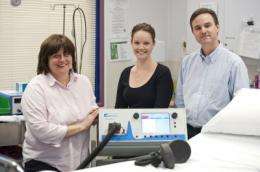
The treating team; Anne Maree Clinton, Dr Kate Hoy and Professor Paul Fitzgerald with the MST machine.
In an Australian first, researchers are studying Magnetic Seizure Therapy (MST) as an alternative treatment for the 30 per cent of patients suffering from depression who don't respond to traditional treatment.
The study, led by researchers from the Monash Alfred Psychiatry Research Centre (MAPrc) and funded by beyondblue and the National Health and Medical Research Council (NHMRC), has been published in two leading journals: Psychiatry Research: Neuroimaging and Depression and Anxiety. Both papers are a result of the same study.
MAPrc Deputy Director Professor Paul Fitzgerald, who led the study, said depression was a common and disabling disorder, affecting up to one in five Australians during their lifetime.
"Electroconvulsive Therapy (ECT) is one of the only established interventions for treatment resistant depression," Professor Fitzgerald said.
"But use of ECT is limited due to the presence of memory-related side effects and associated stigma."
For this reason, the MAPrc researchers began exploring new treatment options. MST is a brain-stimulation technique that may have similar clinical effects to ECT without the unwanted side effects.
"In MST, a seizure is induced through the use of magnetic stimulation rather than a direct electrical current like ECT. Magnetic fields are able to pass freely into the brain, making it possible to more precisely focus stimulation," Professor Fitzgerald said.
"By avoiding the use of direct electrical currents and inducing a more focal stimulation, it is thought that MST will result in an improvement of depressive symptoms without the memory difficulties seen with ECT."
Research is still at an early stage and MST is only available in a handful of locations worldwide. The MAPrc is the only centre in Australia conducting trials with this therapy.
The study found that MST resulted in an overall significant reduction in depression symptoms; 40 per cent showed overall improvement and 30 per cent showed some improvement. None of the trial participants complained of cognitive side effects.
"MST shows antidepressant efficacy without apparent cognitive side effects. However, substantial research is required to understand the optimal conditions for stimulation and to compare MST to established treatments, including ECT," Professor Fitzgerald said.
"In order to accurately assess the comparable efficacy of MST to ECT, large-scale randomised controlled trials are required. There remains considerable work to be done before statements of the relative efficacy of these treatments can be made."
More information: onlinelibrary.wile… 005/abstract
Provided by
Monash University
-
Antidepressants aid electroconvulsive therapy in treating severe depression
Jul 06, 2009 |
not rated yet |
0
-
Treatment for juvenile offenders shows positive results 22 years later
Nov 17, 2011 |
not rated yet |
0
-
Promising new depression treatment
Apr 05, 2011 |
not rated yet |
0
-
Study explains how shock therapy might ease severe depression
Mar 19, 2012 |
not rated yet |
0
-
Electrical stimulation of the brain is a safe treatment for depression
Mar 06, 2012 |
not rated yet |
0
-
Motion perception revisited: High Phi effect challenges established motion perception assumptions
Apr 23, 2013 |
3 / 5 (2) |
2
-
Anything you can do I can do better: Neuromolecular foundations of the superiority illusion (Update)
Apr 02, 2013 |
4.5 / 5 (11) |
5
-
The visual system as economist: Neural resource allocation in visual adaptation
Mar 30, 2013 |
5 / 5 (2) |
9
-
Separate lives: Neuronal and organismal lifespans decoupled
Mar 27, 2013 |
4.9 / 5 (8) |
0
-
Sizing things up: The evolutionary neurobiology of scale invariance
Feb 28, 2013 |
4.8 / 5 (10) |
14
-
How can there be a term called "intestinal metaplasia" of stomach
10 hours ago
-
Pressure-volume curve: Elastic Recoil Pressure don't make sense
May 18, 2013
-
If you became brain-dead, would you want them to pull the plug?
May 17, 2013
-
MRI bill question
May 15, 2013
-
Ratio of Hydrogen of Oxygen in Dessicated Animal Protein
May 13, 2013
-
Alcohol and acetaminophen
May 13, 2013
- More from Physics Forums - Medical Sciences
More news stories
Weather worries can threaten a child's mental health
(HealthDay)—The monstrous tornado that devastated Moore, Okla., on Monday, killing dozens of adults and children, is a stunning example of violent weather that can affect a child's mental well-being.
Psychology & Psychiatry
1 hour ago |
not rated yet |
0
Teens exposed to schoolmate's death by suicide much more likely to consider or attempt suicide
Youth who had a schoolmate die by suicide are significantly more likely to consider or attempt suicide, according to a study in published in CMAJ (Canadian Medical Association Journal). This effect can last 2 years or mo ...
Psychology & Psychiatry
5 hours ago |
not rated yet |
0
Genetic predictors of postpartum depression uncovered
Johns Hopkins researchers say they have discovered specific chemical alterations in two genes that, when present during pregnancy, reliably predict whether a woman will develop postpartum depression.
Psychology & Psychiatry
13 hours ago |
not rated yet |
0
|
Mediterranean diet seems to boost ageing brain power
A Mediterranean diet with added extra virgin olive oil or mixed nuts seems to improve the brain power of older people better than advising them to follow a low-fat diet, indicates research published online in the Journal of ...
Psychology & Psychiatry
22 hours ago |
3.5 / 5 (2) |
2
The incidence of eating disorders is increasing in the UK
More people are being diagnosed with eating disorders every year and the most common type is not either of the two most well known—bulimia or anorexia—but eating disorders not otherwise specified (eating disorders that ...
Psychology & Psychiatry
22 hours ago |
not rated yet |
0
Reducing caloric intake delays nerve cell loss
Activating an enzyme known to play a role in the anti-aging benefits of calorie restriction delays the loss of brain cells and preserves cognitive function in mice, according to a study published in the May ...
CDC says high number of public pools contain microbes
(HealthDay)—Three-quarters of public schools in the metro Atlanta area contain microbes, including bacteria indicating the presence of fecal matter, according to research published in the May 17 issue of ...
Researchers find genetic risk factor for pulmonary fibrosis
A paper recently published in the New England Journal of Medicine and co-written by physicians and scientists at the University of Colorado School of Medicine finds that an important genetic risk factor for pulmonary fibros ...
Biomarkers discovered for inflammatory bowel disease
Using the Department of Defense Serum Repository (DoDSR), University of Cincinnati (UC) researchers have identified a number of biomarkers for inflammatory bowel disease (IBD), which could help with earlier diagnosis and ...
Changing cancer's environment to halt its spread
By studying the roles two proteins, thrombospondin-1 and prosaposin, play in discouraging cancer metastasis, a trans-Atlantic research team has identified a five-amino acid fragment of prosaposin that significantly reduces ...
Global recommendations on child medicine
Transparent information on the evidence supporting global recommendations on paediatric medicines should be easily accessible in order to help policy makers decides on what drugs to include in their national drug lists, according ...