New metric to track prosthetic arm progress
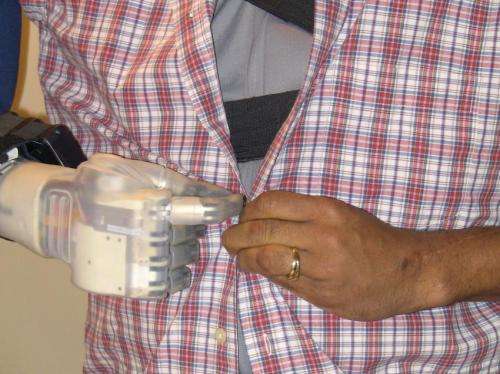
Amputees with a new prosthetic arm must learn how to use their device to perform everyday tasks that were once second nature. Taking off a shirt becomes a conscious, multistep effort: grasp the shirt, lift the shirt over the head, pull arms through the sleeves, place the shirt on the table, let go of the shirt.
In the best cases of treatment, patients work with teams of doctors, prosthetists, and therapists to learn how their new limbs can help them regain function and quality of life. But clinicians have had few tools to assess whether that crucial teaching/learning process is going well, because of a lack of standardized measurements to use with adults with upper limb amputations. To change that, a research team has unveiled a new index that clinicians can use to assess their patients' progress. They describe the Activities Measure for Upper Limb Amputees (the AM-ULA) in an article published online Oct. 19 in the Archives of Physical Medicine and Rehabilitation.
"Patients can't just take a prosthesis out of the box and start using it skillfully," said lead author and physical therapist Linda Resnik, an associate research professor in public health at Brown University and a research scientist at the Providence Veterans Affairs Medical Center. "The upper limb is used to perform so many types of tasks. Patients need training to make the most of an upper limb prosthesis. Physical and occupational therapists train people to use adaptive equipment and prosthetic devices, – teaching them strategies to accomplish functional tasks, and guiding them in therapeutic exercises and activities. We need measures to let us know if our patients are improving the way that we expect them to. When they get a new device, what are the benefits? Are they able do more with it?"
The AM-ULA provides standardized methods and criteria for clinicians to grade patients' performance, speed, and skill using any kind of prosthetic arm to do 18 everyday tasks. Tasks on the AM-ULA include not only putting on and removing a shirt, but also serving soda from a can, combing hair, tying shoes, and using a spoon. They are the kinds of tasks adults need to be independent in caring for themselves and others.
Resnik, who directs a prosthetics research program at the Providence VA's new Center for Neurorestoration and Neurotechnology, led the development of the new measure to aid her testing of a prosthetic arm developed by DEKA Research. She and the team tested the metric with 49 veterans at VA facilities in Tampa and New York and the U.S. Army's Fort Sam Houston in Texas.
Some existing measures are self-assessments where patients report how they are doing on a standardized scale, but Resnik said while those are essential, they don't tell clinicians everything they need to know. For instance, an amputee might subconsciously use other body parts to compensate for an insufficiency with a prosthetic arm.
"This particular tool, because of the grading criteria that we use, considers aspects of movement quality that might not be picked up in a self report," she said. "We look at the amount of body compensation used to perform a task – how much bending or use of other more proximal joints is involved in an activity. That's important, because we know that upper limb amputees often develop problems in their neck and back."
Resnik's team built the new measure much like a prosthetics engineer builds an arm: they designed a prototype based on tasks from other measures, and refined it iteratively using feedback from content experts.
One of the key methods of refining the metric and ensuring its reliability was determining whether two independent raters, observing the same patient performance, arrived at the same ratings or strongly disagreed. The researchers also determined when raters differed with themselves when the test was administered twice within a short period of time. Originally the measure included 24 tasks, but ultimately six were dropped because the independent raters came to ratings that were too different, too often.
The researchers also validated the measure by making sure that the results made sense, based upon what was known clinically. For instance, scores of the AM-ULA were highest for people with amputation of the hand, lower for those with amputation above the elbow, and lowest for amputees with amputation at the shoulder.
To help clinicians interpret changes in AM-ULA scores in individual patients, the team analyzed the statistics to calculate how much of a change in the overall score could be considered more than just natural "noise" in the data. For example, a patient whose scores change more than 3.7 points between sessions is likely to have truly changed, that change exceeds random error of measurement.
Although Resnik was inspired to develop the metric for her own research, she said she hopes the metric will become a commonly used, standard tool in the field.
"Outcome measures are needed in all areas of health care, but particularly so in the area of prosthetic rehabilitation," Resnik said. "High tech prosthetic devices have great promise to help people regain function, but the costs for myoelectric and microprocessor prosthetic devices are substantially higher than those for simpler, body powered devices."
Most insurance companies restrict the amount of money allowable for prosthetic devices and the amount of therapy that's available to people, she said. If patients don't benefit from using a high tech device or from therapy, it's difficult to justify prescription of such devices or continued therapy services.
"Thus, it is important to have sensitive and responsive methods to objectively assess the benefits of prosthetic devices and training," Resnik said. "What I hope is that clinicians would use this measure to track how their patients are doing."


