Retinal hemorrhage pattern can predict inflicted brain injury
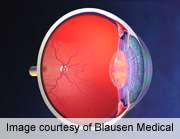
In children under the age of 3, a high dot-blot count for retinal hemorrhages is a strong predictor of inflicted traumatic brain injury rather than accidental traumatic brain injury, according to research published online Oct. 8 in Pediatrics.
(HealthDay)—In children under the age of 3, a high dot-blot count for retinal hemorrhages (RHs) is a strong predictor of inflicted traumatic brain injury (ITBI) rather than accidental traumatic brain injury (ATBI), according to research published online Oct. 8 in Pediatrics.
Robert A. Minns, M.B., B.S., Ph.D., of the Royal Hospital for Sick Children in Edinburgh, U.K., and colleagues conducted a six-year, observational, prospective study involving 114 infants and young children admitted to the pediatric intensive care unit with traumatic and nontraumatic encephalopathies. The authors sought to evaluate whether RHs, observed using wide-field retinal imaging within 24 hours, could be used to reliably distinguish between ITBI and ATBI.
The researchers noted significant differences in the average number of RHs as well as in their location and depth. RHs associated with ATBI were near the optic disc and more superficial than those in ITBI. In contrast, RH due to ITBI tended to be more peripheral and involve deeper layers. In children under the age of 3 years with greater than 25 dot-blot (intraretinal) hemorrhages, the positive predictive value for ITBI was 93 percent.
"This article presents the first prospective study with objectively measured RHs from all possible etiologies in children and predicts inflicted brain injury from certain RH characteristics alone," the authors write.
More information: Abstract
Full Text (subscription or payment may be required)
Journal reference:
Pediatrics
Copyright © 2012 HealthDay. All rights reserved.
-
Disability caused by traumatic brain injury in children may persist and stop improving after 2 years
Sep 18, 2012 |
not rated yet |
0
-
Outcomes for children after brain injury difficult to predict and highly variable
Jun 18, 2012 |
not rated yet |
0
-
Risk factors predictive of psychiatric symptoms after traumatic brain injury
Jul 12, 2011 |
not rated yet |
0
-
Concussions not taken seriously enough, researcher says
Jan 18, 2010 |
not rated yet |
0
-
Severe retinal hemorrhaging is linked to severe motor vehicle crashes
Jun 23, 2008 |
not rated yet |
0
-
Motion perception revisited: High Phi effect challenges established motion perception assumptions
Apr 23, 2013 |
3 / 5 (2) |
2
-
Anything you can do I can do better: Neuromolecular foundations of the superiority illusion (Update)
Apr 02, 2013 |
4.5 / 5 (11) |
5
-
The visual system as economist: Neural resource allocation in visual adaptation
Mar 30, 2013 |
5 / 5 (2) |
9
-
Separate lives: Neuronal and organismal lifespans decoupled
Mar 27, 2013 |
4.9 / 5 (8) |
0
-
Sizing things up: The evolutionary neurobiology of scale invariance
Feb 28, 2013 |
4.8 / 5 (10) |
14
-
Calculating Steam Pressure in Closed Container
2 hours ago
-
Learning curve of Electromagnetism?
7 hours ago
-
thin glass in liquid
8 hours ago
-
How many joules expended for a push up?
11 hours ago
-
force to keep the folding doors
11 hours ago
-
Confusion regarding direction of kinetic friction on inclined plane.
12 hours ago
- More from Physics Forums - Classical Physics
More news stories
New study recommends using active videogaming ('exergaming') to improve children's health
Levels of physical inactivity and obesity are very high in children, with fewer than 50% of primary school-aged boys and fewer than 28% of girls meeting the minimum levels of physical activity required to maintain health. ...
Pediatrics
May 17, 2013 |
5 / 5 (1) |
0
Study shows preschoolers affected by medication-related poisonings at alarming rate
Poisonings in young children have increased over the past decade, mainly due to medications in the home. A new study led by the Central Ohio Poison Center at Nationwide Children's Hospital, found that medication-related poisonings ...
Pediatrics
May 16, 2013 |
not rated yet |
0
Implementation research and child diarrhea
While considerable recent progress has been made against childhood diarrheal diseases, the number of children dying from diarrhoea remains unacceptably high.
Pediatrics
May 14, 2013 |
not rated yet |
0
Massage therapy shown to improve stress response in preterm infants
It seems that even for the smallest of people, a gentle massage may be beneficial. Newborn intensive care units (NICUs) are stressful environments for preterm infants; mechanical ventilation, medical procedures, caregiving ...
Pediatrics
May 14, 2013 |
not rated yet |
0
Study updates estimates, trends for childhood exposure to violence, crime, abuse
A study by David Finkelhor, Ph.D., of the University of New Hampshire, and colleagues updates estimates and trends for childhood exposure to a range of violence, crime and abuse victimizations.
Pediatrics
May 13, 2013 |
not rated yet |
0
New research identifies risks, interventions for children's GI health
An increasing number of U.S. children are experiencing gastrointestinal issues that require interventions to resolve, according to research presented at Digestive Disease Week (DDW).
US psychiatry gets makeover in new manual
The latest makeover to a massive psychiatric tome honored by some, reviled by others and even called the "Bible" of mental disorders is being released Saturday with a host of new changes.
New case of SARS-like virus in Saudi: ministry
A new case of the deadly coronavirus has been detected in Saudi Arabia where 15 people have already died after contracting it, the health ministry announced on Saturday on its Internet website.
AIDS science at 30: 'Cure' now part of lexicon
Big names in medicine are set to give an upbeat assessment of the war on AIDS on Tuesday, 30 years after French researchers identified the virus that causes the disease.
For combat veterans suffering from post-traumatic stress disorder, 'fear circuitry' in the brain never rests
Chronic trauma can inflict lasting damage to brain regions associated with fear and anxiety. Previous imaging studies of people with post-traumatic stress disorder, or PTSD, have shown that these brain regions can over-or ...
New colonoscope provides ground-breaking view of colon
A ground-breaking advance in colonoscopy technology signals the future of colorectal care, according to research presented today at Digestive Disease Week(DDW). Additional research focuses on optimizing the minimal withdrawal ...