Research finds children living at high altitude at higher risk of mental development delays
November 6, 2012 by Bob Yirka in Pediatrics report

Mountain

Enlarge

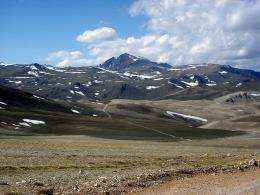
Photo of White Mountain peak taken in the Alpine Zone. Credit: Jonathan Lamb/Wikimedia Commons

(Medical Xpress)—George Wehby from the University of Iowa has been conducting a study to discover adverse mental development effects on toddlers and babies due to living at high altitudes. He's found, as he describes in his paper published in the Journal of Pediatrics that children living above 8,530 feet were twice as likely to be at risk of experiencing delays in their mental development as those living at or below 2,625 feet.

To find out more about possible adverse mental development in children living at high altitudes, Wehby worked with pediatricians from South American countries Ecuador, Brazil, Argentina, Bolivia and Chile over the years 2005 and 2006. Pediatricians administered tests to over 2000 children living in both high and lower altitude communities. The tests entailed asking the children to perform tasks that measured motor skills and problem solving abilities. Prior research had shown that living at can impact physical development, this new research was conducted to find out if the same is true of mental development.

In analyzing the results of the tests given to the children, Wehby found that those children three months to two years old showed a one in three to one in four chance of being at high risk of mental developmental delays, compared to one in five for children not living at high altitude. At high altitudes, the air has less oxygen in it, which some have suggested might mean that less oxygen makes it to the brain of a growing fetus, leading to developmental delays. The data also showed that for every 328 foot increase in altitude, there was a corresponding 2 percent increased risk of .

Wehby suggests that the data shows that and those involved in making health care need to be made aware of possible adverse effects on children living at high altitudes, and not just in South American countries. Cities in the United States, such as Albuquerque and Denver both have populations living over a mile high and some smaller communities in a few western states exist at over 10,000 feet. He adds that more testing needs to be done to determine why living at high altitudes impacts development and to determine if doing so has other as yet unknown adverse effects.

More information: Living on Higher Ground Reduces Child Neurodevelopment—Evidence from South America, doi:10.1016/j.jpeds.2012.09.011 , http://www.jpeds.com/article/S0022-3476(12)01025-6/abstract

Abstract
Objective
To study the effects of altitude on infant neurodevelopment in the first 2 years of life.
Study design
Data from a unique study of normal infant neurodevelopment in 5 South American countries were used. The sample included 2116 infants 3-24 months of age who were evaluated for neurodevelopmental problems by study physicians during their routine well-child visits at 31 pediatric practices. We used regression models with country fixed-effects that compare the neurodevelopment of children born at different altitudes within the same country to avoid confounding. The regressions adjust for several socioeconomic and demographic factors. We also evaluated altitude effects stratifying by sex, age, and household wealth. Infant neurodevelopment was evaluated by physicians by using the Bayley Infant Neurodevelopmental Screener. The primary outcome is an indicator for whether the infant is at high risk for neurodevelopmental problems based on the Bayley Infant Neurodevelopmental Screener norms.
Results
Altitude significantly increases the probability of being at high risk for neurodevelopmental problems (100-meter increase in altitude: OR 1.02; 95% CI 1.001-1.037; high altitude greater than 2600 meters vs low altitude less than 800 meters: OR 2.01; 95% CI 1.36-2.973). The effects are larger for females and for second than first year of life. The largest effect is for females 12-24 months of age (high vs low altitude: OR 4.147; 95% CI 1.466-12.013). There are no significant differences in altitude effects by household wealth.
Conclusions
Altitude may significantly increase the risk of neurodevelopmental problems during the first 2 years of life, especially for females during their second year of life.

Journal reference: Journal of Pediatrics search and more info website

© 2012 Phys.org

5 /5 (2 votes)  

Filter


Move the slider to adjust rank threshold, so that you can hide some of the comments.


Display comments: newest first

Digital_Wangateur
Nov 06, 2012

Rank: 1 / 5 (3)
huummm then why do the schools in Pitkin County CO send almost all of there kids to higher education allot more than than most schools nationally ... this study does not take in to account resources most communities that are in that zone are not wealthy ... on the other hand there is Pitkin county ... this study is bogus, without including the local education systems funding the wealth of the parents only has to do with the nutrition the receive and the stuff they have at home.
antialias_physorg
Nov 06, 2012

Rank: 5 / 5 (2)
why do the schools in Pitkin County CO send almost all of there kids to higher education...

What the hell has that got to do with the article?
this study is bogus, without including the local education systems funding the wealth of the parents

This study was administered on infants 3-24 months old.
And they do note:
"The regressions adjust for several socioeconomic and demographic factors."

Did you even read the article before commenting? You should try it some time.
NotAsleep
Nov 06, 2012

Rank: 5 / 5 (1)
"The data also showed that for every 328 foot increase in altitude, there was a corresponding 2 percent increased risk of developmental delays."

I'm curious how linear this trend is and if it starts at sea level. The adult human body is excellent at adapting to high altitudes with decreased performance generally starting at 8,000 feet and sharply increasing after 12,000 feet in a decidedly non-linear fashion
antialias_physorg
Nov 06, 2012

Rank: 5 / 5 (1)
I'm curious how linear this trend is and if it starts at sea level.

If it does then I know a couple of people who I'd love to subject to (massive) below sea-level depths. Either case it's win-win.
Sinister1811
Nov 07, 2012

Rank: not rated yet
why do the schools in Pitkin County CO send almost all of there kids to higher education...

What the hell has that got to do with the article?


To be fair, he sounds like he's misinterpreting a lot of things, and actually thinks that "higher education" literally means being physically/geographically higher. It's no wonder he didn't understand the article.
Rank 5 /5 (2 votes)
Relevant PhysicsForums posts

More news stories

New study recommends using active videogaming ('exergaming') to improve children's health

Levels of physical inactivity and obesity are very high in children, with fewer than 50% of primary school-aged boys and fewer than 28% of girls meeting the minimum levels of physical activity required to maintain health. ...

Pediatrics created May 17, 2013 | popularity 5 / 5 (1) | comments 0

Study shows preschoolers affected by medication-related poisonings at alarming rate

Poisonings in young children have increased over the past decade, mainly due to medications in the home. A new study led by the Central Ohio Poison Center at Nationwide Children's Hospital, found that medication-related poisonings ...

Pediatrics created May 16, 2013 | popularity not rated yet | comments 0

Implementation research and child diarrhea

While considerable recent progress has been made against childhood diarrheal diseases, the number of children dying from diarrhoea remains unacceptably high.

Pediatrics created May 14, 2013 | popularity not rated yet | comments 0

Massage therapy shown to improve stress response in preterm infants

It seems that even for the smallest of people, a gentle massage may be beneficial. Newborn intensive care units (NICUs) are stressful environments for preterm infants; mechanical ventilation, medical procedures, caregiving ...

Pediatrics created May 14, 2013 | popularity not rated yet | comments 0

Study updates estimates, trends for childhood exposure to violence, crime, abuse

A study by David Finkelhor, Ph.D., of the University of New Hampshire, and colleagues updates estimates and trends for childhood exposure to a range of violence, crime and abuse victimizations.

Pediatrics created May 13, 2013 | popularity not rated yet | comments 0


New research identifies risks, interventions for children's GI health

An increasing number of U.S. children are experiencing gastrointestinal issues that require interventions to resolve, according to research presented at Digestive Disease Week (DDW).

US psychiatry gets makeover in new manual

The latest makeover to a massive psychiatric tome honored by some, reviled by others and even called the "Bible" of mental disorders is being released Saturday with a host of new changes.

New case of SARS-like virus in Saudi: ministry

A new case of the deadly coronavirus has been detected in Saudi Arabia where 15 people have already died after contracting it, the health ministry announced on Saturday on its Internet website.

AIDS science at 30: 'Cure' now part of lexicon

Big names in medicine are set to give an upbeat assessment of the war on AIDS on Tuesday, 30 years after French researchers identified the virus that causes the disease.

New colonoscope provides ground-breaking view of colon

A ground-breaking advance in colonoscopy technology signals the future of colorectal care, according to research presented today at Digestive Disease Week(DDW). Additional research focuses on optimizing the minimal withdrawal ...

For combat veterans suffering from post-traumatic stress disorder, 'fear circuitry' in the brain never rests

Chronic trauma can inflict lasting damage to brain regions associated with fear and anxiety. Previous imaging studies of people with post-traumatic stress disorder, or PTSD, have shown that these brain regions can over-or ...