Gene linked to respiratory distress in babies
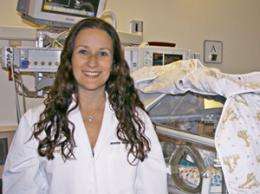
(Medical Xpress)—Some infants are more susceptible to potentially life-threatening breathing problems after birth, and rare, inherited DNA differences may explain why, according to research at Washington University School of Medicine in St. Louis.
The study is the first to identify a single gene—ABCA3—that is associated with a significant number of cases of respiratory distress syndrome (RDS) in babies born at or near full term. RDS is the most common respiratory problem in newborns and the most common lung-related cause of death and disease among U.S. infants less than a year old.
Their findings will be published in the December 2012 issue of Pediatrics and are available online.
The research may lead to new diagnostic and therapeutic strategies for prevention and treatment to improve respiratory outcomes for babies.
"We found that mutations in ABCA3 account for about 10 percent of respiratory disease in babies born near their due dates," said Jennifer A. Wambach, MD, assistant professor of pediatrics and the study's lead author. "These are babies who we typically think should have mature lungs and breathe normally. While we have known for a while that RDS is a heritable disease, this is the first gene to account for a significant proportion of disease among infants that are full-term or nearly full-term."
RDS occurs when an infant's lungs don't produce enough surfactant, a liquid that coats the inside of the lungs and helps keep them open so the baby can breathe. If there isn't enough surfactant, an infant has to work hard to breathe and may suffer from a lack of oxygen. Premature infants are at especially high risk of RDS, as surfactant production increases as babies near term. However, 2 percent to 3 percent of term and near-term babies also develop RDS.
The researchers' findings suggest a range of possibilities, Wambach said. These include using the genetic knowledge to plan affected infants' births near hospitals with neonatal intensive-care units and developing medical therapies to target the abnormal protein resulting from these mutations.
Wambach said the researchers hope to identify additional genes that cause neonatal RDS and better identify babies at risk.
"But right now we're studying how these mutations function in the laboratory," Wambach said. "Statistical associations help guide us, but we also need to understand the biology of these mutations."
The research team—including Aaron Hamvas, MD, and F. Sessions Cole, MD—evaluated five genes known to be important for normal breathing immediately after birth. Hamvas is the James Keating Professor of Pediatrics and medical director of the newborn intensive care unit at St. Louis Children's Hospital. Cole is the Park J. White, MD, Professor of Pediatrics.
The team looked at five genes involved in the metabolism of lung surfactant by taking DNA samples from more than 500 infants of African and European descent, with and without respiratory distress, who were carried to term or near term. They evaluated the same genes in an additional 48 babies with especially severe respiratory distress to see if their findings applied to that group, and in a third group of 1,066 Missouri babies, to determine the frequency of the mutations in a general population.
In comparing babies with and without respiratory distress, they found that babies of European descent with respiratory distress were more likely to have a single mutation in ABCA3, one of the five genes tested, than the infants with no breathing problems. Babies of African descent with respiratory distress also were more likely to have single ABCA3 mutations, but this difference did not reach statistical significance.
More than one-quarter of the babies with especially severe respiratory distress had a single mutation in ABCA3. Infants who inherit two defective copies of the ABCA3 gene usually require lung transplantation for survival. However, this is the first study to show that a single mutation in ABCA3 predisposes infants to respiratory distress that can usually be treated with neonatal intensive care.
The researchers also found that 1.5 percent to 3.6 percent of babies born in Missouri carry a single ABCA3 mutation, leading the researchers to estimate that about 10 percent of RDS cases among term and near-term infants may be attributable to mutations in ABCA3.
"We picked five candidate genes and thought we would find rare mutations in all of the genes," Wambach said. "However, we found very few mutations in the other genes, and they were not associated with RDS. Our findings were really isolated to this one gene, ABCA3."
More information: Wambach JA, Wegner DJ, DePass K, Heins H, Druley TE, Mitra, RD, An P, Zhang Q, Nogee LM, Cole FS, Hamvas A. Single ABCA3 Mutations and Risk for Neonatal Respiratory Distress Syndrome. Pediatrics vol. 130 (6), December 2012


