Need to learn from incidents and near misses in the health care chain
November 12, 2012 in Health

Need to learn from incidents and near misses in the health care chain

Enlarge

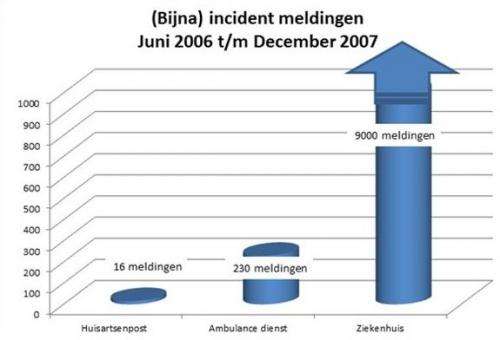
Approximately 1,735 patients a year on average die in the Netherlands as a result of mistakes. Health care professionals try to learn from these incidents and near misses, but the learning process is often confined within the individual organizations and the individual links in the health care chain. But incidents and near misses occur just as much when patients are referred from one link to another. Research into communication between the various links on incidents and near misses shows up the weak spots in the learning process within the chain. On 9 November 2012 Greet van der Kaap, research lecturer at Windesheim University of Applied Sciences in Zwolle, is to receive her PhD from the University of Twente on 'The Weakest Link, inter-organisational communication about (near) incidents in the health care chain'.

Patients and professionals in the health service depend on the correct transfer of from one link to another. If the information on a patient's is incorrect, an ambulance paramedic cannot provide the right care on the way to hospital. Or if a patient is allergic, everyone in the chain needs to know this. Something can go wrong in a link and only be discovered later on. can learn from these incidents and near misses by communicating about them.

Apples and oranges

But does every part of the chain speak the same language? Greet van der Kaap's study shows that different professions define incidents and near misses differently. Pharmacists and nurses often give specific examples, such as the wrong medication or mix-ups with names. For physicians and specialists this is much more of a grey area, concerning whether diagnoses are missed. In effect this is like comparing apples and oranges, and it hampers the between the various links.

Need to learn from incidents and near misses in the health care chain
Enlarge


Problem-solving ability

According to Van der Kaap, the combination of a high degree of problem-solving ability and a high degree of autonomy hampers communication on incidents and near misses, as can be seen for example in the case of GPs, specialists and nursing home doctors. The problem is solved: it's gone, so why talk about it? Professionals with a lower degree of autonomy, such as pharmacists and , are more likely to communicate with other professions, as they are not allowed to take decisions on medicines themselves, they cannot prescribe a solution if something goes wrong. For the sake of inter-organizational learning, however, it is important for all professionals to communicate about incidents and near misses.

Solutions

Van der Kaap puts forward some solutions to improve learning within the health care chain. This will require a good balance between differentiation and integration. Professionals need to realize that they form part of a chain, and communication with one another on incidents and near misses is vital. Providing feedback to professionals in other links is inextricably linked with inter-organizational learning. A reporting system covering the entire chain, for example with certain weeks scheduled for reporting (putting everyone on alert every so often) could also help – provided it is organized in such a way that it does not involve a lot of red tape or place excessive demands on scarce resources such as time and money.

Provided by University of Twente search and more info website

not rated yet  

Rank not rated yet
Relevant PhysicsForums posts

More news stories

New research identifies risks, interventions for children's GI health

An increasing number of U.S. children are experiencing gastrointestinal issues that require interventions to resolve, according to research presented at Digestive Disease Week (DDW).

Health created May 18, 2013 | popularity not rated yet | comments 0 | with audio podcast

Youth who have their first drink during puberty have higher levels of later drinking

Research shows that the earlier the age at which youth take their first alcoholic drink, the greater the risk of developing alcohol problems. Thus, age at first drink (AFD) is generally considered a powerful predictor of ...

Health created May 17, 2013 | popularity not rated yet | comments 0

British MPs concerned about parliamentary boozing

One quarter of British lawmakers believe there is an "unhealthy" drinking culture in the Houses of Parliament, according to a survey published on Friday.

Health created May 17, 2013 | popularity not rated yet | comments 0

Patient openness to research can depend on race and sex of study personnel

Researchers at the University of Cincinnati (UC) have found that the race and sex of study personnel can influence a patient's decision on whether or not to participate in clinical research.

Health created May 17, 2013 | popularity not rated yet | comments 0

Clinical support for patient self-management is rhetoric rather than reality

The processes to allow people to self-manage their own illness are not being used appropriately by health professionals to the benefit of their patients, new research suggests.

Health created May 17, 2013 | popularity not rated yet | comments 0


Researchers identify a potential new risk for sleep apnea: Asthma

Researchers at the University of Wisconsin have identified a potential new risk factor for obstructive sleep apnea: asthma. Using data from the National Institutes of Health (Heart, Lung, and Blood Institute)-funded Wisconsin ...

Ginger compounds may be effective in treating asthma symptoms

Gourmands and foodies everywhere have long recognized ginger as a great way to add a little peppery zing to both sweet and savory dishes; now, a study from researchers at Columbia University shows purified components of the ...

Study finds that sleep apnea and Alzheimer's are linked

A new study looking at sleep-disordered breathing (SDB) and markers for Alzheimer's disease (AD) risk in cerebrospinal fluid (CSF) and neuroimaging adds to the growing body of research linking the two.

Computational tool translates complex data into simplified 2-dimensional images

In their quest to learn more about the variability of cells between and within tissues, biomedical scientists have devised tools capable of simultaneously measuring dozens of characteristics of individual ...

New theory on genesis of osteoarthritis comes with successful therapy in mice

Scientists at Johns Hopkins have turned their view of osteoarthritis (OA) inside out. Literally. Instead of seeing the painful degenerative disease as a problem primarily of the cartilage that cushions joints, ...

'Gap' for HIV vaccine efforts after latest setback

The hunt for an HIV vaccine has gobbled up $8 billion in the past decade, and the failure of the most recent efficacy trial has delivered yet another setback to 26 years of efforts.