Inpatient brain injury education increases bike helmet use, study finds
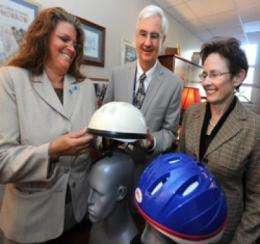
A 30-minute brain injury education program taught in the hospital may increase children's use of bicycle helmets, Georgia Health Sciences University researchers report.
The researchers provided bicycle helmet safety and brain injury prevention information to 120 patients age 5 to 18 at Georgia Health Sciences Children's Medical Center and found that helmet usage increased by 72.5 percent within the first month following the program – from only 11 children reporting wearing a bicycle helmet on every ride to 98 always wearing helmets.
"This is a big step in the right direction," said Rene Hopkins, Coordinator of Safe Kids East Central, a community-based childhood injury prevention program led by GHS Children's Medical Center, and a co-author on the study in the Journal of Child Neurology. Hopkins, a nurse educator who teaches bicycle safety in communities surrounding the Children's Medical Center, understands the numbers she's up against.
Only about one in four children age 4 to 15 wear a helmet when riding a bike and teen use of helmets is nearly zero, according to the Centers for Disease Control and Prevention. In addition, the CDC estimates that about 153,000 children are treated in emergency departments each year for head injuries suffered while bicycling.
"Wearing a bicycle helmet reduces the risk of severe brain damage from an injury by up to 88 percent," said Hopkins. "We want to get this message out in a venue where it will be heard, and the Children's Medical Center seemed like the logical place. When I go to schools, I get the kids and not the parents. When I go to PTA meetings, I get the parents but not the kids. But at the hospital, we get both parents and kids at the same time, and they tend to be more receptive to prevention information. There is an understood credibility in the health care setting," she said.
All 120 study participants received a bicycle helmet and basic helmet safety literature at the Children's Medical Center. In addition, 58 of the participants were randomly selected for additional brain injury education during their session that included basic brain function and anatomy and several hands-on demonstrations, like comparing the brain with an egg.
"We explained how the egg is like the head, the shell is like the skull, the white is like the fluid surrounding your brain, and the yolk is like the brain itself, protected by the rest," said Hopkins. "Then we showed what happens when you have a brain injury by dropping an unprotected egg."
Next, a gelatin brain mold was used to help children understand what a brain looks and feels like. Children also were asked to draw a clock showing a specified time on a piece of paper while looking only in a mirror held in front of them to simulate brain impairment that can result from a head injury.
One month following the program, 92.6 percent of the children who received the additional brain injury intervention reported wearing a helmet on every ride compared to 82.8 percent of those who received the abbreviated session. At three months, 96.2 percent who received the intervention were still wearing their helmets, while the other group dropped to 80 percent.
"Overall, 94 of the 120 children reported that they were still wearing helmets on every ride at three months out. So just giving the children a helmet and safety information while they were at the hospital made a huge difference," said Dr. Vernon A. Barnes, a physiologist in the Medical College of Georgia Department of Pediatrics at GHSU and corresponding author on the study. "But providing the additional intervention made an even stronger difference, because those children had higher retention rates at both one and three months."
Though parents were present during teaching, the study found them to be poor role models, with only 5 to 6 percent wearing a helmet on follow up. The CDC maintains that children are more likely to wear helmets if their parents do.
Since no previous studies have evaluated the efficacy of head injury prevention with the education of hospitalized children and their caregivers, Barnes said he would like to see other children's hospitals try the program with their patients. The next step will be to ascertain the best teaching model, including evaluating the program in the pediatric outpatient clinics.
"Pediatrics is all about illness and injury prevention, so it makes sense to discuss these things during routine health assessments," said Dr. Alice Little Caldwell, a Children's Medical Center pediatrician who also contributed to the study. "When I take the time with my patients to explain these kinds of things, I think it's very meaningful."
Enlisting health care providers to promote helmet-wearing, not just in our children's hospital, but across the nation, could significantly reduce the number of head injuries in children as a result of bicycle accidents, Barnes said.
A reduction in injuries means a reduction in health care costs as well.
Hopkins, who often provides free helmets to children through Safe Kids initiatives, said that a standard helmet costs about $15. The societal costs associated with bicycle-related head injury or death resulting from head injury is more than $3 billion annually, according to the CDC. Safe Kids USA estimates that a 25 percent reduction in childhood bicycle injuries and deaths could save over $500 million in medical costs and productivity lost.
"While cost is important, it's preventing injuries and saving lives that matters most," said Hopkins.


