Japan firm offers 3D model of foetus
November 27, 2012 by Miwa Suzuki in Other

Expectant parents in Japan can now obtain a 3D model of the foetus

Enlarge

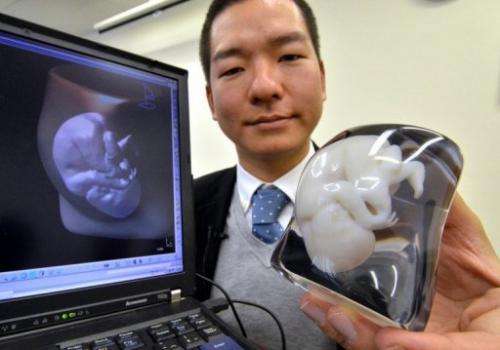
This photo, taken on November 26, shows Japan's 3D computer-aided design (CAD) venture Fasotec employee Tomohiro Kinoshita displaying a nine-month fetus and mother's body image, made of two-colour acrylic resin at the company's headquarters in Chiba, suburban Tokyo.

Expectant parents in Japan who can't wait to show the world what their baby will look like can now buy a three-dimensional model of the foetus to pass around their friends.

The nine-centimetre (3.6-inch) resin model of the white foetus, encased in a transparent block in the shape of the mother's body, is fashioned by a 3D printer after an MRI scan.

"As it is only once in a lifetime that you are pregnant with that child, we received requests for these kind of models from pregnant women who... do not want to forget the feelings and experience of that time," said Tomohiro Kinoshita of FASOTEC, the company offering the service.

The "Shape of an Angel", which costs 100,000 yen ($1,200), comes with a miniature version that could be a nice adornment to a mobile phone, he added. Many young women in Japan have decorations attached to their cellphone strap.

The company said the ideal time for a scan is around eight or nine months into the pregnancy.

For those who would like a less pricey version, the company will start offering a 3D model of the face of the foetus at 50,000 yen in December.

It will use ultrasound images taken at a medical clinic in Tokyo that has forged a tie-up with the company.

FASOTEC, originally a supplier of devices including 3D printers, uses a layering technique to build up three-dimensional structures. The technique has been touted as a solution to localised manufacture on a small scale.

The company also produces 3D models of internal organs that can be used by doctors to plan surgery or by medical students for training, a spokesman said.

It is also possible that models can be used in hospitals to better inform patients what their problems are, instead of relying on difficult-to-understand diagrams.

The technology "realises not only the form but also texture of the model—for example making it hard or soft", the firm said in a statement.

"By making a model that is similar to a real organ or bone, one can simulate operations and practise different surgical techniques."

Kinoshita said the company hit upon the idea of making 3D models of unborn babies in the hope that people would become more aware of the technology.

The company said some medics could also foresee diagnostic possibilities with the models that may help predict difficulties in the birthing process.

Three-dimensional printers have been around for several decades but advances in the technology mean it is now gaining in popularity in several fields.

The machines work in a similar way to an inkjet printer, but instead of ink they deposit layers of material on top of each other, gradually building up the product they are making.

Where traditional manufacturing only becomes efficient with economies of scale because of the need to produce moulds, 3D printing is capable of producing single copies of relatively complicated objects.

The technology is not yet advanced enough to build telephones or computers but it is already used to make components.

(c) 2012 AFP

5 /5 (1 vote)  

Rank 5 /5 (1 vote)
Related Stories
Relevant PhysicsForums posts

More news stories

Future doctors unaware of their obesity bias

Two out of five medical students have an unconscious bias against obese people, according to a new study by researchers at Wake Forest Baptist Medical Center. The study is published online ahead of print in the Journal of ...

Other created 2 hours ago | popularity not rated yet | comments 0

Plastic realistic: Medical students to use plastinated human bodies for anatomy learning

Nanyang Technological University's (NTU) new medical school will be pioneering the use of plastinated bodies for medical education in Singapore.

Other created 11 hours ago | popularity not rated yet | comments 0

Survey points out deficiencies in addictions training for medical residents

A 2012 survey of internal medicine residents at Massachusetts General Hospital (MGH) – one of the nation's leading teaching hospitals – found that more than half rated the training they had received in addiction and other ...

Other created May 22, 2013 | popularity 5 / 5 (1) | comments 0

Early use of tracheostomy for mechanically ventilated patients not associated with improved survival

For critically ill patients receiving mechanical ventilation, early tracheostomy (within the first 4 days after admission) was not associated with an improvement in the risk of death within 30 days compared to patients who ...

Other created May 21, 2013 | popularity not rated yet | comments 0

Decisions to forgo life support may depend heavily on the ICU where patients are treated

The decision to limit life support in patients in the intensive care unit (ICU) appears to be significantly influenced by physician practices and/or the culture of the hospital, suggests new findings from researchers at the ...

Other created May 21, 2013 | popularity not rated yet | comments 0


Glucosamine supplements tied to risk of eye condition

(HealthDay)—Glucosamine supplements that millions of Americans take to help treat hip and knee osteoarthritis may have an unexpected side effect: They may increase risk for developing glaucoma, a small ...

Controlling mood through the motions of mitochondria

(Medical Xpress)—Regulating the distribution of power in neurons is done by a system that makes the national electric grid look simple by comparison. Each neuron has several thousand mitochondria confined ...

Scientists discover molecule triggers sensation of itch

Scientists at the National Institutes of Health report they have discovered in mouse studies that a small molecule released in the spinal cord triggers a process that is later experienced in the brain as ...

Multiple research teams unable to confirm high-profile Alzheimer's study

Teams of highly respected Alzheimer's researchers failed to replicate what appeared to be breakthrough results for the treatment of this brain disease when they were published last year in the journal Science.

Researchers find common childhood asthma unconnected to allergens or inflammation

Little is known about why asthma develops, how it constricts the airway or why response to treatments varies between patients. Now, a team of researchers at Weill Cornell Medical College, Columbia University Medical Center ...

Motion quotient: IQ predicted by ability to filter motion (w/ video)

A brief visual task can predict IQ, according to a new study. This surprisingly simple exercise measures the brain's unconscious ability to filter out visual movement. The study shows that individuals whose ...