Neural circuit in the songbird brain that encodes representation of learned vocal sounds located
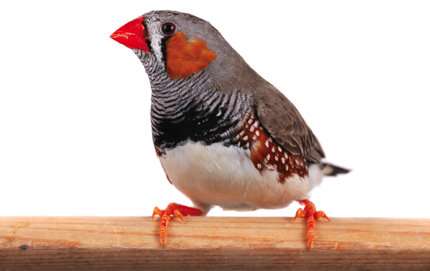
(Medical Xpress)—Although less than half the size of a walnut and weighing one gram, the brain of a songbird is fully capable of generating complex learned behaviors. Songbirds are one of the few groups of animals other than humans that actually learn the sounds used for their vocal communication and for that reason are fascinating to study.
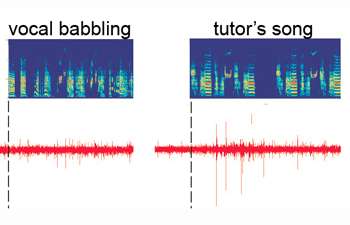
In a process similar to speech acquisition in humans, vocal learning in songbirds requires a period of sensorimotor integration early in life during which vocalizations are evaluated via auditory feedback and progressively refined to achieve an accurate imitation of a "tutor," such as a parent. Specifically, auditory feedback of vocal babbling (hearing self-produced vocalizations) is compared to a neural memory of tutor sounds in order to correctly match vocal production to those sounds.
A major question with regard to mechanisms of vocal learning is: What neural circuits carry out comparisons of auditory feedback to the neural representation of tutor vocal sounds?
Like a human infant, a juvenile songbird must first listen to and memorize the vocal sounds made by tutors (adult members of their own species). This auditory memory of vocal sounds is called a template, since it forms the pattern that must be translated from an auditory neural representation into a motor program that enables vocal muscles to imitate those sounds. Once this template memory has been learned, a juvenile songbird listens to its own auditory feedback, and then practices for about a month before gradually transforming unorganized "babbling" sounds into replicas of the tutor vocal sounds.
Hearing an adult tutor produce vocal sounds during a specific period of development is critical.
"Without that you'll strike out," Bottjer said. "For songbirds and humans, the first base of learning is having the right auditory experience in order to memorize vocal sounds."
Despite this fact, discovering the neural locus of the auditory template memory in the brain has been an elusive goal.
In a recent breakthrough, Bottjer's laboratory has located the neural signature of memorized tutor sounds in the songbird brain by studying the lateral magnocellular nucleus of the anterior neostriatum (LMAN)—a region in the cortex of the songbird brain crucial for learning. To their surprise, the LMAN region turned out to contain two subregions, a core of larger neurons that drive vocal production, and a surrounding shell of smaller neurons. The core and shell regions of LMAN give rise to parallel circuits through the basal ganglia and back to the cortex—an architecture that is well suited for comparing feedback of current vocal production to the template memory of tutor sounds.
Jennifer Achiro, a neuroscience doctoral student in Bottjer's laboratory, wondered if the function of the shell region of LMAN might be to carry out this comparator function. She and Bottjer hypothesized that the parallel circuit made by the shell region somehow compared auditory feedback of current vocal behavior to the template memory in order to achieve an accurate imitation. If so, then the shell circuit of LMAN should contain neural representations of both current vocal behavior (babbling) and the target vocal behavior (the memorized tutor sounds). Achiro recorded and studied the activity of more than 1,000 individual neurons while birds were listening to a battery of different vocal sounds.
"What we found is that any given neuron in this region is selectively tuned to either tutor sounds or to the bird's own vocalization but not both," Achiro said. "Individual neurons never respond to both vocal babbling sounds and the tutor sounds. It's one or the other."
"These data support the hypothesis that the shell subregion of LMAN is critical in vocal learning by comparing the babbling sounds being produced to the template memory of tutor sounds," Bottjer added.
Bottjer and Achiro believe neurons that respond only to memorized tutor sounds act as a filter: Juvenile birds occasionally produce a sound that is similar enough to a tutor sound to activate tutor-tuned neurons and this would enable these neurons to act as a filter for correct matches of current vocal production to the template memory. In addition, feedback of tutor-similar babbling sounds (i.e., that are a close enough match to tutor song) would activate both tutor-tuned and babbling-tuned shell neurons simultaneously. They predict these two types of neurons will converge somewhere downstream to complete the comparison process.
Human speech also requires auditory experience during a critical period of development in which both memorizing vocal sounds and the auditory-motor integration needed to imitate those sounds is occurring. In numerous human speech disorders, neurodevelopmental aspects of this process are disrupted.
Autism and Tourette syndrome, for example, involve deficits in social interactions and vocal communication. For people who stutter, it is the neural processing of their own auditory feedback that is critically disrupted, generally early in vocal learning. That involves cortico-basal ganglia circuitry similar to the circuits that Bottjer and Achiro are studying in songbirds.
"Humans and songbirds are both matching their own early vocalizations to the neural representation of vocal auditory memory," Bottjer said. "This encoding and integration process
is very likely to be disrupted in people with disordered speech and we can begin to understand this by studying the songbird brain." These studies are yielding basic information regarding fundamental mechanisms of neural development and learning. This type of "basic-science" research advances our understanding of normal brain functioning, especially the enhanced learning capacity of juvenile brains, and forms a foundation for understanding etiologies for a wide spectrum of neurodevelopmental disorders.


