US organ transplant pioneer Murray dies at 93 (Update)
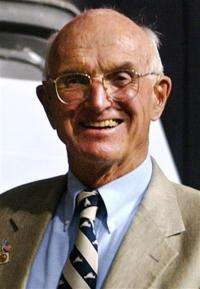
This July 28, 2004 file photo shows Dr. Joseph E. Murray, who performed the world's first successful kidney transplant and won a Nobel Prize for his pioneering work, has died at age 93. Murray's death in Boston was confirmed Monday by Brigham and Women's Hospital spokesman Tom Langford. Murray shared the Nobel Prize in Physiology or Medicine in 1990 with Dr. E. Donnall Thomas, who won for his work in bone marrow transplants. (AP Photo/Eric Miller)
Dr. Joseph Murray, who won the Nobel Prize for performing the first-ever successful organ transplant, died late Monday in Boston at the age of 93, his family said.
After suffering a stroke Thursday, Murray died at Boston's Brigham and Women's Hospital, where he conducted the landmark kidney transplant in 1954.
"We are grateful that we had the opportunity to have a wonderful Thanksgiving together as a family—four generations of Murrays—and we will cherish the many happy memories we have of this remarkable man," his son Rick Murray said.
Born on April 1, 1919 in Milford, Massachusetts, Murray traced his interest in the emerging science of transplants to the three years he spent on the surgical ward of an army hospital in Pennsylvania during World War II.
There surgeons would often treat severely burned soldiers with skin grafts from cadavers as a temporary measure.
"The slow rejection of the foreign skin grafts fascinated me. How could the host distinguish another person's skin from his own?" Murray would later write in an autobiographical essay published by the Nobel committee.
Murray learned that the chief plastic surgeon, Colonel James Brown, had earlier carried out a skin graft on identical twins in which the recipient's body had accepted the foreign tissue rather than instinctively attacking it.
"This was the impetus to my study of organ transplantation," Murray wrote.
The prospect of transplanting organs from one living patient to another was controversial from the outset, with critics viewing it as a violation of nature that endangered both the donor and the recipient.
But the public attitude to the procedure changed following Murray's historic operation on December 23, 1954, when he transplanted a kidney from Ronald Herrick to identical twin brother Richard, extending his life by eight years.
In those eight years, Herrick married his post-operative nurse, had two children and toasted his brother for "the extra drink," the Boston Globe reported. Ronald Herrick only passed away in 2010.
In the 1960s Murray helped to develop the drug Imuran, which suppressed the immune system to allow patients to accept transplants from unrelated donors.
He won the Nobel Prize in Medicine in 1990, sharing the honor with E. Donnall Thomas, who pioneered bone marrow transplants.
Their discoveries have been used to cure or provide a decent life for tens of thousands of severely ill patients.
Murray later focused on plastic surgery, specifically the repair of facial defects in children. He led Brigham's plastic surgery department for almost four decades and the division at Children's Hospital Medical Center from 1972 to 1985, said the Globe.
"My life as a surgeon-scientist, combining humanity and science, has been fantastically rewarding," Murray wrote in the Nobel autobiography.
"In our daily patients we witness human nature in the raw—fear, despair, courage, understanding, hope, resignation, heroism. If alert, we can detect new problems to solve, new paths to investigate."
Murray is survived by his wife, three sons, three daughters and 18 grandchildren, the Globe said.
(c) 2012 AFP
-
Donor in 1st successful transplant dies in Maine
Dec 29, 2010 |
not rated yet |
0
-
On the cusp of new transplant era
Sep 28, 2011 |
not rated yet |
0
-
Rare 'domino' transplant preformed
Oct 03, 2006 |
not rated yet |
0
-
Italy hospital conducts first fully robotic liver procedure
Jun 25, 2012 |
not rated yet |
0
-
Stem cell study seeks to wean non-related transplant recipients from anti-rejection drugs
May 28, 2009 |
not rated yet |
0
-
Motion perception revisited: High Phi effect challenges established motion perception assumptions
Apr 23, 2013 |
3 / 5 (2) |
2
-
Anything you can do I can do better: Neuromolecular foundations of the superiority illusion (Update)
Apr 02, 2013 |
4.5 / 5 (11) |
5
-
The visual system as economist: Neural resource allocation in visual adaptation
Mar 30, 2013 |
5 / 5 (2) |
9
-
Separate lives: Neuronal and organismal lifespans decoupled
Mar 27, 2013 |
4.9 / 5 (8) |
0
-
Sizing things up: The evolutionary neurobiology of scale invariance
Feb 28, 2013 |
4.8 / 5 (10) |
14
-
Classical and Quantum Mechanics via Lie algebras
Apr 15, 2011
- More from Physics Forums - Independent Research
More news stories
ACP issues recommendations for management of high blood glucose in hospitalized patients
High blood glucose is associated with poor outcomes in hospitalized patients, and use of intensive insulin therapy (IIT) to control hyperglycemia is a common practice in hospitals. But the recent evidence does not show a ...
Other
May 24, 2013 |
4 / 5 (1) |
0
Future doctors unaware of their obesity bias
Two out of five medical students have an unconscious bias against obese people, according to a new study by researchers at Wake Forest Baptist Medical Center. The study is published online ahead of print in the Journal of ...
Other
May 23, 2013 |
not rated yet |
0
Plastic realistic: Medical students to use plastinated human bodies for anatomy learning
Nanyang Technological University's (NTU) new medical school will be pioneering the use of plastinated bodies for medical education in Singapore.
Other
May 23, 2013 |
not rated yet |
0
Survey points out deficiencies in addictions training for medical residents
A 2012 survey of internal medicine residents at Massachusetts General Hospital (MGH) – one of the nation's leading teaching hospitals – found that more than half rated the training they had received in addiction and other ...
Other
May 22, 2013 |
5 / 5 (1) |
0
Early use of tracheostomy for mechanically ventilated patients not associated with improved survival
For critically ill patients receiving mechanical ventilation, early tracheostomy (within the first 4 days after admission) was not associated with an improvement in the risk of death within 30 days compared to patients who ...
Other
May 21, 2013 |
not rated yet |
0
First drug to improve heart failure mortality in over a decade
Coenzyme Q10 decreases all cause mortality by half, according to the results of a multicentre randomised double blind trial presented today at Heart Failure 2013 congress. It is the first drug to improve heart failure mortality ...
Seniors more likely to crash when driving with pet, study finds
(HealthDay)—Animals make great companions for senior citizens, but elderly people who always drive with a pet in the car are far more likely to crash than those who never drive with a pet, researchers have ...
Heart failure accelerates male 'menopause'
Heart failure accelerates the aging process and brings on early andropausal syndrome (AS), according to research presented today at the Heart Failure Congress 2013. AS, also referred to as male 'menopause', was four times ...
Death highest in heart failure patients admitted in January, on Friday, and overnight
Mortality and length of stay are highest in heart failure patients admitted in January, on Friday, and overnight, according to research presented today at the Heart Failure Congress 2013. The analysis of nearly 1 million ...
Feds fight morning-after pill age ruling in NY
(AP)—Department of Justice lawyers have again asked a federal appeals court in New York to delay lifting age restrictions and prescription requirements on an emergency contraceptive popularly known as the morning-after ...
New immune system discovered
(Medical Xpress)—A research team, led by Jeremy Barr, a biology post-doctoral fellow, unveils a new immune system that protects humans and animals from infection.