Upbeat view on old age may help seniors bounce back from disability
November 20, 2012 by Serena Gordon, Healthday Reporter in Health

Upbeat view on old age may help seniors bounce back from disability

Study found those with more optimistic outlooks had better recoveries.

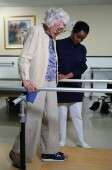
(HealthDay)—Seniors who tend to think of other older people as spry instead of decrepit are far more likely to bounce back after a serious disability than people with a more negative outlook, according to a new study.

Older people who had positive age stereotypes were 44 percent more likely to recover completely from a severe disability. They also were 23 percent more likely to progress from a severe disability to a mild disability.

"This research suggests that we might want to think about the role of stereotypes in disability," said the study's lead author, Becca Levy, associate professor of and at the Yale School of Public Health in New Haven, Conn.

Results of the study are published as a research letter in the Nov. 21 issue of the .

The researchers say they began the study because little research has been done to figure out why some recover from disability and others do not. They recruited more than 700 people aged 70 or older who were not disabled at the start of the study. During the 11-year follow-up period, nearly 600 people were disabled for at least a month.

The disability had to affect a person's ability to perform activities of daily living, such as dressing and feeding themselves.

During the study, the researchers asked the study volunteers, "When you think of old persons, what are the first five words or that come to mind?" Their responses were graded on a scale of one (most negative) to five (most positive). A word such as "decrepit" scored a one, while the word "spry" scored a five.

Those with a more positive attitude toward seniors were far more likely to recover completely from their disability. The positive group had almost an 8 percent higher recovery rate from a severe disability to no disability. A similar improvement occurred in the rates of going from severe disability to mild disability.

There also was a slight improvement in the rates of people going from a mild disability to no disability for those with positive age stereotypes.

A few factors could be at play here, Levy said. One could be that a might help buffer against stress and lessen cardiovascular responses to challenges, which could reduce disability from heart issues.

She said it's also possible that people who believe older folks can still be strong may be more likely to go to rehabilitation, and to participate in vigorous exercise programs that may help improve their disability.

Another expert noted how society's view of aging has changed.

"Active life spans have increased for older people, even from just 20 years ago," said Dr. Gary Kennedy, director of the division of geriatric psychiatry at Montefiore Medical Center, in New York City. "That might help make people's perspectives more positive."

And, he added, positive people may "stay physically active, and that can-do attitude lets you attack your problems more aggressively, making you more likely to keep at it until you're better."

If you tend to be more negative naturally, Levy noted, "there are many positive examples out there. Try to think about ways of bolstering positive age stereotypes, and questioning negative ."

Although the study found an association between having a positive view of aging and better recovery from disability, it did not prove a cause-and-effect relationship.

More information: Learn more about preventing falls, a common cause of disability, from the U.S. National Institutes of Health's Senior Health website.

Journal reference: Journal of the American Medical Association search and more info website

Copyright © 2012 HealthDay. All rights reserved.

not rated yet  

Filter


Move the slider to adjust rank threshold, so that you can hide some of the comments.


Display comments: newest first

theskepticalpsychic
Nov 20, 2012

Rank: not rated yet
Interesting. But note: the only times anybody uses the word "spry" is in reference to old people. "THat teen is sure spry for his age!" is not a remark one hears often. How about simply using the word "agile"? Or "energetic"? I say this because word connotations can be subtle markers for a speaker's unconscious attitudes towards the subject s/he is discussing.
Rank not rated yet
Relevant PhysicsForums posts

More news stories

Farm bill: Senate rejects GMO labeling amendment

The Senate has overwhelmingly rejected an amendment allowing states to require labeling of genetically modified foods.

Health created 25 minutes ago | popularity not rated yet | comments 0

McDonald's can't shake criticism about nutrition

(AP)—McDonald's once again faced criticism that it's a purveyor of junk food that markets to children at its annual shareholder meeting Thursday.

Health created 1 hour ago | popularity not rated yet | comments 0

Economic incentives increase blood donation without negative consequences

Can economic incentives such as gift cards, T-shirts, and time off from work motivate members of the public to increase their donations of blood?

Health created 3 hours ago | popularity not rated yet | comments 0 | with audio podcast

Adult day services for dementia patients provide stress relief to family caregivers

Family caregivers of older adults with dementia are less stressed and their moods are improved on days when dementia patients receive adult day services (ADS), according to Penn State researchers.

Health created 5 hours ago | popularity not rated yet | comments 0

Schools should provide opportunities for 60 minutes of daily physical activity to all students

Given the implications for the overall health, development, and academic success of children, schools should play a primary role in ensuring that all students have opportunities to engage in at least 60 minutes per day of ...

Health created 5 hours ago | popularity not rated yet | comments 0


When oxygen is short, EGFR prevents maturation of cancer-fighting miRNAs

Even while being dragged to its destruction inside a cell, a cancer-promoting growth factor receptor fires away, sending signals that thwart the development of tumor-suppressing microRNAs (miRNAs) before it's dissolved, researchers ...

Diabetes' genetic underpinnings can vary based on ethnic background, studies say

Ethnic background plays a surprisingly large role in how diabetes develops on a cellular level, according to two new studies led by researchers at the Stanford University School of Medicine.

Flu vaccine also linked to narcolepsy in adults, study reports

Finnish researchers unveiled new data Thursday to link the Pandemrix flu vaccine to a higher risk of the sleeping disorder narcolepsy in adults.

Heart healthy lifestyle may cut kidney disease patients' risk of kidney failure

Maintaining a heart healthy lifestyle may also help protect chronic kidney disease patients from developing kidney failure and dying prematurely, according to a study appearing in an upcoming issue of the Journal of the Am ...

J&J expects 10-plus new drug applications by 2017

(AP)—Johnson & Johnson is developing what could eventually be game-changing treatments for depression and pain, and it's aiming to apply for approval of more than 10 new medicines by 2017, executives said Thursday during ...

Second child contracts polio in Pakistan's Waziristan

A second child has contracted polio in a restive Pakistani tribal region near the Afghan border after the Taliban banned vaccinations there nearly a year ago, a UN official said Thursday.