EP studies helpful in lumbar spinal stenosis prognosis
December 28, 2012 in Diseases, Conditions, Syndromes
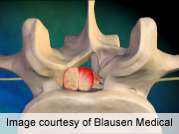
Electrophysiological abnormalities have been identified that are of some prognostic value in determining deteriorating clinical status over the long term for patients with mild-to-moderate lumbar spinal stenosis, according to research published in the December issue of the European Spine Journal.
(HealthDay)—Electrophysiological abnormalities have been identified that are of some prognostic value in determining deteriorating clinical status over the long term for patients with mild-to-moderate lumbar spinal stenosis (LSS), according to research published in the December issue of the European Spine Journal.
Blanka Micankova Adamova, Ph.D., of University Brno in the Czech Republic, and colleagues followed a group of 56 patients with clinically symptomatic mild-to-moderate LSS for seven years to identify predictors of clinical outcome that might one day assist in therapeutic selection.
The researchers identified electrophysiological parameters that were significantly associated with unsatisfactory clinical outcomes in this patient population. Specifically, patients with electromyography (EMG) signs of pluriradicular involvement were 3.72-fold more likely to have an unsatisfactory outcome (68.2 versus 32.3 percent). Additionally, those with an averaged soleus H-reflex amplitude of 2.8 mV or less were 2.87-fold more likely to have an unsatisfactory outcome (50.0 versus 14.7 percent).
"Satisfactory outcome (unchanged or better clinical status) appeared in 61 percent of patients with mild-to-moderate LSS after seven-year follow-up," the authors write. "As electrophysiological parameters showed some prognostic value in patients for LSS, especially those of pluriradicular involvement and the parameters of soleus H-reflex, we recommend the use of needle EMG and conduction studies as a standard examination in patients with LSS."
More information: Abstract
Full Text
Copyright © 2012 HealthDay. All rights reserved.
-
Lumbar spinal stenosis lowers health-related QoL
Apr 07, 2012 |
not rated yet |
0
-
Pain, disability don't predict function in spinal stenosis
Jul 16, 2012 |
not rated yet |
0
-
Tests don't predict outcome after spine fusion for back pain
Nov 15, 2012 |
not rated yet |
0
-
Tests ID'd for use in outcome assessment of spinal stenosis
Jul 12, 2012 |
not rated yet |
0
-
Disc disease severity doesn't predict surgical outcomes
Nov 09, 2012 |
not rated yet |
0
-
Motion perception revisited: High Phi effect challenges established motion perception assumptions
Apr 23, 2013 |
3 / 5 (2) |
2
-
Anything you can do I can do better: Neuromolecular foundations of the superiority illusion (Update)
Apr 02, 2013 |
4.5 / 5 (11) |
5
-
The visual system as economist: Neural resource allocation in visual adaptation
Mar 30, 2013 |
5 / 5 (2) |
9
-
Separate lives: Neuronal and organismal lifespans decoupled
Mar 27, 2013 |
4.9 / 5 (8) |
0
-
Sizing things up: The evolutionary neurobiology of scale invariance
Feb 28, 2013 |
4.8 / 5 (10) |
14
-
Classical and Quantum Mechanics via Lie algebras
Apr 15, 2011
- More from Physics Forums - Independent Research
More news stories
WHO: Scientific red tape mars efforts vs. virus
International efforts to combat a new pneumonia-like virus that has now killed 22 people are being slowed by unclear rules and competition for the potentially profitable rights to disease samples, the head ...
Diseases, Conditions, Syndromes
5 minutes ago |
not rated yet |
0
Shortage of key drug hampering U.S. efforts to control TB, report says
(HealthDay)—A shortage of a critical tuberculosis drug has hampered the efforts of health departments across the United States to contain the spread of the highly infectious lung disease, federal officials ...
Diseases, Conditions, Syndromes
45 minutes ago |
not rated yet |
0
Heart healthy lifestyle may cut kidney disease patients' risk of kidney failure
Maintaining a heart healthy lifestyle may also help protect chronic kidney disease patients from developing kidney failure and dying prematurely, according to a study appearing in an upcoming issue of the Journal of the Am ...
Diseases, Conditions, Syndromes
1 hour ago |
not rated yet |
0
Flu vaccine also linked to narcolepsy in adults, study reports
Finnish researchers unveiled new data Thursday to link the Pandemrix flu vaccine to a higher risk of the sleeping disorder narcolepsy in adults.
Diseases, Conditions, Syndromes
1 hour ago |
not rated yet |
0
Second child contracts polio in Pakistan's Waziristan
A second child has contracted polio in a restive Pakistani tribal region near the Afghan border after the Taliban banned vaccinations there nearly a year ago, a UN official said Thursday.
Diseases, Conditions, Syndromes
1 hour ago |
not rated yet |
0
Controlling mood through the motions of mitochondria
(Medical Xpress)—Regulating the distribution of power in neurons is done by a system that makes the national electric grid look simple by comparison. Each neuron has several thousand mitochondria confined ...
Future doctors unaware of their obesity bias
Two out of five medical students have an unconscious bias against obese people, according to a new study by researchers at Wake Forest Baptist Medical Center. The study is published online ahead of print in the Journal of ...
Research identifies a way to make cancer cells more responsive to chemotherapy
Breast cancer characterized as "triple negative" carries a poor prognosis, with limited treatment options. In some cases, chemotherapy doesn't kill the cancer cells the way it's supposed to. New research from Western University ...
Mayo Clinic genomic analysis lends insight to prostate cancer
Mayo Clinic researchers have used next generation genomic analysis to determine that some of the more aggressive prostate cancer tumors have similar genetic origins, which may help in predicting cancer progression. The findings ...
Merck ends development of Parkinson's disease drug
(AP)—Merck & Co. says it is ending development of an experimental Parkinson's disease drug because the drug wasn't working.
New microsphere-based methods for detecting HIV antibodies
Detection of HIV antibodies is used to diagnose HIV infection and monitor trials of experimental HIV/AIDS vaccines. New, more sensitive detection systems being developed use microspheres to capture HIV antibodies ...