Mathematics: The key to better and cheaper healthcare
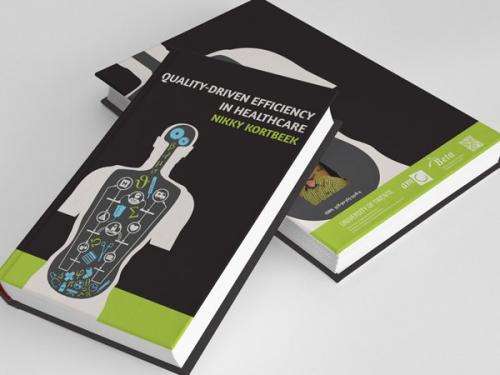
Efforts to achieve higher efficiency in healthcare delivery are often assumed to be forced by budget cuts that are in the end harmful to patients. However, quality improvements and cost savings can in fact go side-by-side, argues Nikky Kortbeek in his thesis on which he was recently awarded a PhD with distinction.
He performed his research at the Center for Health Operations Improvement Research (CHOIR) of the University of Twente and at the Quality Assurance & Process Innovation Department (KPI) at the Academic Medical Center Amsterdam (AMC). It is precisely by getting a better grip on the logistics behind healthcare delivery that a higher quality of care can be realized. In his thesis he demonstrates, for example, that the productivity of staff and beds in nursing ward can be improved by 10 to 20% while at the same time increasing the reliability of the quality of care.
Healthcare organizations face huge challenges during the upcoming years: the constant cost increases must be halted, while at the same time patients are becoming more and more demanding, and hospitals nationwide still cope with some 2000 avoidable deaths each year. Simultaneously improving efficiency and quality of care would seem to be a contradiction in terms. Yet Kortbeek shows in his thesis, along a number of case studies, that this is absolutely doable. The key is developing and applying mathematical models.
Uncertain versus unpredictable
It sounds plausible that a nursing ward cannot be prepared for every scenario possible: the number of patients arriving during a certain day is unknown, some recover more quickly than others, and complications may occur. But this, Kortbeek explains, does not mean that it is impossible to plan ahead: "Variability is not the same as unpredictability. It is the goal of our research field, stochastic operations research, to help problem owners make the best possible decisions in complex and uncertain environments."
Politically charged
Mathematical models also facilitate decision-making processes in hospitals, claims Kortbeek. As healthcare environments are often politically charged, experimenting with a new approach in practice straight away is a high-risk strategy. Mathematical models have a quantitative predictive value. This makes healthcare professionals more ready to acknowledge and understand the need for the proposed measures: they provide insight in why a new approach works better.
Flexible staffing
Kortbeek's thesis describes a number of cases where he and his fellow researchers supported hospitals to organize processes in the healthcare chain as a whole so as to make better use of scarce resources such as beds, operating theatres and staff. For instance, they can predict bed occupancies on an hourly level if they take relevant information on operating theatre schedules into account. They also propose flexible nurse staffing strategies, meaning that is it only at the start of their shifts decided in which they will be working. This makes it easier to accurately respond to the fluctuating patient population. Applying this methodology to four surgical nursing wards at the AMC shows, for instance, that productivity can be improved by 10 to 20% with higher quality of care.
Paediatric neuromuscular centre
Kortbeek and a group of students also worked on establishing the AMC's center for children with chronic neuromuscular diseases, "The Childrens' Muscle Center Amsterdam', which opened on 20 November. Having to visit the hospital several times in succession places a great strain on them. The question was, why not schedule all the consultations and therapies on the same day? This would mean taking all the required treatments, diagnostic test, and consultations into account, as well as the availability of specialists, to create optimal day schedules. This was done successfully, resulting in better coordinated and less stressful treatments.
Nikky Kortbeek (1983) did his PhD research – he gained his PhD with distinction on 23 November – in Prof. Richard Boucherie's Stochastic Operations Research Group, which is part of the University of Twente's CTIT research institute. The research for healthcare institutions took place under the auspices of the Center for Health Operations Improvement Research (CHOIR), which is now working together with many medical centres in the Netherlands.
The thesis, "Quality-Driven Efficiency in Healthcare," for which Kortbeek was recently awarded a PhD with distinction, is available in digital form.


