Professor works toward a better brainwave monitor
December 6, 2012 by Angela Herring in Neuroscience
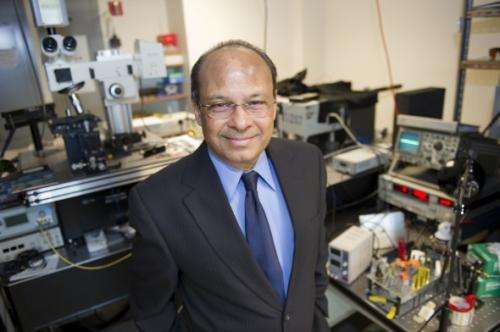
Srinivas Sridhar’s electric field encephalography (EFEG) is capable of getting much more detailed information about the brain’s electrical activity. Credit: Mary Knox Merrill
The electrical outputs of the brain contain massive amounts of information that could be a powerful resource if we could fully tap into it. Our brain processes things we see before any conscious recognition of those images comes to bear. While we can already measure electromagnetic activity with EEG and MEG, both of these techniques are limited.
A new method developed in the lab of physics professor Srinivas Sridhar could measure the brain's activity to, for example, detect threatening patterns in a drone pilot's field of vision or track the brain's response to neurological drugs. Other possible applications range from emotion analysis to neuromarketing, whereby researchers examine the unconscious response to advertisements
Backed by an I-Corps grant from the National Science Foundation, Sridhar plans to turn this idea into a reality. "It's a platform that could be adapted to different applications," Sridhar said of the theoretically feasible technology. Now he and his team, which comprises psychology professor Yuri Petrov and associate research scientist Ozgur Yavuzcetin, are developing an experimental prototype.
Sridhar noted that the new technology could be useful for many medical applications, including monitoring the brain of an anesthetized patient.
The new technology would be completely portable. Sridhar envisions an iPhone app that collects brainwave activity of patients with neurological disorders, processes the data in the cloud and then broadcasts it to their doctors.
"The I-Corps program creates an innovation ecosystem to translate NSF research into real products," Sridhar said. "The goal is simple: Commercialize this." In partnership with Northeastern Health Sciences Entrepreneur alumnus Roy Miller, that is exactly what the team plans to do.
More information: works.bepress.com/ssridhar
Provided by
Northeastern University
-
The language of neural cells
Aug 23, 2012 |
not rated yet |
0
-
Titania nanotubes go commercial: Potential use in fuel cells, solar panels
Nov 01, 2012 |
not rated yet |
0
-
Tracking America's physical activity, via smartphone
Jun 19, 2012 |
not rated yet |
0
-
Are we justified in our fights to save endangered species?
Oct 04, 2012 |
not rated yet |
0
-
A small-scale solution with a large-scale impact
Aug 27, 2012 |
not rated yet |
0
-
Motion perception revisited: High Phi effect challenges established motion perception assumptions
Apr 23, 2013 |
3 / 5 (2) |
2
-
Anything you can do I can do better: Neuromolecular foundations of the superiority illusion (Update)
Apr 02, 2013 |
4.5 / 5 (11) |
5
-
The visual system as economist: Neural resource allocation in visual adaptation
Mar 30, 2013 |
5 / 5 (2) |
9
-
Separate lives: Neuronal and organismal lifespans decoupled
Mar 27, 2013 |
4.9 / 5 (8) |
0
-
Sizing things up: The evolutionary neurobiology of scale invariance
Feb 28, 2013 |
4.8 / 5 (10) |
14
-
Pressure-volume curve: Elastic Recoil Pressure don't make sense
7 hours ago
-
If you became brain-dead, would you want them to pull the plug?
May 17, 2013
-
MRI bill question
May 15, 2013
-
Ratio of Hydrogen of Oxygen in Dessicated Animal Protein
May 13, 2013
-
Alcohol and acetaminophen
May 13, 2013
-
Marie Curie's leukemia
May 13, 2013
- More from Physics Forums - Medical Sciences
More news stories
For combat veterans suffering from post-traumatic stress disorder, 'fear circuitry' in the brain never rests
Chronic trauma can inflict lasting damage to brain regions associated with fear and anxiety. Previous imaging studies of people with post-traumatic stress disorder, or PTSD, have shown that these brain regions can over-or ...
Neuroscience
9 hours ago |
not rated yet |
0
|
Temporal processing in the olfactory system
The neural machinery underlying our olfactory sense continues to be an enigma for neuroscience. A recent review in Neuron seeks to expand traditional ideas about how neurons in the olfactory bulb might encode information about ...
Neuroscience
20 hours ago |
not rated yet |
0
|
Melon focus headband turns to Kickstarter for rollout plans
(Medical Xpress)—What if the quality of your work depends more on your focus on the piano keys or canvas or laptop than your musical or painting or computing skills? If target users can be convinced, they ...
Neuroscience
21 hours ago |
3.7 / 5 (3) |
0
|
Deep brain stimulation: A fix when the drugs don't work
Neurological disorders can have a devastating impact on the lives of sufferers and their families.
Neuroscience
May 17, 2013 |
5 / 5 (1) |
0
|
Brain makes call on which ear is used for cell phone
If you're a left-brain thinker, chances are you use your right hand to hold your cell phone up to your right ear, according to a newly published study from Henry Ford Hospital in Detroit.
Neuroscience
May 16, 2013 |
2 / 5 (2) |
0
|
New research identifies risks, interventions for children's GI health
An increasing number of U.S. children are experiencing gastrointestinal issues that require interventions to resolve, according to research presented at Digestive Disease Week (DDW).
New colonoscope provides ground-breaking view of colon
A ground-breaking advance in colonoscopy technology signals the future of colorectal care, according to research presented today at Digestive Disease Week(DDW). Additional research focuses on optimizing the minimal withdrawal ...
AIDS science at 30: 'Cure' now part of lexicon
Big names in medicine are set to give an upbeat assessment of the war on AIDS on Tuesday, 30 years after French researchers identified the virus that causes the disease.
Now we know why old scizophrenia medicine works on antibiotics-resistant bacteria
In 2008 researchers from the University of Southern Denmark showed that the drug thioridazine, which has previously been used to treat schizophrenia, is also a powerful weapon against antibiotic-resistant bacteria such as ...
Individuals who drink heavily and smoke may show 'early aging' of the brain
Treatment for alcohol use disorders works best if the patient actively understands and incorporates the interventions provided in the clinic. Multiple factors can influence both the type and degree of neurocognitive abnormalities ...
College women exceed NIAAA drinking guidelines more frequently than college men
In order to avoid harms associated with alcohol consumption, in 2009 the National Institute on Alcohol Abuse and Alcoholism issued guidelines that define low-risk drinking. These guidelines differ for men and women: no more ...
Dec 06, 2012
Rank: not rated yet