UCLA doctors remove man's heart, replace it with total artificial heart
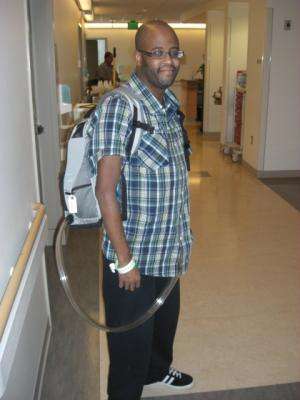
Imagine living without a heart. It is possible—if you have a new artificial heart pumping blood through your body. You can even go to the supermarket, watch your kid's soccer game or go on a hike.
Ronald Reagan UCLA Medical Center has performed its first procedure to remove a patient's diseased heart and replace it with a SynCardia Temporary Total Artificial Heart.
Chad Washington, 35, underwent the seven-hour transplant surgery at UCLA on Oct. 29, led by Dr. Murray Kwon, an assistant professor of cardiothoracic surgery.
The temporary pump will act as a "bridge" until Washington receives a new donor heart.
"Historically, patients with a total artificial heart had to remain hospitalized while they waited for a transplant because they were tethered to a large machine to power the device," Kwon said. "Today, however, this device can be powered by advanced technology small enough to fit in a backpack."
"It sounds like a loud grandfather clock going 'tick-tock' in my chest, but it doesn't feel foreign. It's there to help," Washington said of the artificial heart. "I'm so glad to be living in an age where technology is moving so fast."
Washington, an aspiring chef is who is married and has a 4-year-old son, has suffered from heart disease since he was born. From the time he was 10 days old through adulthood, he underwent a series of heart-repair surgeries and had pacemakers and a defibrillator implanted.
Then his heart deteriorated. He received a heart transplant in February of this year, and for the first time in his life, he knew what it was like to live with a healthy heart. It gave him energy, and he was amazed that he could run 25 minutes on a treadmill.
Unfortunately, after six months of functioning perfectly well, the donor heart started showing signs of a serious form of rejection that did not respond to therapy. Washington's condition worsened. An immediate re-transplantation with a new donor heart was not an option because his body had built up antibodies that would likely attack a new heart.
Thankfully, the artificial heart offered hope.
"By removing the patient's diseased donor heart, we removed the source of his end-stage heart failure," said Dr. Ali Nsair, an assistant professor of cardiology at UCLA. "The total artificial heart—and being off immunosuppressant medications—allows his body to recover and get ready for a heart transplant in a few months."
Dr. Mario Deng, a professor of cardiology and medical director of the UCLA Advanced Heart Failure/Mechanical Support/Heart Transplant Program added that since the pump's energy source is portable, Washington can go home and resume normal activities with his family while he waits for a new heart.
"This ability to be at home with family is an important element in helping the patient to maintain a positive outlook during the waiting period," Deng said.
Approved by the Federal Drug Administration in 2004, the SynCardia Total Artificial Heart replaces both failing heart ventricles and the four heart valves. It works by providing a high volume of blood-flow through both ventricles, which helps to speed the recovery of vital organs and make the patient a better candidate for transplant surgery.
Once the total artificial heart is implanted, it is connected by two small air tubes known as "drivelines" to a large external driver that powers the heart while the patient remains hospitalized. When the patient's condition stabilizes post-operatively, he or she can be switched over to the smaller 13.5-pound Freedom portable driver, which can be carried in a backpack, thus giving the patient the freedom to leave the hospital.
"This technology offers a lifeline for patients who are in severe heart failure and dying," said Dr. Richard J. Shemin, professor and chair of cardiothoracic surgery at UCLA and surgical director of the UCLA Mechanical Circulatory Support Program. "These patients have run out of medical options and require a heart transplant. The total artificial heart offers advantages over other devices used for mechanical support of patients awaiting a heart transplant. With the new Freedom driver for powering the device, the patients can leave the hospital, live at home and undergo rehabilitation, improving their clinical condition and quality of life as they await their transplant."
While at home, Washington will follow an exercise and nutrition plan tailored to help him build up strength and improve his health in anticipation of receiving a second donor heart.
"My family and I are so thankful for all of the support we've been getting from the doctors and staff here at the hospital, as well as our family and friends," Washington said.
Originally used as a permanent replacement heart, SynCardia's Total Artificial Heart is currently approved as a bridge to transplant for people dying from end-stage biventricular heart failure. There have been more than 1,000 implants of the Total Artificial Heart worldwide, accounting for more than 270 patient-years of life. The wearable driver is currently undergoing an FDA-approved investigational device exemption clinical study. For more information, visit www.syncardia.com.


