Study evaluates lunchroom plate waste
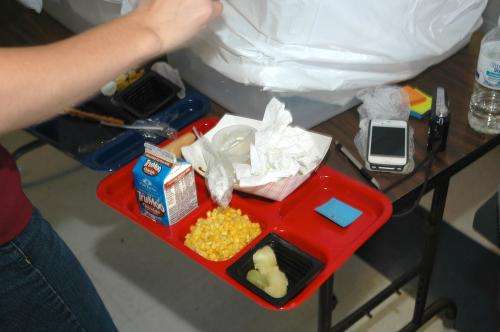
Even though school children are served a healthy lunch, researchers are wanting to know how much of their entrees are actually being eaten or pushed aside, and the cost associated with serving daily meals in a study conducted by Texas A&M University System researchers.
A team led by Texas A&M AgriLife Research and the Institute for Obesity at Texas A&M University has been measuring food waste in elementary schools in Bryan and Dallas. The project, funded by the Alliance for Potato Research and Education, follows guidelines set by the U.S. Department of Agriculture-Food and Nutrition Service National School Breakfast and School Lunch Programs.
"We hope this will expand into a regional and national project," said Dr. Oral Capps, an AgriLife Research economist in College Station. "When you talk about changes in school lunch programs, you are talking about nutrition and economics. Our goal is to make 30 visits to each school on days when they have potatoes served with either green beans, veggie dippers, or corn and peas. This gives us a good overall view of what types of entrees the children are consuming and the ones they are not."
Dr. Peter Murano, director of the Institute for Obesity Research and Program Evaluation at Texas A&M and an AgriLife Research scientist, said the team is using standard methodologies to measure plate waste to determine whether "consumption differs for meals that include potatoes versus alternative vegetable sources."
"Importantly, we plan to quantify consumption/plate waste of not only potatoes, other starchy vegetables and non-starchy vegetables, but also for the entire lunch meal on 'potato days' versus 'non-potato days.'"
Murano said with this information they plan to determine if the presence of potatoes and other starchy vegetables enhances consumption and minimizes plate waste of the entire meal.
Nutritional and cost implications of the Food and Nutrition Service regulations are also part of the research.
The research team consists of "plate waste warriors." The warriors are Texas A&M students who are paid by the hour. Each wears a different colored apron that is associated with the assigned waste bin the entrée is discarded. A minimum of seven workers is needed at each school during the lunch periods (typically 10:45 a.m. through 1 p.m.) The A&M students gather trays containing leftover portions.
Leftovers are separated into different waste bags and each bag is weighed on a scale for plate-waste measurement. When the student goes through the lunch line, a sticker is placed on the food tray to identify the vegetable entrée. Students on the free lunch program are also evaluated for plate waste.
Capps said approximately five to 10 lunches are purchased and each food tray with entrees is weighed prior to serving.
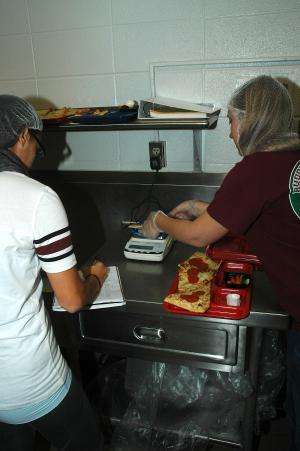
"After they have finished eating, they are guided to where they are to take their leftover tray of food," Capps said.
The student hands their tray to the waste warrior who then dumps each individual leftover entrée into the appropriate trash bin. After each group has eaten, each bag is weighed.
Murano said he has noted many observations during the lunch visits.
"A percentage of students will return food trays after lunch with very little eaten – milk carton unopened, fruit and vegetables untouched, a lot of food is wasted," he said. "Anecdotally comparing fruit and vegetable consumption (not a focus of our project), it appears fruit is much more popular than vegetables. Also, students seem much more likely to choose two fruits as sides rather than two vegetables. And when potato products are served (mashed potatoes, potato wedges, tater tots, etc), just about every student chooses the vegetable."
Capps said another component of the study is "to compare calories, sodium dietary fiber to see if there is a significant difference in nutritional value, comparing waste on that."
"There is potential difference in cost of starchy versus non-starchy foods and plate waste," Capps said. "Overall, it's a well-organized study and joint collaboration with the Institute for Obesity."
Plate waste studies have been done before, Capps said, "but not to this extent."
"We think we have an excellent design for this plate waste study," he said. "We said 'let's take a look at potato meals and non-potato meals and see what the waste is versus nutritional value.'"
Murano said when the analysis of the data is completed, regardless of what they find in terms of vegetable consumption, comparing kindergarten through fifth graders' consumption of potato products to other starchy vegetables (e.g., corn, green peas, beans) to non-starchy vegetables (e.g., green beans, carrots, salads, broccoli) will provide valuable information about the vegetables consumed and plate waste.
He said such information would be valuable to school food service managers, school administration, and even parents.
Murano said schools understand the importance of taste that drives adult and children's food choices, "and the importance of regularly introducing less popular, but healthy, vegetables to students to increase the likelihood of trying and liking them."
"Schools can attempt to increase consumption of specific foods through conducting taste tests with the school children," he said. "In addition, some schools invite local farmers to discuss how they plant and cultivate specific fruits and vegetables and how these nutrient-dense foods are a key part of a healthy diet."
Murano said the school district dietitians spend a lot of time planning meals that offer a variety of foods popular with students as well as meeting the new 2012 Nutrition Standards for School Meals – the new federal guidelines for school breakfast and lunch.
"These new guidelines are in line with the 2010 Dietary Guidelines for Americans. Schools are required to offer at least minimum quantities of all vegetable subgroups (dark green, red/orange, beans/peas (legumes), and starches. This change is intended to encourage student consumption from all subgroups and is consistent with the DGAs' recommendation to increase the variety of vegetables consumed."
Murano said the schools know what food items the students are choosing, but they don't necessarily know the specific consumption and waste behaviors.
"This information is central to our research project, and underlines the importance of plate-waste data collection, he said. "Our research will tell us not only the vegetables that are wasted the most, but also the nutrients the students are not receiving by choosing not to eat particular vegetables, and of course the economic cost. In any research scenario where it is found that healthy food items are being wasted, strategies must be developed and implemented to increase consumption. These may include conducting taste tests, providing nutrition education and implementing successful health promotion interventions."
Final results of the study will be available in March.


