Semen quality of young men in southeast Spain down by 38% in the last decade
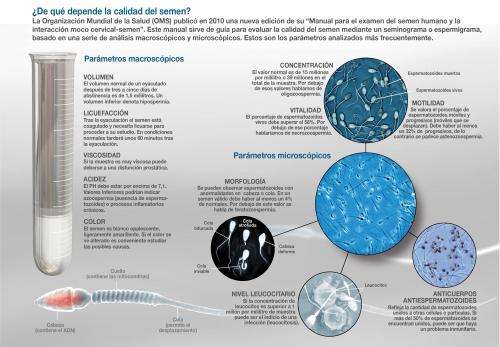
A concentration of lower than 40 million/ml makes it more difficult to conceive. Credit: SINC
The first comparative study on the evolution of sperm quality in young Spanish men over ten years, headed by researchers at the University of Murcia, reveals that spermatozoid concentration in men between 18 and 23 years in the regions of Murcia and Almeria has dropped by an annual average of 2%.
The suspicion that the semen of Spanish men is losing quality now takes force in the case of young men from Murcia and Almeria.
The Andrology journal has published a multidisciplinary and international study, headed by the Department of Preventative Medicine and Public Health of the University of Murcia (UMU), which demonstrates that "total sperm count and concentration has declined amongst young men in the south-east of Spain in the last decade." More specifically, the decrease amounts to 38%.
The lead researcher, Alberto Torres Cantero, explains to SINC that the study involved "comparing the results obtained by the Medical Research Centre of the University of Granada from the semen of 273 men from Almeria between 18 and 23 years, collected between 2001 and 2002, with those samples collected ten years later by 215 undergraduates from Murcia, all the while ensuring that both sample groups had the same age range and similar characteristics."
The analysis shows that the number of spermatozoids is significantly lower in the subjects from Murcia compared to the participants from Almeria. Average concentration goes from 72 million spermatozoids per millilitre in 2011 to 52 million/ml in 2011, according to Torres Cantero, professor of Preventative Medicine and Public Health at UMU.
Another relevant result is that "40% of those university students analysed in Murcia suffered from alterations in at least one semen parameter (morphology, mobility). Furthermore, all sperm indicators are below the norm in 15% of the sample," states Jaime Mendiola, professor at the UMU and first signatory of the study.
Clinic trails are needed
"Before there were no well performed studies to detect a change in sperm quality in Spain," explains Torres. Its main limitation is that it only makes reference to one geographic area and cannot be extrapolated: "We do not know if the same has occurred in other parts of Spain," outlines the researcher. There is little likelihood that the study will be carried out in other regions "because there are no similar semen quality studies in the young and healthy population."
Nonetheless, the fact that semen has worsened does not necessarily mean that the number of infertile men has increased. As Torres clarifies, this study measures semen quality and not fertility, "for which specific criteria established by the WHO are used."
Despite this, Mendiola feels that these data are worrying because "it has been verified in recognised studies that a concentration lower than 40 million/ml makes conception more difficult. If the rate of loss we have outlines continues, with an average decline in quality of 2% per year, the sperm of young men could reach this danger level of 40 million/ml in a very short space of time."
For this reason, the authors stress the urgency to promote "clinical trails that identify effective prevention actions for counteracting this negative trend via lifestyle changes."
"We believe that some prevention actions involving lifestyle improvements, such as a healthier diet, could increase sperm quality," outlines Alberto Torres. "But we still lack rigorous scientific information to propose them neither in the clinical field nor at a population level. If we could identify those actions, we could improve sperm quality."
More information: onlinelibrary.wile… 8.x/abstract
Provided by
Plataforma SINC
-
Better nutrition makes for better sperm
Oct 18, 2011 |
not rated yet |
0
-
Semen quality depends upon antioxidants
Jun 02, 2009 |
not rated yet |
0
-
Fatty diets may be associated with reduced semen quality
Mar 13, 2012 |
not rated yet |
0
-
Men who do exercise produce better quality semen
Oct 31, 2012 |
not rated yet |
0
-
Drinking alcohol during pregnancy may damage semen quality in sons
Jun 29, 2010 |
not rated yet |
0
-
Motion perception revisited: High Phi effect challenges established motion perception assumptions
Apr 23, 2013 |
3 / 5 (2) |
2
-
Anything you can do I can do better: Neuromolecular foundations of the superiority illusion (Update)
Apr 02, 2013 |
4.5 / 5 (11) |
5
-
The visual system as economist: Neural resource allocation in visual adaptation
Mar 30, 2013 |
5 / 5 (2) |
9
-
Separate lives: Neuronal and organismal lifespans decoupled
Mar 27, 2013 |
4.9 / 5 (8) |
0
-
Sizing things up: The evolutionary neurobiology of scale invariance
Feb 28, 2013 |
4.8 / 5 (10) |
14
-
Classical and Quantum Mechanics via Lie algebras
Apr 15, 2011
- More from Physics Forums - Independent Research
More news stories
New research identifies risks, interventions for children's GI health
An increasing number of U.S. children are experiencing gastrointestinal issues that require interventions to resolve, according to research presented at Digestive Disease Week (DDW).
Health
13 hours ago |
not rated yet |
0
|
Youth who have their first drink during puberty have higher levels of later drinking
Research shows that the earlier the age at which youth take their first alcoholic drink, the greater the risk of developing alcohol problems. Thus, age at first drink (AFD) is generally considered a powerful predictor of ...
Health
May 17, 2013 |
not rated yet |
0
British MPs concerned about parliamentary boozing
One quarter of British lawmakers believe there is an "unhealthy" drinking culture in the Houses of Parliament, according to a survey published on Friday.
Health
May 17, 2013 |
not rated yet |
0
Patient openness to research can depend on race and sex of study personnel
Researchers at the University of Cincinnati (UC) have found that the race and sex of study personnel can influence a patient's decision on whether or not to participate in clinical research.
Health
May 17, 2013 |
not rated yet |
0
Clinical support for patient self-management is rhetoric rather than reality
The processes to allow people to self-manage their own illness are not being used appropriately by health professionals to the benefit of their patients, new research suggests.
Health
May 17, 2013 |
not rated yet |
0
US psychiatry gets makeover in new manual
The latest makeover to a massive psychiatric tome honored by some, reviled by others and even called the "Bible" of mental disorders is being released Saturday with a host of new changes.
New case of SARS-like virus in Saudi: ministry
A new case of the deadly coronavirus has been detected in Saudi Arabia where 15 people have already died after contracting it, the health ministry announced on Saturday on its Internet website.
AIDS science at 30: 'Cure' now part of lexicon
Big names in medicine are set to give an upbeat assessment of the war on AIDS on Tuesday, 30 years after French researchers identified the virus that causes the disease.
For combat veterans suffering from post-traumatic stress disorder, 'fear circuitry' in the brain never rests
Chronic trauma can inflict lasting damage to brain regions associated with fear and anxiety. Previous imaging studies of people with post-traumatic stress disorder, or PTSD, have shown that these brain regions can over-or ...
New colonoscope provides ground-breaking view of colon
A ground-breaking advance in colonoscopy technology signals the future of colorectal care, according to research presented today at Digestive Disease Week(DDW). Additional research focuses on optimizing the minimal withdrawal ...
Body clocks of depressed people altered at cell level, researchers show
Every cell in our bodies runs on a 24-hour clock, tuned to the night-day, light-dark cycles that have ruled us since the dawn of humanity. The brain acts as timekeeper, keeping the cellular clock in sync ...